This manual is for BHA FPX 2006 Assessment 2, start to submission. Assessment 2 of BHA FPX 2006, Healthcare Regulation and Regulatory Affairs, moves from a single requirement to an arrangement that several laws touch at once. The assessment usually gives you a business relationship between organizations or clinicians and asks you to analyze the compliance risk in it, which is where the difference between an intent-based criminal statute and a strict liability civil prohibition stops being a definition and starts deciding the answer. Precision earns the criteria here; a general warning about fraud earns nothing. What follows is the method, a structure that separates the criteria cleanly, and an annotated sample excerpt. Prefer that we drafted the risk analysis? A premium original sample arrives within 24 to 48 hours, revised without charge until every criterion is met. Capella's catalog lists the course as BHA-FPX2006, and some courserooms print BHA2006; both point to this same Assessment 2.
One honesty note before the manual: Capella revises courses and scoring guides over time, so always write to the exact scoring guide attached to your assessment in the courseroom. The course identity above is verified on capella.edu; the method and structure below are our tutors' approach to it, not Capella's official rubric text.
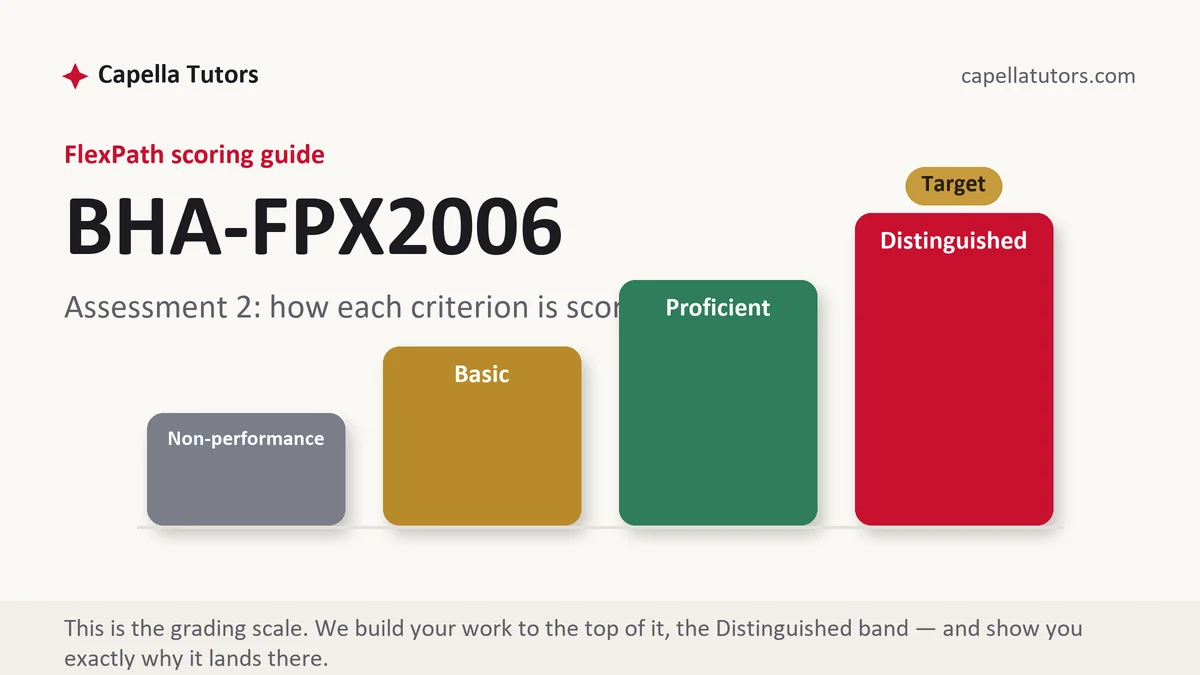
How BHA FPX 2006 Assessment 2 is scored
Each criterion on your guide is placed at one of four levels independently of the others, and the descriptions read like specifications once you know to use them that way:
| Level | What it means on a fraud and abuse risk analysis |
|---|---|
| Distinguished | Each law is analyzed on its own elements rather than blended, the safe harbor or exception is tested against the actual terms of the arrangement, and the answer says what would have to change to make the arrangement defensible. |
| Proficient | The right laws are identified and correctly described, with the arrangement assessed as risky in general terms. |
| Basic | A correct account of what the statutes prohibit, applied to the scenario as a warning rather than as an analysis. |
| Non-performance | One of the applicable laws is missing, or intent and strict liability are treated as the same test. |
Two habits protect every answer in this territory. Analyze one law at a time to its conclusion before starting the next, and never write that an arrangement violates a statute when the accurate sentence is that it fails to fit an exception and therefore carries risk. The second habit alone separates a lot of Basic work from Proficient.
The BHA FPX 2006 Assessment 2 method, step by step
-
List the money and the referrals separately
Draw the arrangement as two flows: what of value moves in which direction, and what business follows. Most compliance analysis in this course becomes straightforward once those two arrows are on paper and pointing at each other.
-
Take the criminal statute first, on its own elements
The federal anti-kickback prohibition is an intent statute reaching remuneration in any form offered to induce referrals of federally funded business. Analyze it alone: what was given, what was expected, and what evidence in the scenario speaks to purpose. Then stop, and start the next law from the beginning.
-
Then the strict liability prohibition, without borrowing intent
The physician self-referral prohibition does not care what anyone meant. It applies to a defined list of designated health services and it produces liability from a technical defect in a lease or a compensation formula. Writing the words good faith into this section is a signal to the evaluator that the two laws have been merged.
-
Test the safe harbor or exception term by term
A space rental arrangement that fits the published safe harbor is written, signed, for at least a year, at fair market value, and set without regard to the volume or value of referrals. Walk the scenario against each condition and say which one it fails, since the failed condition is the whole finding.
-
Rank the exposure and name the disclosure question
Set out what can follow, from repayment obligations and civil penalties to program exclusion, and say which is realistic on these facts. Then note that a self-disclosure route exists and that the decision to use it belongs to counsel, which is the honest boundary of an undergraduate analysis.
-
Write the fix, then self-score
Say what would make the arrangement defensible: an independent valuation, a written agreement with a fixed term, compensation set in advance. Then grade the draft against each criterion and rewrite anything below the top level before submitting.
A structure that maps to the criteria
Planning targets our tutors use for an analysis of this scope. Your scoring guide sets the sections, the order, and the length it expects.
| Section | What it must do | Guide |
|---|---|---|
| The arrangement | Who the parties are, what moves between them, and what business follows, stated neutrally. | ~150 words |
| The intent-based statute | Elements, application to these facts, and the evidence in the scenario that speaks to purpose. | ~300 words |
| The strict liability prohibition | Whether a financial relationship exists, whether designated health services are referred, and which exception was attempted. | ~275 words |
| Safe harbor or exception analysis | Each condition tested against the actual terms, with the failing condition named. | ~250 words |
| Exposure and remediation | The realistic consequence, the theoretical one, and the changes that would make the arrangement defensible. | ~225 words |
| References | Statutes and regulations cited as legal material, inspector general guidance behind them, current APA. | as needed |
Annotated sample excerpt
An original model excerpt from our team, showing an exception tested rather than described. Take the pattern into your own scenario and leave the content behind.
The hospital leases 1,900 square feet of medical office space to the three-physician cardiology group at 14 dollars a square foot on a month-to-month understanding recorded in an email, in a market where comparable suites let at 21 to 24 dollars, and the group refers its imaging to the hospital.1 Tested against the published conditions for a space rental arrangement, this fails three of them at once: there is no signed written agreement, there is no term of at least one year, and the rate is not supported by any valuation, which means the below-market difference is remuneration flowing to a referral source.2 The correct sentence for a paper at this level is that the arrangement does not fit the exception and therefore carries substantial risk under both the intent-based statute and the strict liability prohibition, not that a violation has occurred, since intent is a question of fact and the strict liability analysis would still turn on documents nobody in this scenario has produced.3
- 1The arrangement is described with the numbers that matter, the rate, the size, the market range, and the referral flow, before a single legal conclusion appears.
- 2The exception is walked condition by condition and the failures are counted. This is the paragraph an evaluator is looking for when the criterion says apply.
- 3The finding is stated as risk rather than as guilt, and the reason is given. Refusing the overstatement is what a top-column regulatory answer sounds like.
The full premium sample for your exact assessment, written fresh to your scoring guide and issue, is free to request. Study it, revise it into your own voice, and submit work you understand.
The five mistakes that cost Distinguished
- The two laws blended into one. Intent belongs to one analysis and is irrelevant to the other, and merging them fails the criterion that separates them.
- A violation declared. The defensible sentence is that the arrangement fails an exception and carries risk. Certainty here reads as inexperience.
- The safe harbor described but not tested. Listing conditions is not applying them. Say which condition the facts fail.
- Penalty figures with no year. Civil penalty amounts are adjusted on a schedule, so quote the year or describe the structure instead.
- A client alert cited as the rule. A law firm bulletin is written to attract business. Useful for orientation, unacceptable as authority.
Pre-submission checklist
- The value flow and the referral flow are both described before the analysis
- Each law is analyzed separately, on its own elements
- The exception or safe harbor is tested condition by condition
- The conclusion is written as risk, with the reason for the hedge stated
- Remediation names what would have to change and who would produce it
- Statutes and regulations cited directly, references reconciled in both directions
Compliance risk analysis due?
Send the arrangement, the criteria, and any figures your prompt supplies. The sample comes back inside 24 to 48 hours with each law analyzed on its own elements, the exception tested term by term, and the conclusion written at the confidence the facts support. Free revision until every criterion is satisfied.