This manual is for BHA FPX 2006 Assessment 1, start to submission. Assessment 1 of BHA FPX 2006, Healthcare Regulation and Regulatory Affairs, teaches the move the whole course rests on. The assessment usually hands you a situation and asks which requirement applies, who enforces it, how it lands on these particular facts, and what follows if it is not met. Four steps, four scoring opportunities, and most first drafts answer the first one and stop. Approximately right is the same as wrong in this subject, so the manual below is built around locating the rule rather than describing it. You get the method our tutors use on scenarios like this, a structure mapped to the criteria, and an annotated sample excerpt. Rather hand it over? A premium original sample comes back in 24 to 48 hours, revised free until the guide is met. Capella's catalog lists the course as BHA-FPX2006, and some courserooms print BHA2006; both point to this same Assessment 1.
One honesty note before the manual: Capella revises courses and scoring guides over time, so always write to the exact scoring guide attached to your assessment in the courseroom. The course identity above is verified on capella.edu; the method and structure below are our tutors' approach to it, not Capella's official rubric text.
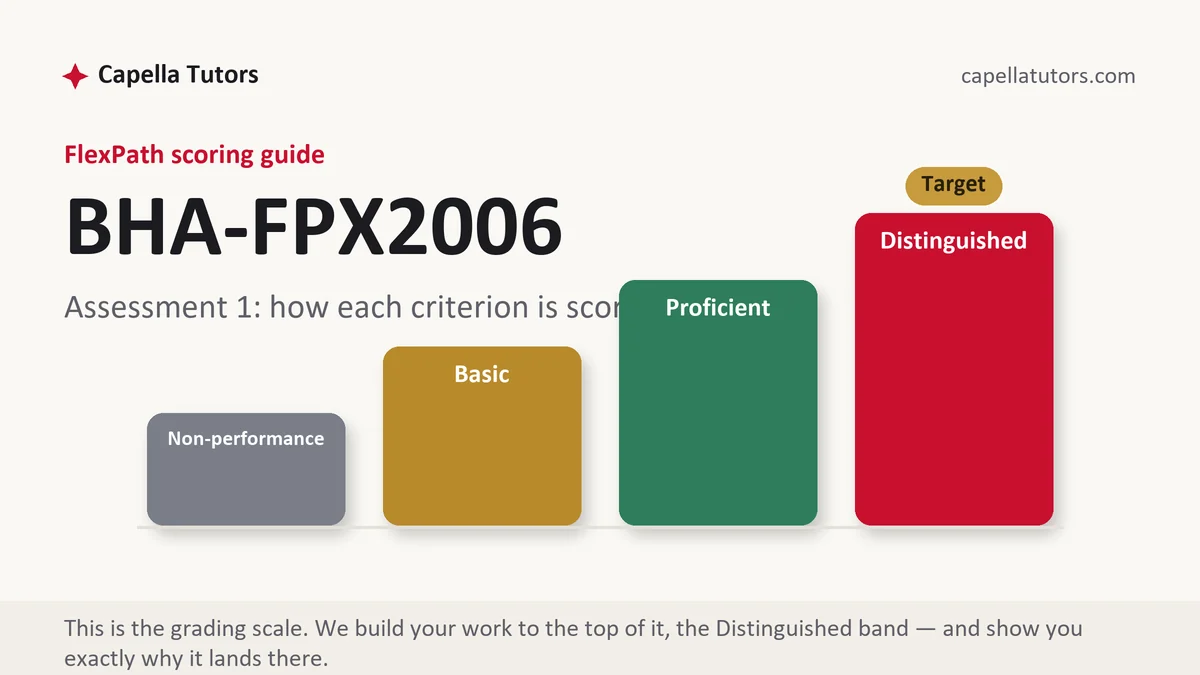
How BHA FPX 2006 Assessment 1 is scored
FlexPath scores each criterion separately against four written levels, and in a regulatory course the level language is unusually literal about what it wants:
| Level | What it means on a regulatory analysis |
|---|---|
| Distinguished | The requirement is named and located, the enforcing body is identified, every element is matched to a fact in the scenario, and the answer says which layer of law is doing the work. Where the answer depends on state law, the paper says so and names the assumption. |
| Proficient | The right rule, correctly applied, with the enforcement path described. Accurate work that leaves the layers unseparated. |
| Basic | A correct general statement about compliance, with the requirement paraphrased from a summary and never located. |
| Non-performance | The applicable requirement is not identified, or the analysis never reaches the facts it was given. |
Nothing in this course rewards throat clearing about the importance of compliance. The reader wants the rule and the application, in that order, as early as the document allows, and every paragraph that arrives before them is unscorable.
The BHA FPX 2006 Assessment 1 method, step by step
-
Sort the facts before you look for a rule
Write the scenario back to yourself in neutral sentences with dates, roles, and setting, and keep conclusions out of it. Half of the wrong answers in this course come from analyzing a fact pattern the student unknowingly edited while summarizing it.
-
Identify the layer you are in
Statute, regulation, sub-regulatory guidance, accreditation standard, and state licensure are five different instruments with five different consequences. Say which one governs before you write about it, because an analysis that treats a private accreditor's standard as federal law has already lost the application criterion.
-
Locate the requirement, then quote its operative words
Find the code section, the manual, or the published standard summary, and restate the operative language in your own words with the citation beside it. A rule you cannot locate is a rule you are paraphrasing from somebody's description of it, and evaluators check.
-
Match each element to a fact
Requirements have elements, and the criterion is asking whether you can pair them. Take them one at a time: this element, that fact, satisfied or not, and say plainly when an element is met, since an analysis that only lists failures reads as an argument rather than an assessment.
-
Name the state layer or name your assumption
Federal requirements set a floor and states build above it. When the prompt does not say which state, choose one, say in the text that you chose it, and analyze consistently. An unmarked assumption is what turns a good regulatory answer into an unreliable one.
-
Check the citations, then self-score
Confirm that every rule cited is the rule and not a law firm's summary of it, that any penalty figure carries the year you took it from, and that the reference list matches the text both ways. Then grade yourself criterion by criterion and fix anything below the top level.
A structure that maps to the criteria
The lengths below are our tutors' planning targets for a regulatory analysis of this size, not Capella rules. Your scoring guide decides the sections and how long they run.
| Section | What it must do | Guide |
|---|---|---|
| The facts | What happened, stated neutrally, with dates, roles, and setting, and no conclusions folded in. | ~150 words |
| The requirement | The rule in one sentence, with the section, manual, or standard identified and its source named. | ~250 words |
| Who enforces it | The agency or body with authority here, and how a violation would come to its attention. | ~200 words |
| Application | Each element matched to a fact in the scenario, including the elements the organization satisfies. | ~300 words |
| Exposure and next steps | What the enforcing body can do, ranked by likelihood, and the first action the organization takes. | ~250 words |
| References | Regulations and statutes cited as legal material, with peer-reviewed health law behind them, current APA. | as needed |
Annotated sample excerpt
A model excerpt written by our team to show what locating a rule looks like on the page. Study the sequence, then run your own scenario through it.
The obligation in this scenario is not a federal one. The clinic operates in a state whose insurance regulator sets timely access standards for network plans, requiring that a non-urgent primary care appointment be offered within a stated number of business days and that plans monitor and report compliance, which reaches the clinic through its participation agreements rather than through a survey.1 Applied to these facts, the third-next-available appointment at the two-provider site has run at 21 business days for six consecutive weeks, which exceeds the standard the plan is obliged to enforce, and the clinic's scheduling template is the mechanism producing it, since it holds eleven slots a day for established patients and two for new ones regardless of demand.2 The exposure here is contractual before it is regulatory: the plan can require a corrective action plan, can withhold the clinic from a directory as accepting new patients, and in the ordinary case does both before any regulatory penalty is discussed.3
- 1The first move is to name the layer, and here it is a state insurance requirement reaching a provider through a contract rather than a federal rule reaching it through a survey. Getting the layer right is the whole analysis.
- 2The element and the fact are matched in the same sentence, with the measured quantity and the mechanism that produces it. An evaluator scoring application finds both without hunting.
- 3Exposure is ranked by what actually happens first. Distinguishing the practical consequence from the theoretical one is the judgment the top column is describing.
The full premium sample for your exact assessment, written fresh to your scoring guide and issue, is free to request. Study it, revise it into your own voice, and submit work you understand.
The five mistakes that cost Distinguished
- Compliance is important. Two hundred words on why regulation matters is two hundred words no criterion is written to reward.
- Accreditation, licensure, and certification treated as one. Three bodies, three consequences, and mixing them fails the application criterion outright.
- A summary cited as the requirement. Most of this material is free to read in its original form, so relying on a description of it reads as avoidance.
- Only the failures listed. An analysis that never says which elements were satisfied reads as advocacy and scores lower for it.
- The state layer ignored. A scenario in a state with stricter rules is answered incompletely unless the paper says so.
Pre-submission checklist
- The facts are restated neutrally before any rule appears
- The governing layer is named: statute, regulation, guidance, accreditation, or state law
- The requirement is cited to its source rather than to a summary
- Every element is matched to a fact, including the ones the organization meets
- The state assumption is stated in the text where the prompt is silent
- Legal material cited in the form APA prescribes, references reconciled both ways
Regulatory analysis due?
Send the scenario, the criteria, and the state if your prompt names one. The sample comes back inside 24 to 48 hours with the requirement located in the rule text, the enforcing body identified, and every element matched to a fact. Revision runs free until every criterion is satisfied.