How to write RSCH-FPX7864 Assessment 1

The short answer

This manual is for RSCH-FPX7864 Assessment 1, start to submission. The first deliverable in Quantitative Design and Analysis usually asks you to defend a design rather than to run one: state a question in measurable terms, choose the method that can answer it, and say honestly what your chosen design leaves unexplained. A flawless procedure attached to the wrong design earns very little here, and a modest design with its limits volunteered earns a great deal. Below is how our doctoral desk assembles that argument, the sections that satisfy the criteria, and an annotated excerpt. Prefer to hand it over? An original premium sample matched to your scoring guide returns in 24 to 48 hours, with free revision for as long as the guide demands it. Your courseroom may print this as RSCH FPX 7864 Assessment 1 or RSCH7864 Assessment 1; it is the same deliverable, and RSCH-FPX7864 Assessment 1 is what this manual walks through.

One honesty note before the manual: Capella revises courses and scoring guides over time, so always write to the exact scoring guide attached to your assessment in the courseroom. The course identity above is verified on capella.edu; the method and structure below are our tutors' approach to it, not Capella's official rubric text.
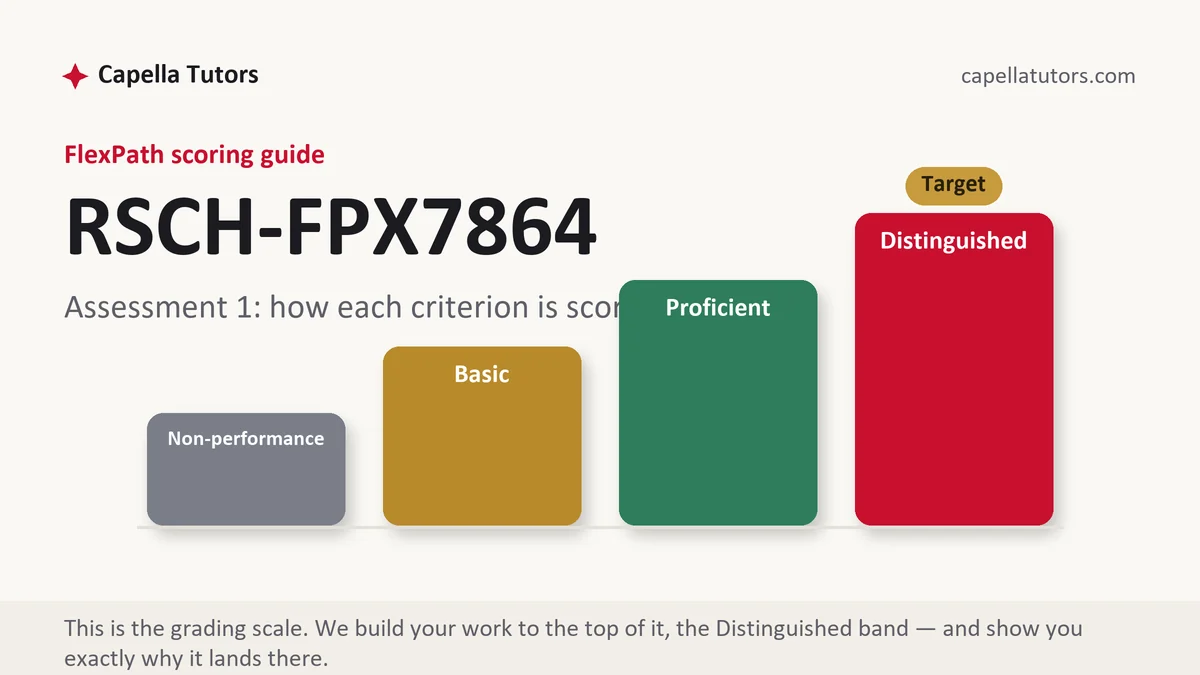
RSCH-FPX7864 Assessment 1 grading scale at Capella FlexPath, the criterion levels this assessment is scored on, from Capella Tutors
How Capella FlexPath grades RSCH-FPX7864 Assessment 1, visualized by Capella Tutors.

How RSCH-FPX7864 Assessment 1 is scored

FlexPath awards no letter grades. Every criterion is scored against four levels, and the level text is what you are writing toward:

LevelWhat it means on a design and methods deliverable
DistinguishedThe design is chosen for a stated reason, each rival explanation is matched either to a design feature or to a limitation you volunteer, and the power calculation was done before the study rather than reconstructed after it.
ProficientAn appropriate design described accurately and completely. Correct, and offered as though it were the only option available.
BasicA design named and a procedure described, with threats to validity mentioned generically or not at all. The usual first attempt.
Non-performanceA required element is missing, most often the operational definitions or any account of how the sample would be obtained.

Randomization is rarely available to a working nurse, and the criteria do not punish its absence. What they punish is silence about what the absence costs, so name the rivals your design cannot exclude and the criterion turns from a liability into an opportunity.

The RSCH-FPX7864 Assessment 1 method, step by step

  1. Write the question so a result could refute it

    Population, comparison, outcome, timeframe, in measurable terms. Then write the null and the alternative and fix your alpha before any data exist. A question phrased so that every possible finding confirms it is not a question, and the hypotheses criterion will say so.

  2. Choose the design your setting can actually support

    Descriptive, correlational, one group before and after, nonequivalent groups, or retrospective records. Say why this one and not the next one up the hierarchy, in terms of access, timeline and consent rather than in terms of preference.

  3. Define every variable so somebody else could measure it

    Independent, dependent, covariates, each with an operational definition and a level of measurement. State the field or instrument the value comes from and the timestamp it is read at, because two analysts pulling the same concept from different fields will not get the same study.

  4. List the rivals, then match each one

    Season, a concurrent staffing change, the attention the project itself creates, and the tendency of an unusually poor baseline to drift back toward normal. Write them out, then say which design feature blunts each and which one nothing blunts. That last admission is worth more than the other four combined.

  5. Do the power calculation in advance

    Decide the smallest difference that would change practice, find a plausible variance estimate in the literature, and compute what sample that requires. A study designed backward from the sample you happen to have is a study that will detect nothing and explain why afterward.

  6. Reconcile and self-score

    Check that every number in the narrative matches the number in the table and that each variable is described identically wherever it appears. Then grade yourself criterion by criterion, D, P, B or N, and revise anything short of the top. Send it in on a Monday or a Tuesday, since an evaluation here can sit for two business days.

A structure that maps to the criteria

These word targets are our doctoral desk's planning figures for a methods deliverable, not Capella rules; expand whichever section your scoring guide weights hardest.

SectionWhat it must doGuide word target
Question and hypothesesThe question in measurable terms, the null and alternative, the alpha, and a direction if you claim one.~200 words
Design and rationaleThe design named, the comparison, the timing, and why the stronger design was not available.~300 words
Variables and measurementEvery variable with an operational definition, a level of measurement, a source field and a role.~300 words
Sample, setting and powerPopulation, sampling method, inclusion and exclusion rules, the detectable effect, and the n it requires.~250 words
Threats to validityEach rival explanation matched to a design feature or acknowledged as a standing limitation.~250 words
Ethics, feasibility, referencesReview requirements, data handling, what could stop the study, and current APA both ways.~200 words

Annotated sample excerpt

An original model paragraph from our doctoral desk, written to show how a modest design is defended rather than apologized for.

Sample excerpt: design and threats Original model · Capella Tutors

The design is a nonequivalent two-group comparison measured before and after: a 32-bed medical unit adds a dedicated admission nurse to the evening shift, while a comparable 30-bed unit in the same building continues unchanged and supplies the comparison series.1 The dependent variable is minutes from bed assignment to completed admission assessment, read from the bed assignment timestamp in the patient placement system and the filing timestamp on the admission assessment flowsheet, which is a ratio-level measure with both endpoints recorded automatically rather than reported by the nurse.2 Randomization was never available here, so the rivals are named instead: seasonal census variation, two travel contracts ending inside the study window, and the attention the pilot itself creates on the intervention unit; the comparison unit blunts the first two, nothing blunts the third, and it is carried into the limitations rather than argued away.3

  • 1Names the design, the comparison and the timing in one sentence. A reader knows immediately what is being compared to what, and over what period.
  • 2Operationalizes the outcome down to the two fields it is computed from, and says why those fields are trustworthy. Level of measurement is stated, not implied.
  • 3Lists the rivals, matches two to a design feature, and concedes the third outright. Volunteering the unblunted threat is the move the top level pays for.

The full premium sample for your exact assessment, written fresh to your scoring guide and issue, is free to request. Study it, revise it into your own voice, and submit work you understand.

Get the full sample free

The five mistakes that cost Distinguished

  • A design named but not chosen. Without a stated reason for rejecting the stronger option, the rationale criterion has nothing to reward.
  • Variables described in concepts. Improved workflow cannot be measured; minutes between two timestamps can.
  • Threats listed generically. Reciting the standard catalog of validity threats without tying each to your own setting reads as a textbook exercise.
  • Power calculated after the fact. An observed power figure computed from your own result carries no information and evaluators know the trick.
  • A sample of convenience left unexamined. Convenience sampling is often the only option, and saying what it costs you is the difference between Basic and Distinguished.

Pre-submission checklist

  • The question is written so that a specific result would refute it
  • Null, alternative and alpha are all stated before any analysis appears
  • Every variable has an operational definition, a level of measurement and a source
  • Each named rival explanation is matched to a design feature or conceded
  • The power calculation fixes the detectable effect in advance
  • Numbers reconciled throughout and every criterion self-scored D

Design deliverable due and the setting will not cooperate?

Send the scoring guide, the question you have in mind, and whatever access you realistically have. We pick the design your site can support and defend it honestly, then two independent quality passes check the criteria and recompute the power arithmetic. Original sample returned in 24 to 48 hours, with no charge for any revision that follows.

Keep going

Online now