This manual is for PSYC-FPX4600 Assessment 3, start to submission. The final deliverable in this course usually hands you a finished piece of work and asks you to take it apart, and the version students find hardest is a written psychological report, because its conclusions sound authoritative and its numbers are printed right there beside them. The graded skill is tracing the inference chain: what was measured, what the measure can support, and the exact point where a conclusion travels further than its own evidence. Below is our tutors' method for taking one apart, a structure keyed to the criteria, and an annotated excerpt from an original model. Want it drafted with backup? A premium original sample for this exact assessment lands inside 24 to 48 hours, with free revisions until your guide is satisfied. Your courseroom may print this as PSYC FPX 4600 Assessment 3 or PSYC4600 Assessment 3; it is the same deliverable, and PSYC-FPX4600 Assessment 3 is what this manual walks through.
One honesty note before the manual: Capella revises courses and scoring guides over time, so always write to the exact scoring guide attached to your assessment in the courseroom. The course identity above is verified on capella.edu; the method and structure below are our tutors' approach to it, not Capella's official rubric text.
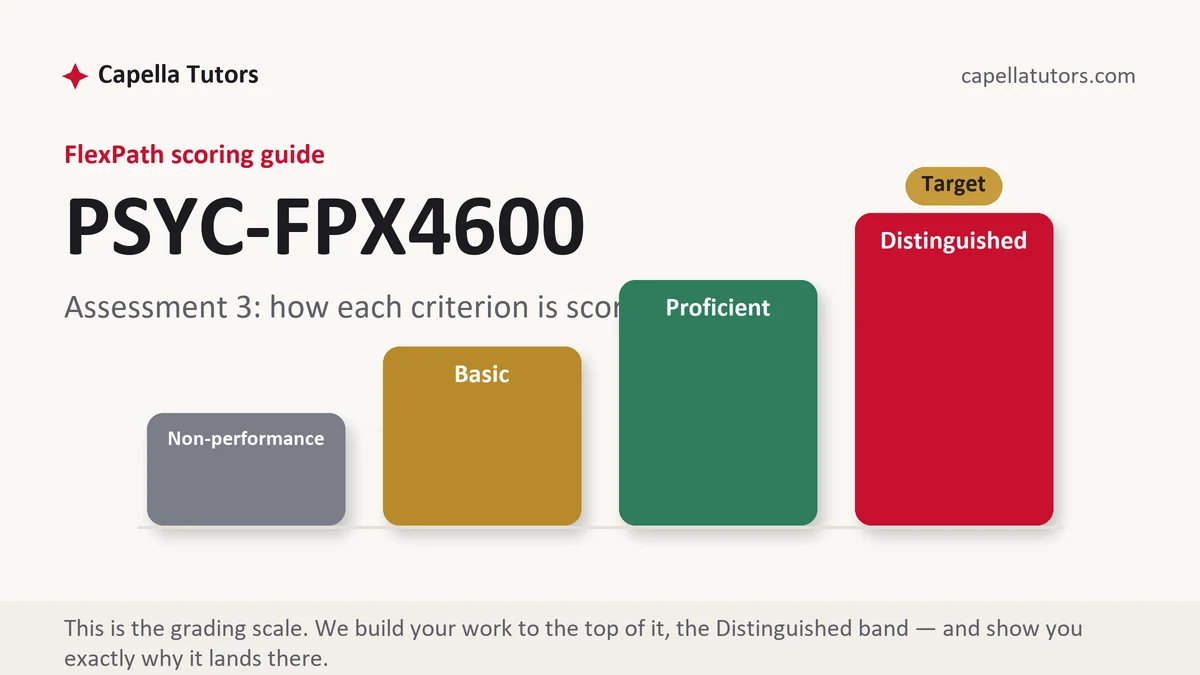
How PSYC-FPX4600 Assessment 3 is scored
The guide is scored one criterion at a time at one of four levels, and the levels describe how far your analysis went:
| Level | What it means on a report critique |
|---|---|
| Distinguished | The chain from measure to conclusion is traced, one specific place where the conclusion outruns the evidence is identified with the number that shows it, and a defensible version of the reasoning is written out. The top column wants the repair as well as the fault. |
| Proficient | The weaknesses are named accurately and the report's conclusion is left standing beside them, unchallenged. |
| Basic | A faithful summary of the document plus a general remark that more information would have helped. |
| Non-performance | The conclusion accepted and restated, or the measures never examined at all. |
Two boundaries protect you here. Your job is the reasoning, not the person, so you critique inference and never offer a competing conclusion about the individual described. And a score is a band rather than a point, which is the single most useful thing you know that the report you are reading may have forgotten.
The PSYC-FPX4600 Assessment 3 method, step by step
-
Make the criteria headings, then read in reviewer order
Read the document the way a methodologist does: the question it was written to answer, then what was measured, then who was measured and when, then the results, and only last the recommendation. Reading the recommendation first makes everything before it look like support, which is exactly the trap.
-
List every claim with the evidence attached to it
Two columns on one page. Claims on the left, the specific measurement or observation behind each on the right. Any claim with an empty right-hand cell is a finding for your critique, and this table usually produces the paper's strongest paragraph without further effort.
-
Look up what the measure says about its own precision
Instruments publish reliability figures and an error band for exactly this reason. Find them in the validation literature through the Capella library or PsycINFO, cite them there rather than to a summary, and write down what the band means in points on the scale you are reading.
-
Find where the conclusion crosses a line the numbers do not
Look for a threshold. Reports often turn on a cut score, a category boundary or a comparison, and the interesting question is whether the band around the observed score sits entirely on one side of it. If it does not, the report's own figures cannot settle the matter it says they settle.
-
Write the sentence the report should have written
Produce a rewritten conclusion at the confidence the evidence supports, with the band, the single administration and the missing corroboration all inside it. Offering the repair is what separates the top of the guide from a competent list of complaints.
-
Stay inside your scope, then self-score
Say plainly that the paper examines the reasoning in the document and does not assess the person it describes, and name who would be qualified to do that. Then mark every criterion at one of the four levels yourself, revise what falls short, and submit early in the week.
A structure that maps to the criteria
Planning targets our tutors use for a short undergraduate critique, not Capella rules; expand whichever section your scoring guide describes at the greatest length.
| Section | What it must do | Guide |
|---|---|---|
| Introduction and the document | What the report is, what question it was written to answer, and what your critique will decide about its reasoning. | ~150 words |
| What the report claims | The claims listed in the report's own words, with the evidence it offers for each one named beside it. | ~200 words |
| The measures and their limits | Each instrument, what it scores, its reliability and its error band, cited to validation work. | ~300 words |
| Where the conclusion outruns the evidence | The threshold the recommendation turns on, and the number that shows the evidence cannot decide it. | ~300 words |
| The defensible version | The conclusion rewritten at the confidence the data support, plus what a second measure would add. | ~250 words |
| Scope, limits, references | What your critique does not claim, who is qualified to assess the person, current APA in both directions. | ~150 words |
Annotated sample excerpt
An original model excerpt from our team, built to show one move clearly. The report described in it is invented for teaching, and the figures exist to show how a band is used against a threshold.
The report's closing paragraph recommends a change of placement on the strength of a composite score of 84, and the paragraph directly above it gives the measure's standard error as three points.1 A score of 84 with an error of that size is a band rather than a point, running from roughly 78 to 90 at conventional confidence, and the boundary the recommendation turns on sits inside that band, so the report's own numbers cannot decide the question the report says they decide.2 A critique that stops at the score has done half the work; the other half asks what else was collected, and here one administration on one afternoon in March carries a recommendation that a second measure, or a structured classroom observation, could have either supported or contradicted at very little cost.3
- 1Puts the recommendation and the error figure in the same sentence, using the document's own printed numbers. The contradiction is shown rather than alleged.
- 2Converts a point into a band, then tests the band against the threshold. This is interpretation rather than calculation, and it is the specific skill the criterion is measuring.
- 3Moves from the number to the design of the assessment itself, naming what was missing and what it would have cost to include. The critique reaches evidence quality, not just arithmetic.
The full premium sample for your exact assessment, written fresh to your scoring guide and issue, is free to request. Study it, revise it into your own voice, and submit work you understand.
The five mistakes that cost Distinguished
- A score treated as a point. Every observed score carries error, and a critique that argues about the number rather than the band has accepted the report's own weakest assumption.
- One administration read as a settled fact. A single session measures a person on one afternoon, and reports that generalize from it are making a claim about stability they did not test.
- The critique that becomes a second opinion. Offering a rival conclusion about the individual leaves your scope and costs the criterion that was easiest to keep.
- Every weakness weighted the same. A list of nine faults with no ranking tells the evaluator you found problems, not that you understand which ones matter.
- The report's own hedges ignored. Where the document already qualified a claim, quoting the qualification and showing the conclusion overtook it is stronger than criticizing a claim it never made.
Pre-submission checklist
- Every criterion answered under its own labeled heading
- The document read in reviewer order, with the recommendation read last
- Claims and their evidence listed in pairs, gaps marked
- Reliability and error figures cited to validation sources
- One threshold identified and tested against the band around the score
- A rewritten conclusion, one scope sentence, current APA both directions, self-scored before submitting
Critique due and the report sounds convincing?
Send the document, the prompt and the criteria. We pair every claim with its evidence, look up what each instrument publishes about its own precision, and return a premium original sample with the threshold analysis and the rewritten conclusion already in place, inside 24 to 48 hours, revised free until the criteria clear.