This manual is for PSYC FPX 4600 Assessment 2, start to submission. The middle deliverable in this course usually asks you to propose a study of your own, which means the graded work happens before any prose gets written: variables turned into things that can be measured, a hypothesis that could come back false, and a design chosen because of the claim you want to make rather than because it is familiar. Most undergraduate proposals are written without anyone being recruited, so the whole case has to stand up on paper. Below is our tutors' method for building that proposal, a structure keyed to the criteria, and an annotated excerpt from an original model. Would you rather hand it over? A premium original sample for this exact assessment is back in 24 to 48 hours and revised free until the criteria clear. Capella's catalog lists the course as PSYC-FPX4600, and some courserooms print PSYC4600; both point to this same Assessment 2.
One honesty note before the manual: Capella revises courses and scoring guides over time, so always write to the exact scoring guide attached to your assessment in the courseroom. The course identity above is verified on capella.edu; the method and structure below are our tutors' approach to it, not Capella's official rubric text.
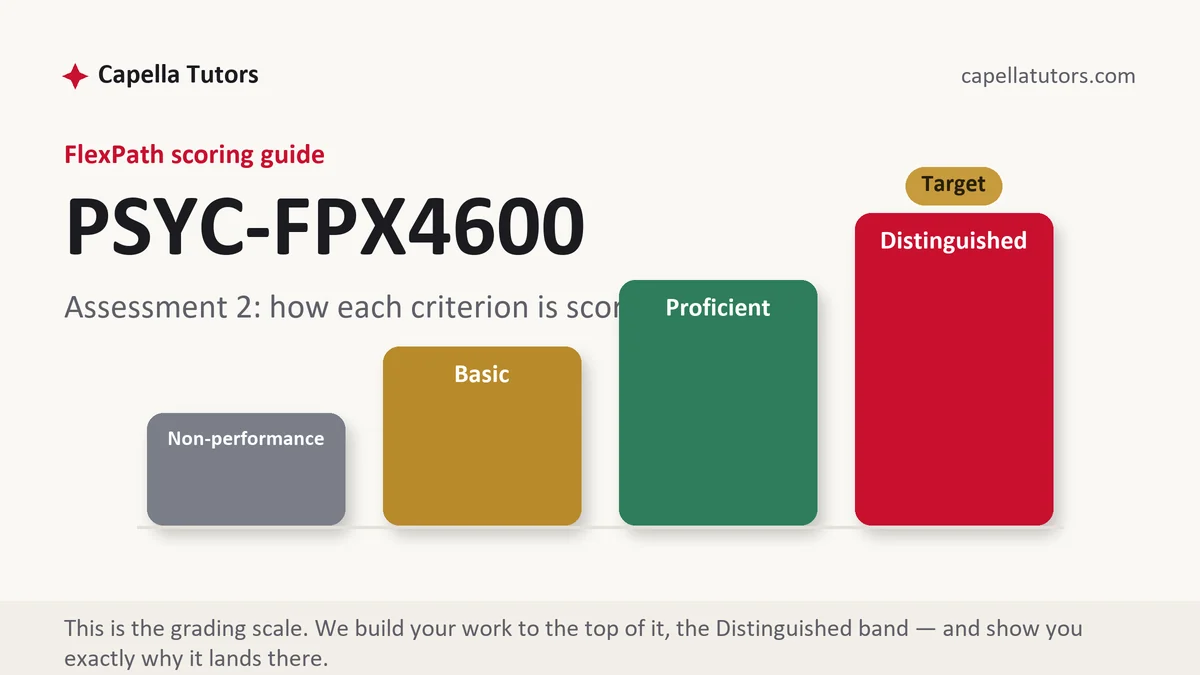
How PSYC FPX 4600 Assessment 2 is scored
Each criterion stands alone at one of four levels, and the descriptions are the specification for what the section has to contain:
| Level | What it means on a research proposal |
|---|---|
| Distinguished | The design is derived from the claim, the confound it was chosen to rule out is named, and the planned analysis could actually test the hypothesis exactly as written. The top column asks for the reason behind each choice, not just the choice. |
| Proficient | A complete proposal with variables operationalized and a directional hypothesis, and the design described rather than justified. |
| Basic | An interesting question with a plausible-sounding method attached and no result that would contradict it. |
| Non-performance | No operational definitions, or a design that could not address the stated hypothesis whatever the data showed. |
One reporting habit is worth more marks here than any statistical technique: put the plain sentence before the numbers, and never report a mean without something about spread beside it. An average with no spread tells a reader where the middle sits and nothing about whether the people in the study resembled each other, which is usually the more interesting question.
The PSYC FPX 4600 Assessment 2 method, step by step
-
Turn the criteria into headings and label what each one wants
A justification, a description or a judgment: each criterion is asking for one of the three. The method section is mostly description and is often over-written, while the design rationale is mostly justification and is almost always under-written. The labels tell you where the words belong before you spend them.
-
Operationalize before you open the literature
Write down how each variable will be measured in terms someone else could copy: a named task with a scoring rule, minutes recorded across a stated window, a scale with its number of items. Vague variables produce vague designs, and the criteria can see the difference in a single sentence.
-
Write a hypothesis that could come back false
Name the groups or conditions as you will create them, name the outcome as you will count it, and give a direction. Then read it back and ask what result would contradict it. If nothing would, rewrite it, because no criterion about design can be met by a prediction that cannot lose.
-
Derive the design from the claim and name the confound
A causal claim needs something manipulated and people assigned to conditions. Where assignment is impossible, choose the strongest available alternative and say what it fails to control. Then name the specific rival explanation your design was built to exclude, since that sentence is what turns a described design into a justified one.
-
Keep sampling and assignment in separate sentences
How participants got into the study governs who your finding applies to; what happened to them once inside governs whether you may talk about cause. Write both facts explicitly, in that order, and state what each one licenses. Merging them is the most recognizable error in this course.
-
Plan the analysis and the reporting, then self-score
Match the analysis to the types of variables you defined, not to the test you remember, and say what will be reported alongside the result: spread, an interval, the number of participants in each condition. Then mark yourself against each criterion and submit early in the week rather than late.
A structure that maps to the criteria
Our tutors' planning targets for a short undergraduate proposal, not Capella rules; the method usually needs more room than students expect and the introduction less.
| Section | What it must do | Guide |
|---|---|---|
| Question and background | The question, why it is worth asking, and the two or three studies that make your predicted direction reasonable. | ~250 words |
| Variables and hypotheses | Each variable operationally defined, then a directional hypothesis and the null stated plainly. | ~200 words |
| Design and rationale | The design, the claim it licenses, the alternative you rejected, and the confound it was chosen to rule out. | ~300 words |
| Participants, sampling, assignment | Who, how many, how recruited, inclusion rules, and how conditions were allocated, kept in separate sentences. | ~250 words |
| Measures and procedure | Instruments with their sources, then what happens in order, written as instructions a stranger could follow. | ~250 words |
| Analysis, limits, references | The planned analysis with what will be reported beside the result, one named threat with its direction, current APA both ways. | ~250 words |
Annotated sample excerpt
An original model excerpt from our team, written for study rather than submission. The study is invented for teaching purposes, and what matters in it is how the hypothesis, the design and the analysis are made to agree with each other.
Hypothesis: adult learners will score higher on a two-minute sustained attention task in the hour after a ten-minute outdoor walk than in the hour after ten minutes of seated reading.1 Each of the thirty participants completes both conditions on separate class evenings, which removes differences between people from the comparison and buys an order problem in exchange, so half begin with the walk and half with the reading and the order each person received is reported with the results.2 The planned analysis compares each person's two scores and reports the average difference with its standard deviation and a confidence interval, because a one-point gap between condition means of eleven and twelve means something quite different if individual differences cluster within two points than if they range across nine.3
- 1Both conditions are defined by what will happen, the outcome is a countable score on a named task, and a result in the opposite direction would contradict the sentence.
- 2The design is justified rather than described, with the cost of the choice admitted and handled. Naming the trade and the fix in one sentence is what the top column rewards.
- 3The analysis matches the design, and the reporting plan includes spread. The final clause explains why, in plain English, before any number appears.
The full premium sample for your exact assessment, written fresh to your scoring guide and issue, is free to request. Study it, revise it into your own voice, and submit work you understand.
The five mistakes that cost Distinguished
- A prediction that cannot lose. If no observation would contradict the hypothesis, every criterion about design has nothing to grade.
- Getting in and being sorted described as one thing. How people were recruited and how they were allocated answer different questions, and one sentence covering both loses the criterion that separates them.
- A mean with no spread beside it. An average alone hides whether the participants resembled each other, which is often the finding.
- An analysis chosen from memory. The test has to follow from the variables you defined, and a familiar test applied to the wrong variable type is visible immediately.
- Limitations written as an apology. Name the threat, say which direction it would push your result, and say what a follow-up would do about it.
Pre-submission checklist
- Every criterion answered under its own labeled heading
- Each variable defined so another person could measure it the same way
- A directional hypothesis with the null stated, and a result that would contradict it
- Sampling and assignment in separate sentences, each with what it licenses
- The confound the design was built to exclude named explicitly
- Analysis matched to variable types with spread in the reporting plan, current APA both directions, self-scored before submitting
Proposal due and the design will not settle?
Send the prompt and the criteria. Our analyst operationalizes the variables first, writes the hypothesis in falsifiable form, picks the design from the claim and names the confound it rules out, then the team returns a premium original sample aimed at the top column in 24 to 48 hours with free revisions until it clears.