How to write PSYC-FPX4600 Assessment 1

The short answer

This manual is for PSYC-FPX4600 Assessment 1, start to submission. The opening deliverable in Research Methods in Psychology often puts a proposed study in front of you and asks whether it could ethically be run, which makes consent, review and debriefing the graded content rather than the paperwork around it. The criteria reward applying a principle to a decision the study actually forces, and they reward proposing a workable version of the study rather than only condemning the one you were handed. Below is our tutors' method for that analysis, a structure keyed to the criteria, and an annotated excerpt from an original model. Rather have it drafted for you? A premium original sample aimed at this exact assessment returns inside 24 to 48 hours, revised free until your guide is satisfied. Your courseroom may print this as PSYC FPX 4600 Assessment 1 or PSYC4600 Assessment 1; it is the same deliverable, and PSYC-FPX4600 Assessment 1 is what this manual walks through.

One honesty note before the manual: Capella revises courses and scoring guides over time, so always write to the exact scoring guide attached to your assessment in the courseroom. The course identity above is verified on capella.edu; the method and structure below are our tutors' approach to it, not Capella's official rubric text.
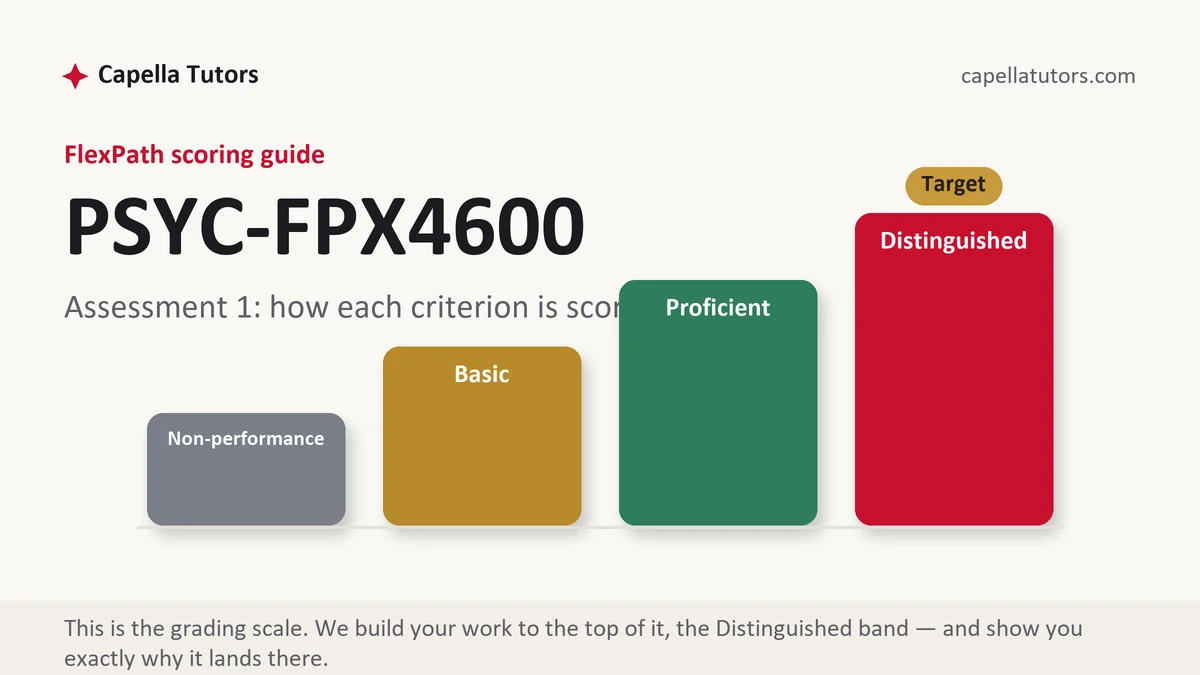
PSYC-FPX4600 Assessment 1 grading scale at Capella FlexPath, the criterion levels this assessment is scored on, from Capella Tutors
How Capella FlexPath grades PSYC-FPX4600 Assessment 1, visualized by Capella Tutors.

How PSYC-FPX4600 Assessment 1 is scored

Every criterion is scored on its own at one of four levels, and the level language is what your paragraphs are aiming at:

LevelWhat it means on an ethics analysis
DistinguishedEach principle is applied to a specific decision the study forces, the particular pressure on this population is named, and a workable alternative design is put on the page. The top column usually wants the redesign, not only the objection.
ProficientThe requirements are stated accurately and applied to the case in general terms, without reaching any single decision inside it.
BasicThe code and the review requirements paraphrased correctly, with the case mentioned on either side of the paraphrase.
Non-performanceConsent or review left out entirely, or concealment defended on the grounds that the data would otherwise be worse.

Two facts about the sequence matter more than students expect. Review happens before anything begins, not as a formality afterward, and consent is a conversation with a record rather than a signature collected at speed. A paper that gets the order of operations right is already most of the way to the top of this guide.

The PSYC-FPX4600 Assessment 1 method, step by step

  1. Turn the criteria into headings and list the decisions

    Copy the guide in, then write out every choice the proposed study forces: who is told what, who may refuse, who holds the recording, who sees the results, and when. Ethics criteria are answered decision by decision, and a paper organized by principle instead of by decision tends to stall at the middle of the scale.

  2. Write down what consent has to contain

    Purpose, what participation involves, how long it takes, foreseeable risks and benefits, what happens to the data, that taking part is voluntary, and that withdrawal carries no penalty. Then check your case against that list item by item. Most flawed designs fail on two or three specific items rather than in spirit.

  3. Name the pressure on this population specifically

    Vulnerability is not a general adjective. Employees can be asked by someone who writes their schedule, patients by someone involved in their care, students by someone who grades them. Say who holds power over the participant in your case and what that does to the meaning of a yes.

  4. Decide what the concealment is doing, and what it obliges

    Withholding some detail is sometimes permissible and always carries a cost: a debriefing obligation, a limit on the risk that may be involved, and a reason on the record. Write the obligation out in full, including what participants will be told afterward, in what words, and by whom.

  5. Propose the workable version

    Redesign the study so it could actually run: what people are told in advance, what stays unspecified, how consent is taken away from anyone with authority over them, and what happens to someone who declines. This paragraph is where the analysis criterion is usually won, because it proves you understood the constraint rather than resented it.

  6. Cite the framework rather than a paraphrase, then self-score

    Requirements and principles come from the professional code and the federal framework themselves, not from a textbook summary of them, and naming the principle you are applying reads stronger than quoting a paragraph of policy. Then score every criterion yourself and submit early in the week.

A structure that maps to the criteria

Planning targets our tutors use for a short undergraduate ethics analysis, not Capella rules; expand whichever section your guide describes in the most detail.

SectionWhat it must doGuide
Introduction and the proposalThe study as proposed, in enough detail that the reader can see the choices it forces, plus what the paper will decide.~150 words
What consent must containThe required elements, checked against this study one at a time, with the failures named specifically.~250 words
Review and approvalWhat has to be approved before recruitment starts, by whom, and what the reviewers would ask about this design.~200 words
The population and its pressureWho holds authority over the participants, and what that does to voluntariness and to the risk profile.~250 words
Concealment, debriefing, redesignWhat is withheld and why, the debriefing owed, and the version of the study that could be run.~300 words
Conclusion and referencesYour judgment, the condition that would change it, current APA in both directions.~150 words

Annotated sample excerpt

An original model excerpt from our team, offered for its moves rather than its content. The study in it is invented for teaching, and the point is how a principle turns into a decision on the page.

Sample excerpt: the redesign Original model · Capella Tutors

As proposed, the study records twelve checkout operators across three shifts without telling them, on the argument that telling them would change the very behavior being measured.1 The argument is probably true and it is not a permission, because respect for persons is a condition the study has to satisfy before it runs rather than a cost to be weighed against data quality.2 A version that could actually go ahead exists: operators are told in advance that recording will happen somewhere inside a two-week window without being told which shifts, consent is taken individually by a researcher rather than by the supervisor who writes the rota, anyone who declines is scheduled exactly as usual and their lane is excluded from the recording, and every participant is told at the end which shifts were used and offered deletion of their own footage.3

  • 1States the design and the researcher's own justification fairly, in one sentence, before answering it. The objection lands harder because the case for the study was made properly.
  • 2Concedes the methodological point and then refuses the inference, naming the principle as a condition rather than a value to be traded. This is applying a code rather than quoting one.
  • 3Redesigns the study to a runnable specification: what is disclosed, what is withheld, who takes consent, what refusal costs, and what the debriefing includes. Four criteria are served by one paragraph.

The full premium sample for your exact assessment, written fresh to your scoring guide and issue, is free to request. Study it, revise it into your own voice, and submit work you understand.

Get the full sample free

The five mistakes that cost Distinguished

  • Data quality offered as a justification. A better measurement is not a reason to skip consent, and writing it as though it were reverses the logic the criteria are testing.
  • Consent treated as a form. A signature gathered in a hurry from someone who has not been told what happens to the recording is documentation without consent.
  • Employees counted as ordinary volunteers. When the person asking controls the schedule, a yes means something different, and the paper has to say so.
  • Debriefing promised and never specified. Participants will be debriefed is a placeholder; who says what, when, and with what offer attached is the answer.
  • The code quoted where it should have been applied. A principle earns its criterion through the choice it settled, not through how exactly it was reproduced.

Pre-submission checklist

  • Every criterion answered under its own labeled heading
  • The decisions the study forces listed before any principle is discussed
  • Each required element of consent checked against the case individually
  • The authority relationship in this population named and its effect stated
  • A runnable redesign covering disclosure, consent, refusal and debriefing
  • Framework and code cited to their own documents in current APA, self-scored before submitting

Ethics analysis due this week?

Send the prompt, the criteria and the study you have been asked to examine. We list the decisions first, check the case against every element of consent, and return a premium original sample with the runnable redesign already written, inside 24 to 48 hours, revised free until the criteria clear.

Keep going

Online now