This manual is for PSYC FPX 4325 Assessment 3, start to submission. The closing deliverable in this course usually asks you to weigh evidence and then say what should be done with it, which puts two skills on the same page: reading a body of research honestly, and recommending only what that research licenses. The criteria in this part of the course reward a writer who can hold a strong pattern and a weak design in the same hand and still reach a conclusion. Below is our tutors' method for that argument, a structure keyed to the criteria, and an annotated excerpt from an original model. Want it handled for you? A premium original sample for this exact assessment arrives in 24 to 48 hours, revised free until your guide is satisfied. Capella's catalog lists the course as PSYC-FPX4325, and some courserooms print PSYC4325; both point to this same Assessment 3.
One honesty note before the manual: Capella revises courses and scoring guides over time, so always write to the exact scoring guide attached to your assessment in the courseroom. The course identity above is verified on capella.edu; the method and structure below are our tutors' approach to it, not Capella's official rubric text.
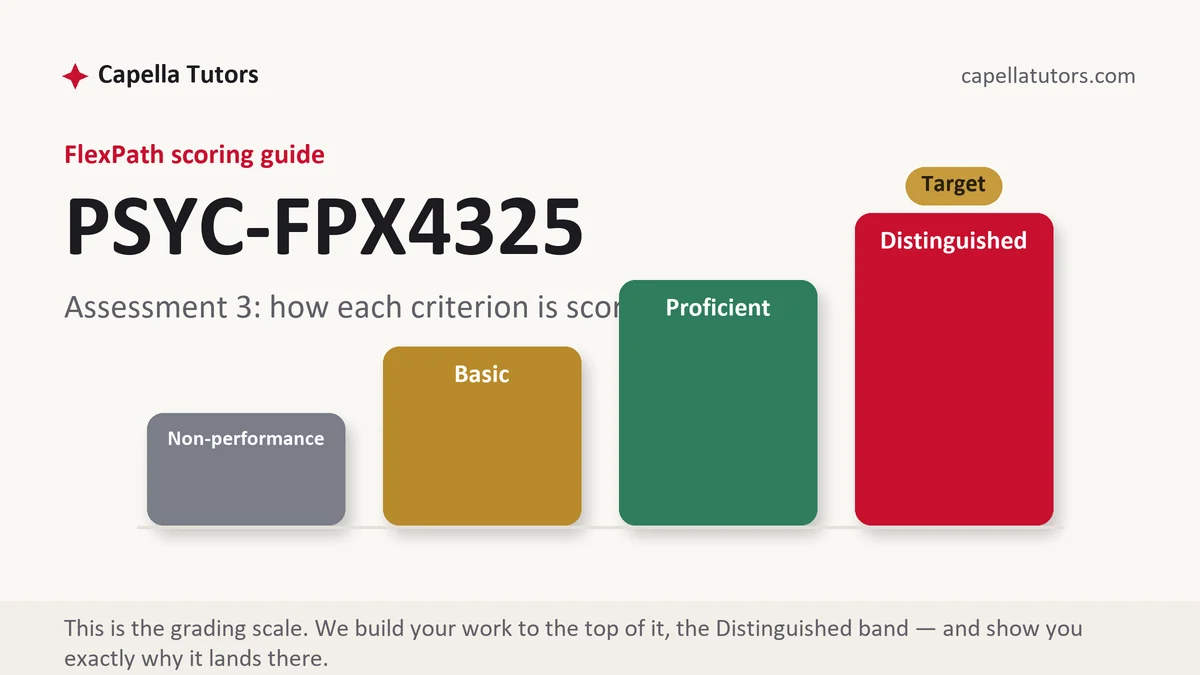
How PSYC FPX 4325 Assessment 3 is scored
The guide is scored criterion by criterion at one of four levels, and the top level is never a matter of style:
| Level | What it means on an evidence and scope analysis |
|---|---|
| Distinguished | Association and causation stay apart, the design behind the finding is named, and the recommendation is limited to what that design licenses, with the person qualified to act on it identified. The extra move lives in the criterion; find it and make it. |
| Proficient | The evidence is summarized accurately with its strength stated, and then the recommendation quietly outruns it by a step. |
| Basic | The finding reported as established fact, followed by a warm paragraph about the value of awareness. |
| Non-performance | No appraisal of the evidence at all, or a decision made on behalf of people the writer has no standing to decide for. |
The interpretive habit that carries this assessment is asking what a number leaves out. A total, a rate and an average all summarize by discarding, and saying what was discarded is usually the most useful sentence available to you.
The PSYC FPX 4325 Assessment 3 method, step by step
-
Turn the criteria into headings and name the decision
Put the guide in your outline, then write one line stating exactly what is being decided and by whom. An analysis with a decision attached stays disciplined; one written about a topic drifts. If your prompt does not name a decision, invent a specific one and say that you have.
-
Go to the source and describe its design in one sentence
Reach the original work through the Capella library, PsycINFO or PubMed and write a single sentence naming who was studied, how they were recruited, what was measured and when. That sentence does more analytic work than three paragraphs of summary, because everything you can and cannot claim follows from it.
-
Separate the well established from the inferred
Make two lists. A pattern reproduced in many populations belongs in the first. The mechanism connecting it to an outcome, and any prediction about an individual, usually belongs in the second. Writing both lists prevents the most expensive error in this course, which is letting a reliable association imply a causal route it cannot support.
-
Ask what the number hides
A count sets very different histories equal. An average tells you nothing about spread, so two groups with identical means can be made of quite different people. A rate depends entirely on its denominator. Say which of those is happening in your evidence, in plain words, before you draw anything from it.
-
Write the recommendation at the size of the evidence
State what should happen, then state what it would take to justify anything stronger. Where the recommendation touches people, build in the principles that keep it decent: safety, honesty about purpose, genuine choice, and a route to follow up that exists before anyone is asked anything.
-
Set the boundary, then self-score
One sentence saying the paper describes rather than diagnoses, one naming who is qualified to act, and one saying what the analysis cannot settle. Then mark every criterion yourself at one of the four levels, revise anything short of the top, and submit early in the week.
A structure that maps to the criteria
Planning targets from our tutors for a short undergraduate analysis, not Capella rules; give the most room to whichever criterion your guide describes at the greatest length.
| Section | What it must do | Guide |
|---|---|---|
| Introduction and the proposal | The decision on the table, who is making it, and the question this paper answers about it. | ~150 words |
| What the evidence establishes | The pattern, how widely it has been reproduced, and the design of the work behind it named in the same sentence. | ~250 words |
| What the design cannot support | The step from association to prediction, with the specific feature of the studies that blocks it. | ~250 words |
| What the number hides | What the count, average or rate discards, and why that matters for the decision being made. | ~200 words |
| The recommendation | What should happen, at the size the evidence licenses, with consent, choice and a follow-up route built in. | ~300 words |
| Scope, limits, references | What the paper declines to claim, who is qualified to act, current APA in both directions. | ~150 words |
Annotated sample excerpt
An original model excerpt from our team, written to show the reasoning shape rather than to be reused. The proposal in it is invented for teaching purposes.
The proposal would add a ten-item childhood adversity count to the enrollment form and refer any student scoring four or more to the counseling office.1 The pattern behind it is real and graded, more counted adversities going with more adult health difficulties across many populations, and the work that established it asked adults to recall their own childhoods inside one insured group, which supports a claim about association across a population far better than a prediction about the person filling in the form.2 A count also discards its own contents, since two students who both answer four have different histories and different resources, so the defensible version of this proposal keeps the questions voluntary and clearly labeled, states on the form what the answers will and will not be used for, and secures the follow-up appointment before the first question is ever asked.3
- 1States the decision and the threshold in one line, so every later paragraph has something specific to argue about rather than a topic.
- 2Credits the finding fully, then names the design feature that limits it, in the same sentence. Association and prediction are separated without dismissing either.
- 3Explains what the number hides, then sizes the recommendation to the evidence and builds consent and a follow-up route into it. This is the move the top of the guide describes.
The full premium sample for your exact assessment, written fresh to your scoring guide and issue, is free to request. Study it, revise it into your own voice, and submit work you understand.
The five mistakes that cost Distinguished
- A population pattern used to predict one person. A graded association across thousands says very little about the individual in front of you, and the criteria treat the slide from one to the other as a reasoning error.
- Recalled childhood described as recorded history. Retrospective self-report is a legitimate method with a known limit, and naming the limit costs one clause.
- Awareness offered as an outcome. Raising awareness cannot be measured or reviewed, so it cannot satisfy a criterion asking what should be done.
- Questions asked with nowhere to send the answers. Any screening recommendation without a follow-up route already in place is worse than none, and saying so earns the ethics criterion.
- A total treated as a description. Summing very different events into one figure sets them equal, and a paper that never says so has skipped the interpretation it was asked for.
Pre-submission checklist
- Every criterion answered under its own labeled heading
- The decision and the decision maker named in the introduction
- The design of the key evidence described in one sentence
- Two lists kept apart: what is established and what is inferred
- One paragraph saying what the number discards
- Recommendation sized to the evidence with consent and follow-up built in, current APA both directions, self-scored before submitting
Evidence appraisal due and the literature disagrees with itself?
Send the prompt and the criteria. Our analyst separates the reproduced pattern from the inferred mechanism, writes the design of every key study into the sentence that cites it, and the team returns a premium original sample built to the top column in 24 to 48 hours, revised free until the criteria clear.