This manual is for PSYC FPX 4325 Assessment 2, start to submission. The middle deliverable in this course usually asks for something actionable, a wellness or self-care plan attached to a situation you have already analyzed, and the criteria have a clear opinion about what makes one good. A plan scores at the top when each item names what will be done, how often, starting when, and what will get in the way, and when the whole thing has a review date and a written condition for calling it a failure. Below is our tutors' method for building one, a structure keyed to the criteria, and an annotated excerpt from an original model. Prefer to have it drafted? A premium original sample for this exact assessment comes back inside 24 to 48 hours, with revisions free until the criteria clear. Capella's catalog lists the course as PSYC-FPX4325, and some courserooms print PSYC4325; both point to this same Assessment 2.
One honesty note before the manual: Capella revises courses and scoring guides over time, so always write to the exact scoring guide attached to your assessment in the courseroom. The course identity above is verified on capella.edu; the method and structure below are our tutors' approach to it, not Capella's official rubric text.
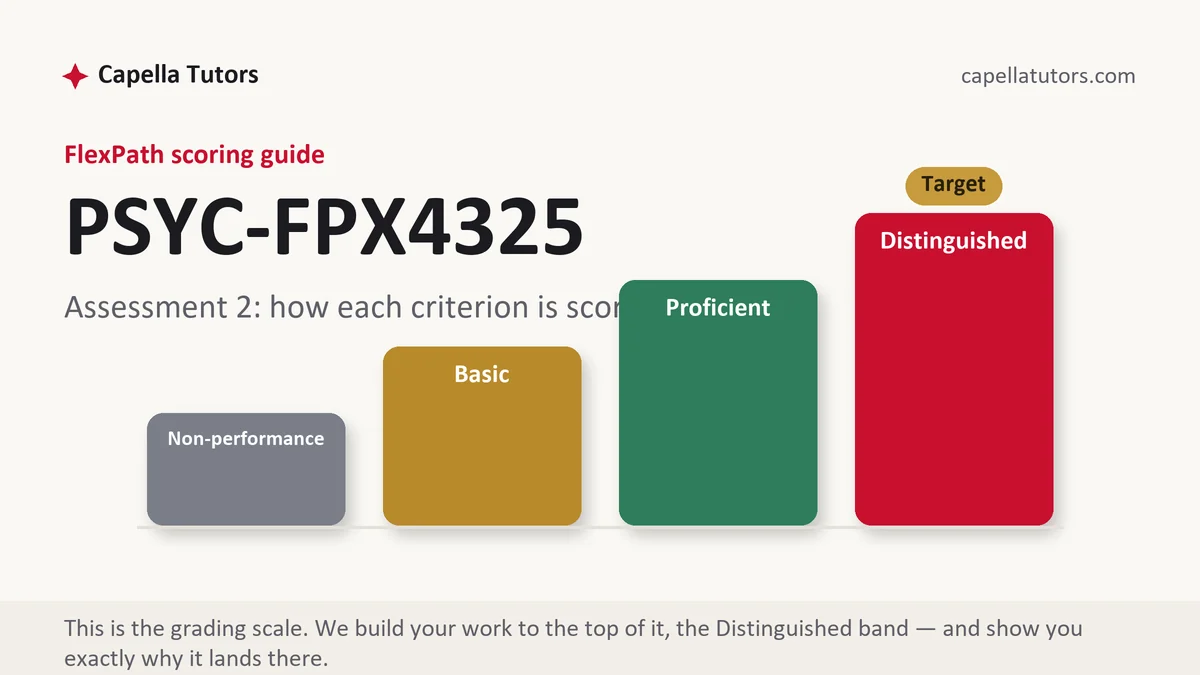
How PSYC FPX 4325 Assessment 2 is scored
Each criterion on the guide is placed at one level of four, independently of the others, and the language of those levels is what your sections have to satisfy:
| Level | What it means on a wellness plan |
|---|---|
| Distinguished | Every item is measurable, each strategy is matched to the appraisal rather than to the topic, and the plan carries a review date plus a written condition for judging it a failure. The extra move sits in the criterion; find it and make it. |
| Proficient | A complete plan whose strategies fit the situation, with no review point and no statement of what would count as not working. |
| Basic | Sensible general advice in a supportive tone: sleep more, eat better, ask for help. Nothing in it can be checked four weeks from now. |
| Non-performance | No plan at all, or a plan built entirely from strategies the person in the case has no power to use. |
Matching is the idea doing most of the work. Where the stressor can be changed, effort aimed at the problem pays; where it cannot, effort aimed at the feeling and at recovery is the competent response rather than the avoidant one. A plan that gets that pairing right reads as analysis, and one that gets it wrong reads as advice.
The PSYC FPX 4325 Assessment 2 method, step by step
-
Separate the analysis criteria from the plan criteria
Put the guide into your outline and mark which criteria want reasoning and which want a plan. Then hold the line between them, because analysis smuggled into plan items makes both harder to score. The plan section should read like instructions, not like an argument about instructions.
-
Split the situation into what can move and what cannot
Two columns, written out before any strategy is chosen. The number of callouts, the closing time of the plant, the progression of an illness: those sit in the second column. Which nights are protected, who else holds the pager, what happens in the hour after a shift: those sit in the first.
-
Match each strategy to the appraisal, not to the topic
For the first column, plan things that recover control: a schedule agreed with somebody else, a delegated task, a shared list. For the second, plan things that reduce load and restore capacity: a protected sleep window, paced breathing, one social contact put back in the week. Say in the paper why each item sits where it does.
-
Give every item a frequency, a start date and a named barrier
Four items done specifically beats nine described generally. Each one gets a number of times per week, a first occurrence, and the obstacle most likely to sink it, written down in advance so the review has something to check rather than a feeling to consult.
-
Write the review date and the definition of failure
Name what you measured at baseline, when you will measure it again, and the result that would tell you the plan is not working. A plan that cannot fail cannot be evaluated, and the sentence defining failure is the one that most reliably lifts this assessment out of the middle of the scale.
-
Name the resources outside the person, then self-score
Add what does not depend on the individual's effort: a crew rotation, a family member, an employee assistance line, a community group. Then mark yourself against each criterion, state in one sentence where a licensed professional would take over, and submit early in the week.
A structure that maps to the criteria
Our tutors' planning targets for a short undergraduate plan, not Capella rules; move the words toward whichever criterion your guide spells out in most detail.
| Section | What it must do | Guide |
|---|---|---|
| Introduction and the situation | Who the plan is for, in a few concrete lines, and what it is trying to achieve in one sentence. | ~150 words |
| What can and cannot be changed | The two columns written out, with the appraisal behind each placement stated. | ~200 words |
| Items aimed at the problem | Strategies that recover control, each with frequency, start date, owner and barrier. | ~250 words |
| Items aimed at load and recovery | Strategies for the part that will not move, specified to the same standard and justified from evidence. | ~250 words |
| Measurement, review and failure | Baseline, review date, and the result that would mean the plan needs replacing rather than repeating. | ~250 words |
| Support, scope, references | Resources outside the person, the referral threshold, current APA in both directions. | ~200 words |
Annotated sample excerpt
An original model excerpt from our team, written so you can see what a specified plan item looks like. The case is invented, and the numbers in it are there to show the level of detail rather than to be copied.
Item three is a protected sleep window of eleven to six, held on the four nights a week he is not first on call, with the pager passed to the second responder on those nights by an arrangement agreed with the station captain before the plan starts.1 It is matched to the appraisal on purpose: the callouts themselves are not his to control, so the item makes no attempt to reduce them and instead recovers control over the hours between them, which is the part of the week that is genuinely negotiable.2 Baseline is seven consecutive nights of recorded sleep times taken before anything changes, review is at four weeks, and the failure condition is written in advance, fewer than four protected nights achieved in any single week, at which point the barrier gets addressed rather than the instruction repeated more firmly.3
- 1Names the hours, the nights, the handover and the person who has to agree to it. A reader could run this item tomorrow without asking a question.
- 2Says out loud why the item sits on the controllable side of the ledger. Matching stated explicitly is what a criterion about fit is looking for.
- 3Baseline, review date and failure condition in one sentence, decided before the fact. This is the sentence most Proficient plans never write.
The full premium sample for your exact assessment, written fresh to your scoring guide and issue, is free to request. Study it, revise it into your own voice, and submit work you understand.
The five mistakes that cost Distinguished
- The plan that cannot fail. With no review point and no failure condition, nothing in the document can be evaluated, including by the person following it.
- Effort aimed at the part that will not move. Problem-focused items pointed at something the person cannot influence read as advice and misuse the appraisal you already established.
- Everything loaded onto one individual. A plan with no external resource in it ignores what the evidence says about support, and the criteria notice the omission.
- Start dates left blank. An item with no first occurrence never acquires one, and undated items are the clearest sign a plan was written to be read rather than run.
- A plan that drifts into treatment. Structured therapeutic work belongs to a licensed professional, and proposing it in an undergraduate plan costs the scope criterion outright.
Pre-submission checklist
- Each criterion answered under its own labeled heading
- The controllable and uncontrollable parts of the situation written out separately
- Every item carrying a frequency, a start date, an owner and a named barrier
- Each strategy justified against the appraisal it is matched to
- Baseline, review date and failure condition all stated in advance
- At least one resource outside the person, a referral threshold, current APA both directions, self-scored before submitting
Wellness plan due and every item sounds vague?
Send the scenario and the criteria. We split the situation into what can move and what cannot, specify each item until a stranger could follow it, and return a premium original sample with the review point and failure condition already written, in 24 to 48 hours, revised free until the criteria clear.