How to write PSYC-FPX4325 Assessment 1

The short answer

This manual is for PSYC-FPX4325 Assessment 1, start to submission. The opening deliverable in Stress, Trauma, and Wellness usually hands you a situation and asks you to explain what is happening in it, which means tracing a route from how the person reads the situation through to what a physician or a researcher could actually observe. The graded skill is the tracing. Saying that a job is stressful is a starting point; showing which properties of the stressor keep the response switched on, and what each step of it would be measured with, is the paper. Below is the method our tutors use to trace one, a structure keyed to the criteria, and an annotated excerpt from an original model. Rather hand it over? A premium original sample for this exact assessment is with you inside 24 to 48 hours, revised free until your guide is satisfied. Your courseroom may print this as PSYC FPX 4325 Assessment 1 or PSYC4325 Assessment 1; it is the same deliverable, and PSYC-FPX4325 Assessment 1 is what this manual walks through.

One honesty note before the manual: Capella revises courses and scoring guides over time, so always write to the exact scoring guide attached to your assessment in the courseroom. The course identity above is verified on capella.edu; the method and structure below are our tutors' approach to it, not Capella's official rubric text.
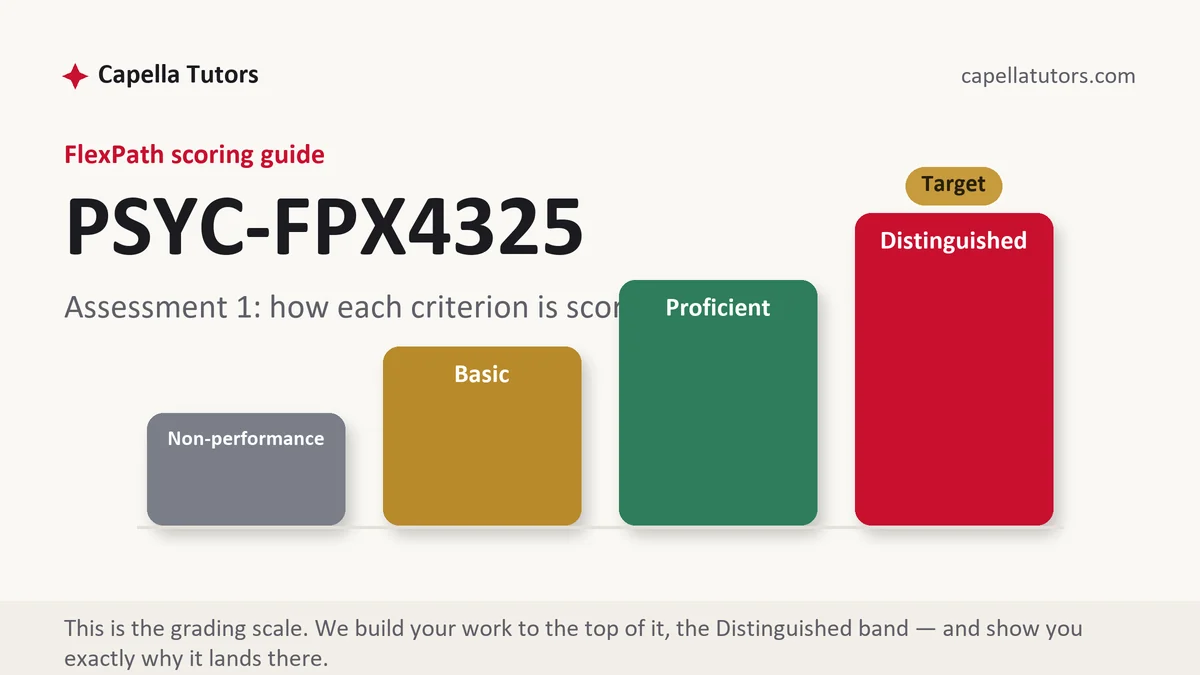
PSYC-FPX4325 Assessment 1 grading scale at Capella FlexPath, the criterion levels this assessment is scored on, from Capella Tutors
How Capella FlexPath grades PSYC-FPX4325 Assessment 1, visualized by Capella Tutors.

How PSYC-FPX4325 Assessment 1 is scored

FlexPath scores each criterion on its own, at one of four levels, and the level wording is the closest thing to instructions you will get:

LevelWhat it means on a stress analysis
DistinguishedAppraisal explains the outcome rather than appearing once and being dropped, the fast and slow arms of the response are kept on their own clocks, and something countable is attached to each step. The extra move is written into the criterion; find it and make it.
ProficientThe mechanism is described correctly and both appraisals are named, with the outcome asserted rather than explained by them.
BasicStress described as harmful in general terms, with the case used as an illustration of the general claim instead of as the thing being analyzed.
Non-performanceThe physiological route is absent, or the analysis has been replaced by advice for the person in the case.

Scope is graded here more closely than in most courses. An undergraduate paper describes a response and reasons about support; it does not assign a condition to anybody. Keeping the verbs descriptive costs you nothing and protects two criteria at once.

The PSYC-FPX4325 Assessment 1 method, step by step

  1. Turn the criteria into headings and sort them by job

    Copy the guide in, then mark each criterion as explain a mechanism, analyze a situation or recommend something. Those need different paragraph shapes and different amounts of room, and mixing them is why drafts in this course run long and land in the middle of the scale.

  2. Describe the stressor by its three properties

    Duration, controllability and predictability decide almost everything that follows, so write them down before you theorize. A one-off event that ends, a long strain the person can influence, and a long strain that keeps changing shape produce different responses, and naming which one you have is the sentence the analysis is built on.

  3. Name both appraisals in the case's own details

    The first judgment asks whether this matters to me, the second asks whether I have what it takes to handle it. Answer both using specifics from the scenario rather than in the abstract, because a secondary appraisal that returns low control has to return it for a reason the reader can see.

  4. Trace the pathway forward and attach a measure at each step

    Perception, the fast sympathetic response, the slower hormonal arm, then the behavior and the outcome. At every step name what could be counted: hours slept, a resting blood pressure reading, a perceived stress score, days absent. A pathway with a number beside each step cannot be dismissed as an adjective.

  5. Keep the verbs descriptive and the boundary explicit

    Write is consistent with, is associated with, would be expected to, and say in one sentence that the paper describes rather than diagnoses. Then name the point at which the situation would need a licensed professional. That sentence is usually worth an entire criterion and takes fifteen seconds.

  6. Read once for causal creep, then self-score

    Search the draft for caused, led to and resulted in, and downgrade each one your evidence cannot carry. Then mark every criterion at one of the four levels yourself, revise anything short of the top, and submit early in the week, since evaluation can take two business days.

A structure that maps to the criteria

Planning targets our tutors use for a short undergraduate analysis, not Capella rules; expand whichever section your scoring guide describes in the most detail.

SectionWhat it must doGuide
Introduction and the caseThe person and the situation in a few concrete lines, plus the question this analysis answers.~150 words
The stressor describedDuration, controllability and predictability, each supported from the details of the scenario.~250 words
AppraisalBoth appraisals answered from the case, with the resources and constraints that produced those answers.~250 words
The physiological routePerception to fast activation to the slower hormonal arm, with the two time courses kept apart.~300 words
What would be observed and measuredThe behavioral and bodily consequences, each with a named measure and a source behind the link.~250 words
Scope, conclusion, referencesWhat the paper claims, what it declines to claim, where a professional takes over, current APA both ways.~150 words

Annotated sample excerpt

An original model excerpt from our team, pitched at the register a top-column criterion describes. The case is invented for teaching, and the point of it is the shape of the reasoning.

Sample excerpt: stressor and appraisal Original model · Capella Tutors

Ms. Bello's rota is posted on Sunday for the week ahead and altered twice in most weeks, which makes the stressor chronic, largely uncontrollable, and unpredictable in the precise sense that matters here, since she cannot tell in advance which resources she will need on which day.1 Her primary appraisal returns threat to something central, because the shifts decide whether her son has childcare; her secondary appraisal returns low control, because the changes come from occupancy figures she never sees and are relayed by a supervisor with no authority to change them.2 That combination, long duration with low control and low predictability, is the one associated with a response that stays engaged rather than resetting, and the consequences a paper can point at are countable: hours slept on a work night, resting blood pressure at a routine appointment, a perceived stress score collected twice.3

  • 1Establishes all three properties of the stressor in one sentence, using details from the scenario rather than adjectives, and defines unpredictability in the sense the analysis will use.
  • 2Answers both appraisals with reasons a reader can check. Low control is earned by naming who holds the information, which is what separates explanation from assertion.
  • 3Links the appraisal to the time course of the response, hedged accurately, then hands the reader three measures. The pathway becomes checkable at the moment the numbers arrive.

The full premium sample for your exact assessment, written fresh to your scoring guide and issue, is free to request. Study it, revise it into your own voice, and submit work you understand.

Get the full sample free

The five mistakes that cost Distinguished

  • Stress named but never traced. A paper that calls the situation stressful without drawing a route from perception to physiology leaves the mechanism criterion empty.
  • Character offered as the explanation. Saying one person copes better because she is tougher replaces appraisal and resources with a compliment, and the criteria are asking for the first two.
  • One arm of the response doing all the work. The fast route and the slower hormonal route run on different clocks, and collapsing them loses the distinction the guide is paying for.
  • Adjectives standing where a measure belongs. Drained, overwhelmed and exhausted cannot be checked in four weeks; hours slept and a repeated score can.
  • The case turned into a patient. Describing a presentation is the assignment; naming a condition belongs to a licensed clinician and costs you the scope criterion.

Pre-submission checklist

  • Every criterion answered under its own labeled heading
  • Duration, controllability and predictability all stated for the stressor
  • Both appraisals answered from details in the case
  • The two time courses of the response kept separate
  • A named measure attached to every observable consequence
  • Descriptive verbs throughout, one scope sentence, current APA both directions, self-scored before submitting

Stress analysis due this week?

Send the scenario, the criteria and anything your instructor has said about scope. We build the draft pathway first, appraisal to physiology to behavior to outcome, with a measure attached at every step, and return a premium original sample written to the top column in 24 to 48 hours with free revisions until it clears.

Keep going

Online now