How to write PSYC-FPX4110 Assessment 3

The short answer

This manual is for PSYC-FPX4110 Assessment 3, start to submission. The final deliverable in this course usually asks you to evaluate rather than build, taking a claim about wellbeing that is circulating in public and testing it against what the research behind it can actually support. The graded skill is sizing a claim to its evidence, which means naming the design, saying what the numbers are numbers of, and answering the strongest objection instead of listing it. Below is our tutors' method for that critique, a structure keyed to the criteria, and an annotated excerpt from an original model. Prefer to hand this one over? A premium original sample written to this exact assessment lands in 24 to 48 hours, revised free until the criteria clear. Your courseroom may print this as PSYC FPX 4110 Assessment 3 or PSYC4110 Assessment 3; it is the same deliverable, and PSYC-FPX4110 Assessment 3 is what this manual walks through.

One honesty note before the manual: Capella revises courses and scoring guides over time, so always write to the exact scoring guide attached to your assessment in the courseroom. The course identity above is verified on capella.edu; the method and structure below are our tutors' approach to it, not Capella's official rubric text.
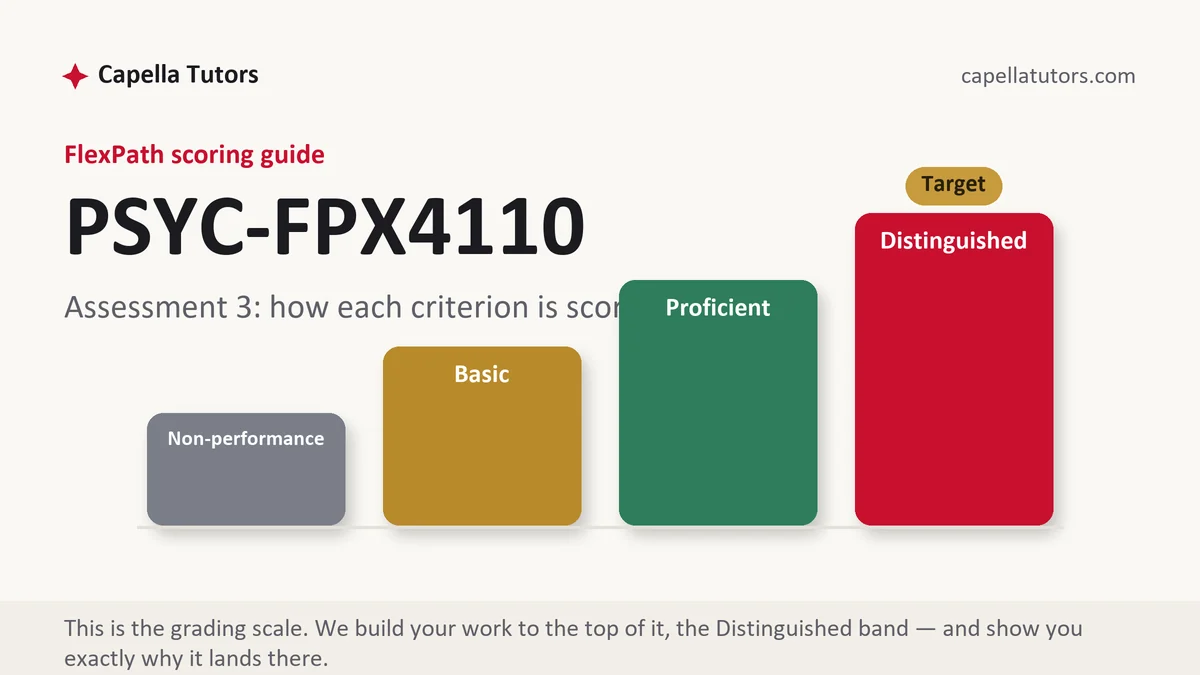
PSYC-FPX4110 Assessment 3 grading scale at Capella FlexPath, the criterion levels this assessment is scored on, from Capella Tutors
How Capella FlexPath grades PSYC-FPX4110 Assessment 3, visualized by Capella Tutors.

How PSYC-FPX4110 Assessment 3 is scored

Criteria are scored one at a time in FlexPath, and the level descriptions are the only instructions that matter once the draft is underway:

LevelWhat it means on an evidence critique
DistinguishedThe claim is restated in terms the evidence could support, the design behind it is named, and the strongest objection is answered on evidence rather than noted and dropped. The top column expects a verdict you are willing to defend.
ProficientThe weaknesses are identified accurately and the verdict is left implicit, so the reader has to assemble your conclusion themselves.
BasicA summary of the claim, a paragraph of general reservations, and a closing line about needing more research.
Non-performanceThe public claim is repeated as though it were a finding, or no source behind it is examined at all.

One habit carries this whole assessment: put the plain sentence in front of the numbers. Write what happened in ordinary words first, then give the figures as support. A claim that survives being written in plain English is usually sound, and one that only works in percentages usually is not.

The PSYC-FPX4110 Assessment 3 method, step by step

  1. Make the criteria your headings, then decide what you are critiquing

    Copy the guide in, then write one line naming your object precisely: this advertisement, this article, this claim in this interview. Critiques go vague when the target is a whole field rather than a document. A named object with a date is what makes every later paragraph checkable.

  2. Find the study, not the claim about the study

    Follow the citation trail back through the Capella library, PsycINFO or PsycARTICLES until you are holding the primary article, and if the trail stops at a press release say so in the paper. A claim with no locatable study is itself a finding, and reporting that is worth more than critiquing what you imagine the study said.

  3. Ask what the number is a number of

    Percentages need a base. A rise of a quarter could mean a quarter of a scale total, a quarter of the participants improving, or a quarter of a standard deviation, and only the last two are interpretable. Work out the base, and if the source does not give one, that absence goes in your critique.

  4. Name the design and what it cannot rule out

    Say in one sentence what kind of study this was, who was in it, how they got in, and how long it ran. Then name the rival explanations it leaves standing: expectation, attention, the passage of time, people who volunteered because they were already looking for change, or a measure collected by whoever wanted the result.

  5. Rewrite the claim so the evidence can carry it

    Produce one sentence you would be willing to defend, with the hedges the discipline uses and the design inside it. This is the single highest-value paragraph in the assessment, because it demonstrates the judgment the criteria are trying to measure rather than describing it.

  6. Handle corrections properly, then self-score

    Where a claim has been retracted or substantially corrected, cite the correction alongside the original and say what survived it. The positivity ratio is the standard example in this course, since its mathematical core was retracted in 2013 after a detailed challenge. Then score yourself against each criterion and submit early in the week.

A structure that maps to the criteria

Planning targets from our tutors for a short undergraduate critique, not Capella rules; give more room to whichever criterion your guide describes at greatest length.

SectionWhat it must doGuide
Introduction and the claimQuote or state the claim exactly, name where it appeared, and say what the paper will decide about it.~150 words
What the source reportsThe study behind the claim described faithfully, including sample, length, measures and the numbers as published.~250 words
Design and rival explanationsThe design named, with each alternative explanation it cannot exclude stated specifically rather than as bias.~300 words
The claim rewrittenOne defensible sentence, hedged accurately, with the design visible inside it.~200 words
The strongest objection, answeredThe best case for the original claim, met with evidence, and the part of the disagreement still open.~250 words
Conclusion and referencesYour verdict, what would change it, current APA in both directions with corrections cited where they exist.~150 words

Annotated sample excerpt

An original model excerpt from our team, included as study material. The claim and the figures in it are invented for teaching purposes rather than taken from a real product or trial.

Sample excerpt: sizing the claim Original model · Capella Tutors

The claim on the app's front page is that users are twenty-five percent happier after two weeks, and the first question is what could possibly be twenty-five percent of.1 The linked study is a two-week trial with no comparison group in which mean scores on a ten-item wellbeing measure moved from 46 to 52, so the advertised figure is a proportion of a scale total, which has no meaning outside that scale, and nothing in the design separates the app from the fortnight it was used in.2 A sentence this evidence could carry reads differently: among adults who chose to download a self-guided wellbeing app, average self-reported wellbeing was six points higher after two weeks on a measure with no published minimum meaningful change, in a study with no comparison condition, which is consistent with a small real benefit and equally consistent with expectation.3

  • 1Quotes the claim exactly and turns straight to the base of the percentage. Asking what the number counts is the move that separates a critique from a summary.
  • 2Reports the study faithfully, in its own numbers, then names the two problems precisely: an uninterpretable base and a design that leaves time unaccounted for.
  • 3Rewrites the claim at the size the evidence supports, with the sample, the design and the missing benchmark all inside one sentence. Plain English first, figures behind it.

The full premium sample for your exact assessment, written fresh to your scoring guide and issue, is free to request. Study it, revise it into your own voice, and submit work you understand.

Get the full sample free

The five mistakes that cost Distinguished

  • The number repeated. Quoting the advertised figure in your own analysis section adopts it, whatever the surrounding sentences say.
  • A scale percentage read as a percentage of a person. Points on an instrument are not units of happiness, and treating them that way is the error the assessment exists to catch.
  • Limitations listed instead of weighed. Naming five weaknesses without saying which one matters most leaves the evaluation criterion unearned.
  • A book or a talk promoted to evidence. Popular sources are fine as examples of how an idea circulated, never as proof that it is true.
  • A corrected claim cited from the original alone. Where a retraction or a published challenge exists, leaving it out of the reference list is the costliest omission in this course.

Pre-submission checklist

  • Every criterion addressed under its own heading
  • The claim quoted exactly, with its source and date named
  • The primary study located, or its absence reported
  • The base of every number identified before the number is discussed
  • One rewritten sentence the evidence can carry, in plain English
  • Corrections and retractions cited alongside originals, current APA both directions, self-scored before submitting

Critique due and the source is a marketing page?

Send the claim, the prompt and the criteria. Our analyst traces the citation to the primary article, works out what each number is a proportion of, and the team returns a premium original sample written to the top column in 24 to 48 hours, with revisions free until the criteria clear.

Keep going

Online now