How to write PSYC-FPX4110 Assessment 2

The short answer

This manual is for PSYC-FPX4110 Assessment 2, start to submission. The middle deliverable in this course usually moves from describing a construct to building something with it, which means an applied behavior-change plan aimed at a person or a small group. The graded difference between the middle and the top of the scale is not enthusiasm, it is specification: the dose, the duration, the people it is for, what it will be measured with, and what it is being compared against. Below is our tutors' method for writing that plan, a structure keyed to the criteria, and an annotated excerpt from an original model. Want it drafted with backup instead? A premium original sample for this exact assessment returns in 24 to 48 hours, revised free until your guide is satisfied. Your courseroom may print this as PSYC FPX 4110 Assessment 2 or PSYC4110 Assessment 2; it is the same deliverable, and PSYC-FPX4110 Assessment 2 is what this manual walks through.

One honesty note before the manual: Capella revises courses and scoring guides over time, so always write to the exact scoring guide attached to your assessment in the courseroom. The course identity above is verified on capella.edu; the method and structure below are our tutors' approach to it, not Capella's official rubric text.
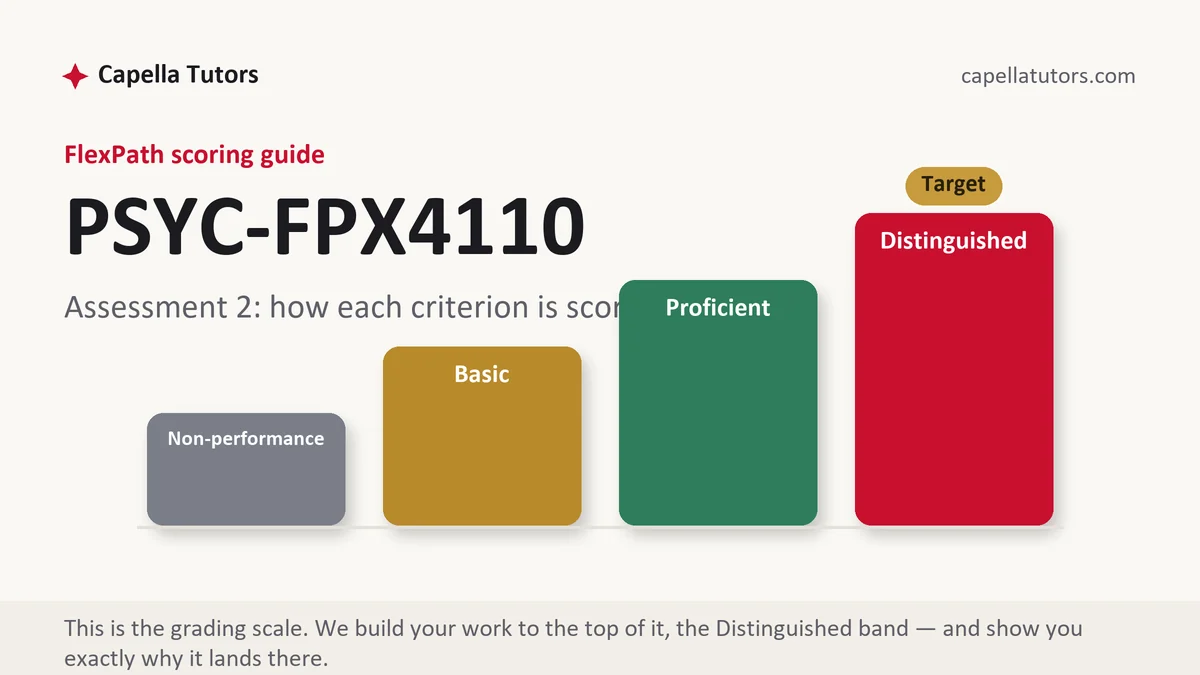
PSYC-FPX4110 Assessment 2 grading scale at Capella FlexPath, the criterion levels this assessment is scored on, from Capella Tutors
How Capella FlexPath grades PSYC-FPX4110 Assessment 2, visualized by Capella Tutors.

How PSYC-FPX4110 Assessment 2 is scored

Every criterion on your scoring guide is placed at one of four levels, with no averaging across them, so a strong paper with one thin section still shows that section:

LevelWhat it means on an applied plan
DistinguishedA stranger could run the plan unchanged, the comparison condition is justified in a sentence, and the size of effect you expect is stated before the plan is defended. The top column usually pays for the sentence that predicts rather than promises.
ProficientA complete plan with activity, dose and duration, measured before and after, with nothing to compare the result against.
BasicA list of pleasant activities and a hopeful paragraph, no frequency, no measurement point, no way of telling afterward whether anything happened.
Non-performanceNo measurement at all, or no plan, only more discussion of the construct the previous section already covered.

The comparison condition is where most of the available credit sits, because without one any improvement is explained just as well by attention, by expectation, or by the fact that people who agree to a wellbeing exercise are already moving in that direction. Build the comparison first and the rest of the plan writes itself around it.

The PSYC-FPX4110 Assessment 2 method, step by step

  1. Split the criteria into define, design and defend

    Print the guide, make each criterion a heading, then tag it with one of those three words. Most of the length belongs to design, most of the marks lost belong to defend, and the define section only needs enough to make the design legible. Anything outside the headings does not count.

  2. Fix the target before you choose the activity

    Decide what you are trying to move and on whom, then pick the exercise that fits it. Aiming at how someone feels day to day and aiming at how they judge their life as a whole are different targets that respond to different things, and a plan built for the wrong one can work perfectly and still measure nothing.

  3. Write the dose in numbers a stranger could follow

    How many times, on which days, for how long each time, over how many weeks, delivered by whom, with what instruction given in what words. Regularly and as needed are not doses. If a reader would have to ask you a question before starting, the specification criterion is not yet met.

  4. Build the comparison condition and say what it holds constant

    The comparison group does something equally time-consuming and equally attended to, minus the active ingredient. Then write the sentence that earns the criterion: this comparison holds writing time, contact with the coordinator and the awareness of being studied roughly constant, so a difference between groups points at the content.

  5. Choose the measurement points and the difference you will believe

    Name the instrument, the baseline occasion, the follow-up occasion, and, before you have any data, the size of change you would treat as real. Expect something modest. The honest reading of this literature is that brief exercises produce small to moderate improvements on self-report and that the improvements fade without repetition.

  6. Write the ethics lines, then self-score

    Say how people are invited rather than told, what happens if they decline, what the data are used for, and who is not a good fit for this exercise. Then read the plan once against each criterion, mark yourself honestly at one of the four levels, and submit early in the week rather than at the end of it.

A structure that maps to the criteria

These are our tutors' planning targets for a short undergraduate plan, not Capella requirements; shift words toward whichever criterion your guide describes in most detail.

SectionWhat it must doGuide
Introduction and targetWho the plan is for, what it aims to move, and one sentence saying what success would look like.~150 words
Why this exerciseThe mechanism you expect to work and the peer-reviewed evidence behind it, with magnitudes reported rather than implied.~250 words
The planActivity, wording of the instruction, frequency, duration, start date, and who delivers it.~300 words
The comparison conditionWhat the comparison group does instead, and the sentence naming what it holds constant.~200 words
Measurement and successInstruments, measurement occasions, and the change you decided in advance to call real.~250 words
Limits, ethics, referencesWhat could explain a result other than the plan, how consent works, current APA in both directions.~150 words

Annotated sample excerpt

Original model work from our team. Every figure in it is illustrative rather than taken from a published trial, and it is included so you can see how a plan reads when it is specified rather than described.

Sample excerpt: the plan and its comparison Original model · Capella Tutors

The plan runs four weeks with the fourteen volunteers who staff the Fenwick community garden on Tuesday and Saturday mornings: in week one each person identifies their highest-ranked strength on a character strengths inventory, then commits to using it deliberately on both weekly shifts and writing three lines afterward on what they did with it.1 The comparison crew at the second garden logs the tasks they completed on the same two mornings and writes three lines about the weather, which keeps writing time, coordinator contact and the awareness of being studied roughly level while removing the strengths content itself.2 Pleasant affect and life satisfaction are collected in week one before anything begins and again in week five, and a two-point difference on a five-item satisfaction total will be reported as inside the noise of the measure rather than as an effect.3

  • 1Every element a reader would need is present: who, how many, which days, what they do, and what they write. No question is left for the writer to answer.
  • 2The comparison is equally busy and equally attended to, and the sentence naming what it holds constant is the one a Proficient plan leaves out.
  • 3Commits in advance to a threshold, which prevents the discussion section from promoting a small wobble into a finding. Predicting modestly is a strength here, not a hedge.

The full premium sample for your exact assessment, written fresh to your scoring guide and issue, is free to request. Study it, revise it into your own voice, and submit work you understand.

Get the full sample free

The five mistakes that cost Distinguished

  • The activity list. Six nice things a person could try, with no frequency and no end date, is a leaflet rather than a plan.
  • Nothing to compare it against. A single group measured twice cannot separate your exercise from the fortnight it happened in.
  • A percentage borrowed from a headline. Claiming a specific rise in happiness treats one sample as an exchange rate and invites the evaluator to check the source.
  • Consent skipped because the activity is pleasant. Volunteers are still participants, and a plan that recruits by announcement has an ethics criterion sitting open.
  • Objections collected and then ignored. A paragraph of limitations followed by an unchanged conclusion is the reliable ceiling at Proficient.

Pre-submission checklist

  • Each criterion answered under its own labeled heading
  • The target named as a specific construct in a specific group
  • Dose written so a stranger could run it without asking a question
  • A comparison condition with a sentence saying what it holds constant
  • Baseline and follow-up occasions fixed, with the meaningful difference set in advance
  • Consent and decline handled in writing, current APA both directions, self-scored before submitting

Intervention plan due this week?

Send the prompt, the criteria and the group you have in mind. We design the comparison condition first, size the expected effect from the literature rather than from optimism, and return a premium original sample written to the top column in 24 to 48 hours, revised free until the criteria clear.

Keep going

Online now