How to write PSYC-FPX4110 Assessment 1

The short answer

This manual is for PSYC-FPX4110 Assessment 1, start to submission. The opening deliverable in Positive Psychology usually asks you to take one element of wellbeing, define it tightly enough to rule something out, and say what would measure it. That looks like vocabulary work and it is not, because the criteria separate a student who can name a construct from one who can say what a score on it means and what a real change in that score would look like. Below is our tutors' method for that paper, a structure keyed to the criteria, and an annotated excerpt from an original model. Rather have it drafted with backup? A premium original sample built for this exact assessment is back in 24 to 48 hours, with revisions free until your guide is satisfied. Your courseroom may print this as PSYC FPX 4110 Assessment 1 or PSYC4110 Assessment 1; it is the same deliverable, and PSYC-FPX4110 Assessment 1 is what this manual walks through.

One honesty note before the manual: Capella revises courses and scoring guides over time, so always write to the exact scoring guide attached to your assessment in the courseroom. The course identity above is verified on capella.edu; the method and structure below are our tutors' approach to it, not Capella's official rubric text.
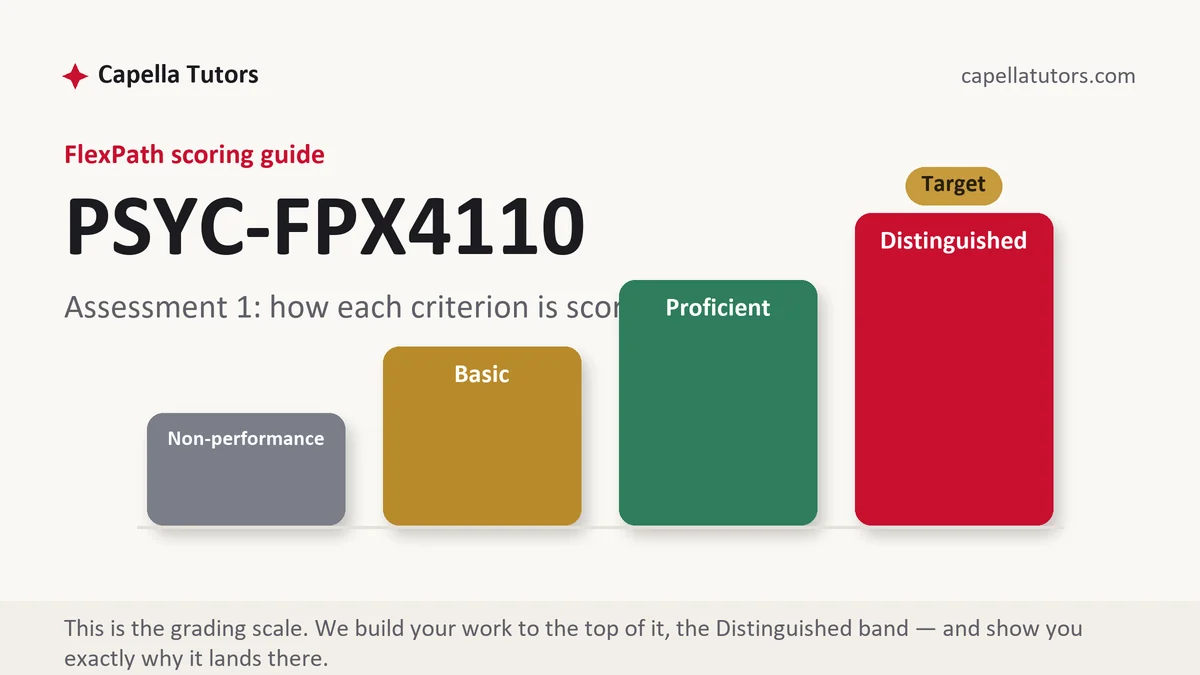
PSYC-FPX4110 Assessment 1 grading scale at Capella FlexPath, the criterion levels this assessment is scored on, from Capella Tutors
How Capella FlexPath grades PSYC-FPX4110 Assessment 1, visualized by Capella Tutors.

How PSYC-FPX4110 Assessment 1 is scored

FlexPath grades criteria, not papers. Each one lands at one of four levels, and the level language tells you what a sentence has to do to earn it:

LevelWhat it means on a construct-and-measurement paper
DistinguishedThe definition rules something out, the construct is held apart from its nearest neighbors throughout, and the instrument is cited to its validation source with its limits stated before any number is interpreted. The extra move is in the criterion; find it and make it.
ProficientThe construct is defined accurately and an instrument is named. Complete work that leaves the numbers to speak for themselves, which they never do.
BasicA correct definition followed by a warm paragraph on why wellbeing matters, with nothing measurable anywhere in it.
Non-performanceNo instrument at all, or a construct that quietly changes meaning between the introduction and the conclusion.

Nothing here asks you to calculate anything, which is the point worth taking seriously. This assessment grades interpretation, and interpretation is where a mean does most of its lying: an average score tells you where a group sits and nothing about how spread out its members are, so two groups with the same mean can contain completely different people. Say what the number is, then say what it hides.

The PSYC-FPX4110 Assessment 1 method, step by step

  1. Turn the criteria into headings and mark the verbs

    Copy each criterion into your outline with its top-level description underneath, then underline the verb. Define, distinguish, apply and evaluate are four different paragraphs, and a definition offered where the guide asked for an evaluation earns nothing. Whatever falls outside those headings is writing you are doing for free.

  2. Choose one construct and name its neighbors

    Pick a single element of wellbeing and then write down the two things it is most often confused with. Life satisfaction is a judgment about your life as a whole; positive affect is how you have felt lately; the absence of distress is a third thing again. Naming the neighbors in your introduction is what a criterion about conceptual clarity is actually looking for.

  3. Pick the instrument before you write about the construct

    Choose your measure early, because it disciplines the definition. If nothing in the literature measures the thing you defined, your definition is an essay topic rather than a construct. Cite the scale to the article that developed and validated it, and record its number of items, its response range and what its authors say it does not capture.

  4. Learn what a number on that scale actually means

    Work out the possible range from the items and the response options, find the midpoint, and read one validation paper for what a typical score looks like. Some instruments rank rather than score, so a strength appearing fifth on a ranked inventory is not a weak strength, and affect scales keep pleasant and unpleasant feeling on separate scores on purpose.

  5. Say in advance what a real change would be

    Write one sentence per measure that names the difference you would treat as meaningful, and commit to it before you look at any result. A two-point move on a five-item total across a fortnight sits inside the noise of the instrument, and saying so before the fact is what stops a paper from over-reading its own case.

  6. Read for slippage, then self-score

    Read the draft once looking only for the moment your construct changes meaning, which usually happens in the paragraph where you get enthusiastic. Then mark yourself against each criterion at one of the four levels, fix anything short of the top, and submit early in the week rather than on a Friday.

A structure that maps to the criteria

These lengths are planning targets our tutors use for a short undergraduate paper of this type, not Capella rules; expand whichever section your scoring guide asks more of.

SectionWhat it must doGuide
Introduction and the constructName the element of wellbeing, the case or population you will apply it to, and the question the paper answers.~150 words
Definition and boundariesThe construct defined so that something is excluded, with the two neighboring constructs named and kept out.~250 words
Where the idea comes fromThe tradition or model the definition belongs to, cited to its own literature rather than to a summary of it.~200 words
MeasurementThe instrument, its items, its range, what a typical score looks like, and what it cannot detect.~300 words
The case readThe construct applied to the person or group in front of you, with the score interpreted rather than reported.~250 words
Limits, conclusion, referencesWhat self-report cannot see, what you are not claiming, current APA in both directions.~150 words

Annotated sample excerpt

An original model excerpt from our team, showing how two scores are turned into one claim. The figures in it are illustrative rather than drawn from any published sample.

Sample excerpt: reading the profile Original model · Capella Tutors

Mr. Alder, eleven months into retirement after thirty-one years carrying mail, scores 29 on a five-item life satisfaction scale answered on a seven-point range, so his total sits well above the scale's neutral point of 20.1 On a separate affect measure his pleasant-feeling score is low and his unpleasant-feeling score is also low, which is not a contradiction, because those two are scored independently and a person can sit near the floor on both.2 Read together the profile says something a single happiness number would have concealed: he judges the shape of his life to be good and is currently having very few pleasant days, and it is the second of those, not the first, that anything built for him would have to move.3

  • 1Gives the score with the information needed to interpret it, items, response range and neutral point, so the reader can place 29 without trusting the writer.
  • 2Anticipates the reader's objection and answers it from how the instrument is built. Knowing that two subscales are independent is measurement literacy rather than trivia.
  • 3Turns two numbers into one plain-English claim and then names the target. The interpretive sentence, not the score, is what the top of the guide is describing.

The full premium sample for your exact assessment, written fresh to your scoring guide and issue, is free to request. Study it, revise it into your own voice, and submit work you understand.

Get the full sample free

The five mistakes that cost Distinguished

  • Happiness treated as one dial. Sliding between satisfaction, mood and the absence of distress loses a criterion without a single factual error on the page.
  • A score read as a category. These instruments describe a position on a range; they do not sort people into types, and writing as though they do overstates what you have.
  • The scale cited to a page reproducing its items. Items without the scoring rules and the validation evidence are not the instrument, and APA wants the source you actually used.
  • A definition that excludes nothing. If your construct covers every good thing that can happen to a person, no criterion about conceptual precision can be met.
  • Register drift into encouragement. The moment the paper starts advising the reader to stay positive, it stops being a psychology paper and is graded as what it became.

Pre-submission checklist

  • Every criterion on the guide sitting under its own heading
  • One construct, defined so that something is ruled out
  • The two nearest neighboring constructs named and kept separate throughout
  • The instrument cited to its validation article, with items and range stated
  • A sentence saying what change on that measure you would call real, written before any result
  • Every citation matched to the reference list both ways in current APA, self-scored before submitting

Want this one built for you?

Send us the prompt, the criteria and whichever scale the assessment names. Our analyst starts from the instrument rather than the prose, so the draft says what a score is before it says what it means, and a team of eight returns a premium original sample aimed at the top column in 24 to 48 hours with free revisions until it clears.

Keep going

Online now