This manual is for PSYC-FPX3770 Assessment 1, start to submission. The first deliverable in a motivation course is usually diagnostic: the assessment hands you a performance problem, or lets you bring one, and asks what kind of motivation is operating rather than how much of it there is. That single distinction decides most of the grade, because a paper describing somebody as unmotivated has produced a label, and a paper naming which condition of motivation is missing has produced something a plan can act on. Below is the method our tutors use for it, a structure the criteria can be read against, and an annotated excerpt from an original model paper. Would you rather delegate the draft? A premium original sample written to your case and your scoring guide comes back in 24 to 48 hours, revised free until the criteria are met. Your courseroom may print this as PSYC FPX 3770 Assessment 1 or PSYC3770 Assessment 1; it is the same deliverable, and PSYC-FPX3770 Assessment 1 is what this manual walks through.
One honesty note before the manual: Capella revises courses and scoring guides over time, so always write to the exact scoring guide attached to your assessment in the courseroom. The course identity above is verified on capella.edu; the method and structure below are our tutors' approach to it, not Capella's official rubric text.
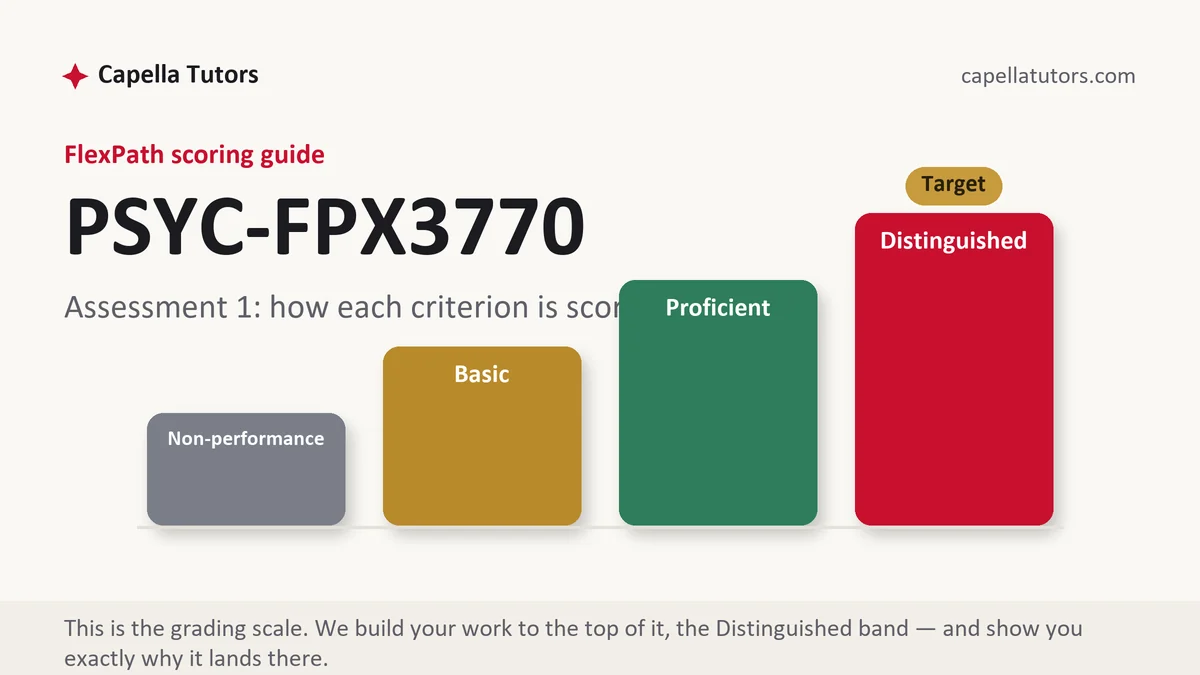
How PSYC-FPX3770 Assessment 1 is scored
No letter grades appear anywhere in FlexPath. Each criterion is placed at one of four levels, and the level language is the closest thing to a worked example you will be given:
| Level | What it means on a motivational diagnosis |
|---|---|
| Distinguished | The problem carries a baseline figure, the account is chosen over a named rival for a reason drawn from the case, and the diagnosis identifies which condition of motivation is missing rather than reporting that motivation is low. The comparison with the rival is usually the criterion's extra clause. |
| Proficient | A correct theoretical account applied accurately to the case, with support. What is absent is the alternative account, or the number that shows the problem is real. |
| Basic | Motivation treated as a quantity, described sympathetically, with theory recited alongside the case rather than applied to it. |
| Non-performance | A required element is missing, most often the evidence behind the theory or any statement of the problem in measurable terms. |
This is a bachelor's-level course, so the criteria are not asking you to advance the field. They are asking you to take a construct out of the reading and use it on something real, precisely, in the words the researchers use, with a source behind each claim about how the construct behaves.
The PSYC-FPX3770 Assessment 1 method, step by step
-
Build the document out of the criteria
List the criteria as headings, paste each Distinguished description underneath, and treat that file as the assignment from then on. It also tells you where the weight sits, since a criterion described in four sentences is asking for more of your paper than one described in a single line.
-
Attach a number to the problem in the first paragraph
Attendance that fell from 21 to 11, records finished late on eleven of twenty shifts, four of nine trainees still uncertified at week six: any of those turns a complaint into a case. Say where the figure came from and over what period, because a diagnosis without a baseline cannot later be shown to have been right.
-
Ask which condition is missing rather than how much motivation there is
The framework most courses use here organizes motivation around three conditions: whether people feel the action is genuinely their own, whether they feel capable at it, and whether they feel connected to the others involved. Work through all three against your case and name the one the evidence points at. That is the diagnosis, and it is what a plan can act on.
-
Separate not wanting to from not being able to
Effort and capability produce the same visible result, and the criteria reward telling them apart. If someone would succeed given a clear route and a fair chance, the problem is capability or task design; if they could succeed and are declining to try, it is motivational. Say which one your case is, and what observation persuaded you.
-
Name the rival account and give it a fair hearing
The usual rival is that the reward structure is doing everything, and it predicts different things from a needs-based account. Write it at full strength, then say what would have to be true for it to win. A theory chosen without a competitor reads as the theory that appeared first in the textbook.
-
Cite the researchers, not the summary, and then self-score
Theories go to the people who proposed them, and training slides tend to drop the conditions that make each theory true. Pull the original statements and the meta-analytic work through the Capella library and PsycINFO. Then mark your own draft against every criterion and rewrite whatever sits below the top level.
A structure that maps to the criteria
These are the lengths our tutors plan to for a diagnosis of this size rather than Capella rules; give more room to whichever criterion your own guide describes in most detail.
| Section | What it must do | Guide |
|---|---|---|
| The performance problem | Who, what is not happening, under what conditions, with a baseline figure and its source. | ~250 words |
| The three conditions tested | Autonomy, competence, and relatedness each checked against the case, with the evidence for each verdict. | ~350 words |
| The diagnosis | The condition identified as missing, stated in the theory's own vocabulary and tied to specific observations. | ~250 words |
| Research support | Studies behind the account, with what was measured and for how long reported before the result. | ~250 words |
| The rival account | The competing explanation at full strength, and the observation that would decide between them. | ~200 words |
| Limits and references | What a single case cannot establish, what you would measure next, and current APA both ways. | ~150 words |
Annotated sample excerpt
An original model paragraph from our team, written where the top of the guide sits. Take the moves and run them on your own case.
The adult learn-to-swim block enrolled 24 people and the sign-in sheets record 21, 20, and 18 present in the first three weeks, then 11 in week five, with no refund requests and no schedule change to explain the drop.1 Week four is where the class moves to the deep end, which places the loss precisely at the point where the task stops matching what most of these swimmers can currently do, and a first session in water they cannot stand up in supplies a failure rather than the early success that builds a belief in one's own capability.2 Autonomy and connection are worth checking before settling on that reading, and both look adequate here, since attendance is voluntary and unpaid and the same eleven swimmers arrive together and talk before class, which is why this paper argues the missing condition is competence rather than interest.3
- 1A baseline with a period and a source, plus two rival explanations disposed of in the same sentence. The evaluator can see the problem before any theory arrives.
- 2Locates the drop against a specific change in the task rather than in the people, and names the mechanism instead of the mood. This is the sentence the analysis criterion pays for.
- 3Tests all three conditions and says why two were set aside. Ruling things out on the record is what separates a diagnosis from a preference.
The full premium sample for your exact assessment, written fresh to your scoring guide and issue, is free to request. Study it, revise it into your own voice, and submit work you understand.
The five mistakes that cost Distinguished
- Motivation treated as an amount. More of an unspecified thing is not a diagnosis, and it leaves any later plan with nothing to act on.
- No baseline. A problem with no figure attached cannot be shown to exist, let alone shown to have improved.
- Capability confused with willingness. They look identical from outside and call for opposite responses, so the paper has to say which one it found.
- Theory recited beside the case. A paragraph of definitions followed by a paragraph of story is two paragraphs, not an application.
- A single account with no competitor. Choosing without comparing reads as convenience, and the comparison is usually written into the criterion.
Pre-submission checklist
- A baseline figure with its period and source in the opening section
- All three conditions of motivation checked, with two of them explicitly set aside
- The diagnosis stated in the theory's vocabulary and tied to observations
- Theories cited to the researchers who proposed them, not to summaries
- The rival account stated fairly, with the observation that would decide it
- Limits named, current APA both ways, and a self-score criterion by criterion
Want the diagnosis written with you?
Send the prompt, the scoring guide, and the person or group the paper is about. We will find the baseline, test the three conditions against your case, and name the rival account before an evaluator does. First premium sample free.