How to write PSYC-FPX2800 Assessment 3

The short answer

This manual is for PSYC-FPX2800 Assessment 3, start to submission. The closing deliverable in this course usually changes the reader rather than the subject: you write for somebody outside the courseroom, a group of first-year students, a parent, a client, a community table, while the criteria carry on grading you as a psychology student. Your scoring guide decides whether the product is a handout, a short presentation, a letter or a brief guide, and whether a separate rationale with citations travels with it. The trap runs both ways, since an academic paragraph pasted into a leaflet fails the audience row while a friendly leaflet with nothing behind it fails the evidence row. Below is the method our tutors use for it, a structure that satisfies both readers at once, and an annotated excerpt from an original model. Prefer to hand it off? Send the prompt and the guide and a premium original sample returns in 24 to 48 hours, revised free until the criteria are met. Your courseroom may print this as PSYC FPX 2800 Assessment 3 or PSYC2800 Assessment 3; it is the same deliverable, and PSYC-FPX2800 Assessment 3 is what this manual walks through.

One honesty note before the manual: Capella revises courses and scoring guides over time, so always write to the exact scoring guide attached to your assessment in the courseroom. The course identity above is verified on capella.edu; the method and structure below are our tutors' approach to it, not Capella's official rubric text.
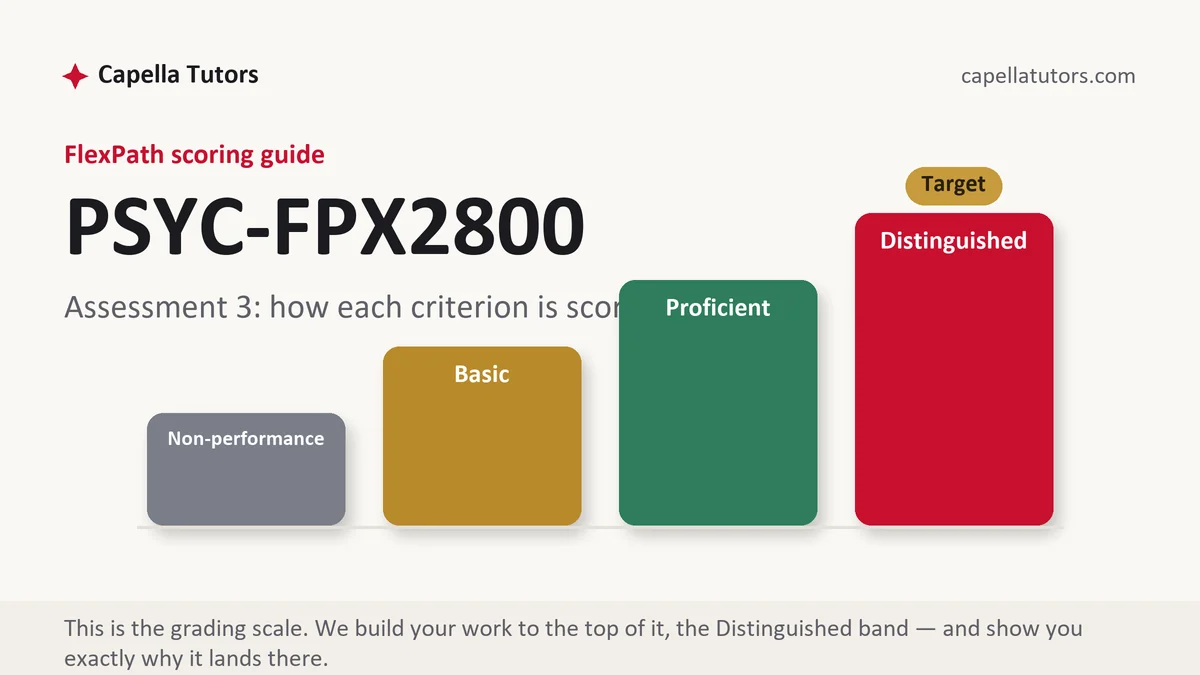
PSYC-FPX2800 Assessment 3 grading scale at Capella FlexPath, the criterion levels this assessment is scored on, from Capella Tutors
How Capella FlexPath grades PSYC-FPX2800 Assessment 3, visualized by Capella Tutors.

How PSYC-FPX2800 Assessment 3 is scored

The four columns do not soften because the writing is for a lay reader. On an educational piece they split along usefulness and evidence together:

LevelWhat it means on an educational piece
DistinguishedThe piece is genuinely usable by the audience the prompt names, every term it needs is defined in that audience's language without losing accuracy, each number is explained before it is printed and reported with the conditions attached, and the research sits visibly underneath in the rationale or the citations. The extra move is telling the reader what the figures do not promise.
ProficientAccurate, readable and sourced, with the numbers correct and the conditions on them left in the background.
BasicEither a course paper with a friendly title, or a cheerful leaflet with no evidence anywhere behind it.
Non-performanceThe named audience is never addressed, or an evidence row has no sources in it to score.

Read the guide for two readers at once. One row asks whether an eighteen-year-old at a folding table could use this, another asks whether a faculty evaluator can see the research under it, and satisfying only one of the two is how this assessment is usually lost.

The PSYC-FPX2800 Assessment 3 method, step by step

  1. Write the reader down before you write anything for them

    Name the audience, what they already believe, the decision in front of them this month, and where they will be standing when they read it. A page someone reads while queueing is a different document from a page a parent reads at a kitchen table, and the guide's audience row is scored on that difference.

  2. Choose the one thing the piece exists to change

    A handout that covers a whole chapter changes nothing, because the reader takes away whatever was easiest to skim. Decide the single message, keep the two facts that carry it, and cut everything you are including to prove that you read the textbook.

  3. Define each term in the reader's language, without losing the term

    Explain first and label second. Say what happens for people using a method in an ordinary year, then say that the tables call this typical use, and the reader keeps both the idea and the vocabulary they will meet at a clinic. Accuracy and plainness compete less often than students assume.

  4. Explain the number before you print it

    Give a frame the reader can hold: out of one hundred people using this for a year, this many would experience the outcome. Percentages without a denominator, a population and a period are read as verdicts rather than as measurements, and a lay document is where that damage actually lands on somebody.

  5. Say what the figures do not cover

    Name the question your number does not answer, because a reader will otherwise assume it does. A figure about preventing pregnancy says nothing about preventing infection, an estimate from one population may not describe another, and every table has a revision year worth printing. This is the sentence that separates a careful piece from a confident one.

  6. Write the rationale for the evaluator, then self-score both halves

    Where your guide allows a rationale, that is where the academic register lives: why this audience, why this message, which sources you used, why each figure was framed as it was, all in current APA with author and date. Then score the piece against the audience rows and the rationale against the evidence rows, separately, since the same criterion set is grading two different documents.

A structure that maps to the criteria

Planning targets our tutors use for an educational deliverable in this course rather than Capella requirements; a guide that asks for a presentation redistributes these across slides and notes.

SectionWhat it must doGuide
The reader and the decisionWho this is for, what they are deciding, and where and how they will read it.~120 words
The single messageThe one thing the piece exists to change, stated in the reader's own words.~150 words
Terms in plain languageEach necessary term explained, then named, so the reader carries both away.~250 words
The numbers, explained then givenA frame per hundred people per year, the figures, and the conditions they depend on.~300 words
What this does not coverThe questions the figures leave open, and the specific place to take them next.~250 words
Rationale and referencesAudience, message and framing defended in academic register, current APA both ways.~200 words

Annotated sample excerpt

An original model excerpt from our team, showing how two numbers get handled in a document a stranger will actually read.

Sample excerpt: the numbers, explained then given Original model · Capella Tutors

Two numbers are printed for every method and they answer different questions: one is how often it fails for people using it across an ordinary year, forgotten days and rushed evenings included, and the other is how often it fails when it is used exactly as directed every time. The tables call the first typical use and the second perfect use.1 Read them like this: out of one hundred people relying on a method for a year, the first number is how many would become pregnant in ordinary life, and the second is how many would if nothing ever went wrong.2 The gap between them is the useful part, because it tells you which methods ask something of you every week and which do not, and the methods whose two numbers stay close are the ones that keep working when life gets busy. None of these figures says anything about protection from infection, which is a separate question with a separate answer, and the estimates here come from a public health agency table with the revision year printed beside it.3

  • 1Both ideas explained before either label appears, so the reader leaves with the meaning and with the words a clinic will use.
  • 2The frame arrives before the figures, per hundred people per year, which is the only form of this number an ordinary reader can act on.
  • 3The comparison stated, one thing the figures do not promise named, and the source given with its revision year. Those three moves keep the evidence rows satisfied inside a lay document.

The full premium sample for your exact assessment, written fresh to your scoring guide and issue, is free to request. Study it, revise it into your own voice, and submit work you understand.

Get the full sample free

The five mistakes that cost Distinguished

  • A course paper with a friendly title. If a sentence needs psychology vocabulary to parse, the audience row is already gone.
  • Sources dropped because the reader is not academic. The evidence criterion does not care who the piece is for, and the rationale still has to show the research.
  • One figure where two are needed. Typical use and directed use answer different questions, so printing a single number is misleading rather than simpler.
  • The alarm register. Fear reads as advocacy, produces a document nobody keeps, and costs the accuracy these criteria are built to score.
  • Nothing said about what the figures leave out. A number that quietly implies protection it never offered is the error most likely to reach a real reader.

Pre-submission checklist

  • The reader, the decision and the length written down before drafting began
  • One message the piece exists to deliver, with the textbook material cut
  • Every term explained in plain language first and named second
  • Each number framed per hundred people per year before the figure is printed
  • What the figures do not cover stated, with the source and its revision year
  • A rationale in academic register, values attributed to their holders, APA matched both ways

Handout due and it still reads like a term paper?

Send the criteria and the audience your prompt names. We write the piece for the reader and the rationale for the evaluator, with every figure explained before it is printed, back in 24 to 48 hours and revised free until both halves clear.

Keep going

Online now