This manual is for PSYC-FPX2800 Assessment 2, start to submission. The middle deliverable in this course usually stops summarizing and starts arguing: a position taken on a question where the public disagreement runs louder than the evidence, and your scoring guide decides whether it arrives as an argumentative paper, an analysis of a policy, or a judgment between two competing claims. The row that sets your grade is the objection, because a paper that answers the other side's best case scores where a paper that answers its worst case does not. Below is the method our tutors use for it, a structure that builds the claim out of the evidence rather than the other way round, and an annotated excerpt from an original model. Prefer to hand it off? Send the prompt and the guide and a premium original sample comes back in 24 to 48 hours, revised free until the criteria clear. Your courseroom may print this as PSYC FPX 2800 Assessment 2 or PSYC2800 Assessment 2; it is the same deliverable, and PSYC-FPX2800 Assessment 2 is what this manual walks through.
One honesty note before the manual: Capella revises courses and scoring guides over time, so always write to the exact scoring guide attached to your assessment in the courseroom. The course identity above is verified on capella.edu; the method and structure below are our tutors' approach to it, not Capella's official rubric text.
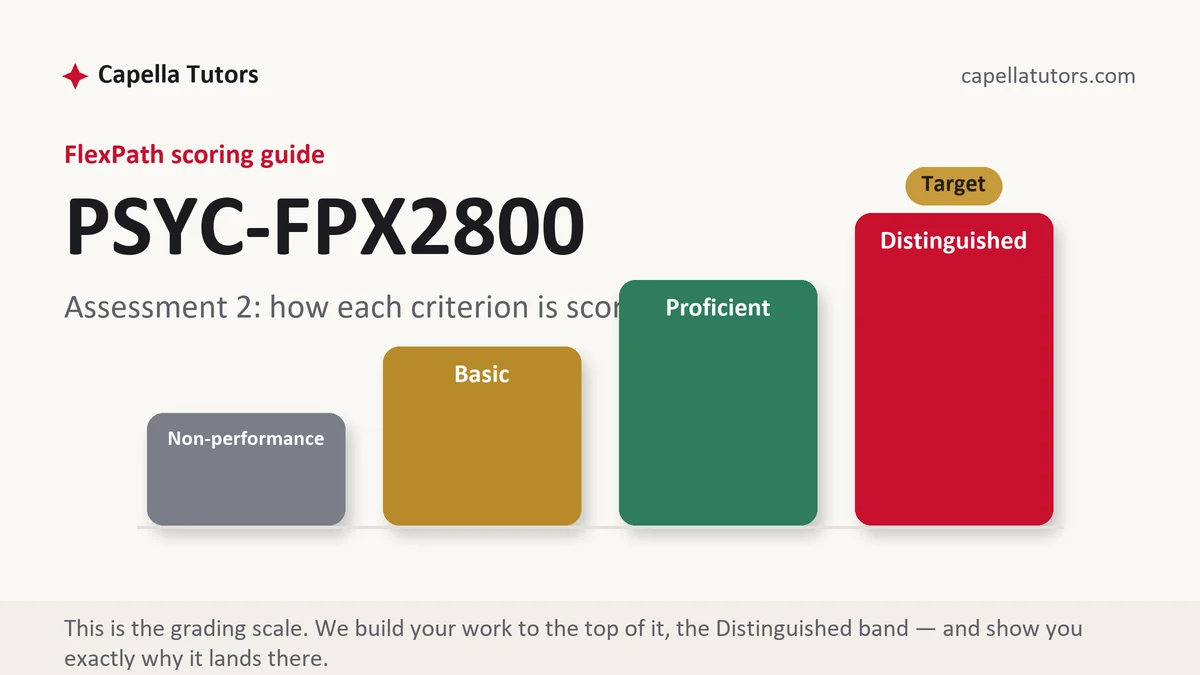
How PSYC-FPX2800 Assessment 2 is scored
Every criterion still lands in one of four columns. On an argued paper the columns follow the argument rather than the topic:
| Level | What it means on an argued paper |
|---|---|
| Distinguished | The claim is arguable in one sentence, the evidence carries it study by study with each design and outcome named, the strongest version of the opposing case is stated fairly and then met, values are attributed to the people who hold them, and the paper says what would change its position. |
| Proficient | A clear claim supported completely from sound evidence, with the opposing view acknowledged rather than answered. |
| Basic | A position asserted first and then supplied with agreeable sources, the other side represented in its weakest available form. |
| Non-performance | No position, no evidence, or no opposing view at all. In this kind of criterion the missing element is nearly always the objection. |
Order matters more than length here. Draft the evidence section before you write the claim, since a claim written first quietly selects its own sources, and these rows reward the reverse sequence.
The PSYC-FPX2800 Assessment 2 method, step by step
-
Turn the topic into a claim someone could refuse
Finish the sentence "I will argue that ___" and check what fills the blank. Sexuality education is a topic and cannot be defended; a named curriculum for a named grade in a named district can be. If your sentence cannot be refused by a reasonable person, it cannot be argued either, and the paper becomes a report.
-
Pick sources for their method rather than their conclusion
Sort what you find by design before you read for agreement: trials with random assignment, cohorts followed over years, systematic reviews that pooled both, and single-site evaluations that pooled nothing. Note which outcome each one measured and whether the program was delivered as written, because a study of a program nobody implemented properly answers a different question.
-
Say what was measured, then how large it was
Knowledge, attitudes, the timing of first intercourse and contraceptive use at last intercourse are four outcomes, and a program can move one without moving another. Write the outcome in plain words, then the direction, then the size, and report a modest effect as modest. A reader who checks your source and finds it smaller than your sentence stops trusting the rest.
-
State the objection the way its holders would state it
Write the version an intelligent opponent would sign, then ask whether the disagreement is empirical or about values, because the two need different answers. A claim that a program does harm is a claim you can test. A claim that parents rather than schools should decide is not, and pretending otherwise is what makes an argument read as advocacy.
-
Answer with evidence, then concede what is fair
Meet the empirical half with studies and the value half in its own currency, whether that is an opt-out, published materials or a decision left with the people whose authority is at issue. Then give ground once, deliberately: name the outcome where your evidence is thin or the population where it does not exist. A conceded limit costs nothing in the columns and buys the credibility the rest of the paper spends.
-
Name what would change your mind, then finish the citations
One sentence describing the finding that would move you demonstrates the judgment the top column asks for. Then check that professional bodies are cited as positions rather than as findings, that advocacy organizations on either side are labeled as such, and that current APA runs in both directions before you self-score each criterion.
A structure that maps to the criteria
Our tutors' planning targets for an argued paper in this course, not Capella rules; a guide that splits the objection into two criteria wants two sections.
| Section | What it must do | Guide |
|---|---|---|
| The question and the claim | The decision on the table, who has to make it, and your position in one refusable sentence. | ~150 words |
| What the evidence measured | The designs available, the outcomes each measured, and what implementation looked like. | ~300 words |
| The case for the claim | Each source doing a named job inside the argument, with sizes and directions reported. | ~300 words |
| The objection, at full strength | The version its holders would recognize, separated into its empirical and value halves. | ~250 words |
| The answer and the concession | Evidence against the empirical half, a procedural answer to the value half, one limit conceded. | ~250 words |
| What would change the claim, and references | The finding that would move you, positions labeled as positions, current APA both ways. | ~150 words |
Annotated sample excerpt
An original model excerpt from our team, showing the paragraph that decides most argued papers in this course.
The strongest objection is not the one usually printed: it holds that a school board rather than a researcher decides what fourteen-year-olds are taught about sex, and that a curriculum conflicting with what many families teach at home costs the district something no trial ever measured.1 That is a claim about authority rather than about effects, and it is owed an answer in its own currency, which here means a retained parental opt-out, the full materials published before the term, and an evening at which any lesson can be read end to end.2 On the empirical half, reviews of school programs report modest effects, larger for knowledge and for contraceptive use than for the timing of first intercourse, and no credible finding that instruction brings that timing forward, which is the specific fear inside the objection; so the defensible sentence is that the evidence favors the comprehensive option on the outcomes anyone has measured while the question of who decides stays with the board.3
- 1The objection appears in the form its holders would sign, and it is the strong version rather than the convenient one. This sentence is most of the distance between the top two columns.
- 2A value objection answered procedurally rather than with a study, because no study settles who holds the authority.
- 3The empirical half reported outcome by outcome with sizes, the one fear behind the objection addressed directly, and the border between evidence and values stated instead of blurred.
The full premium sample for your exact assessment, written fresh to your scoring guide and issue, is free to request. Study it, revise it into your own voice, and submit work you understand.
The five mistakes that cost Distinguished
- A topic standing in for a claim. A subject area cannot be defended or refused, while a specific decision for a specific group can.
- The convenient objection. Answering the weakest version of the other side leaves the row that pays for the strongest one empty.
- Values argued as though they were errors. A disagreement about who decides is not settled by a trial, and treating it as one reads as poor judgment.
- Sizes left off the findings. A modest effect reported as proof invites the reader to check the source, and the check always favors the writer who called it modest.
- Advocacy material used as evidence. Organizations on either side of the question are evidence of a position, and the criteria want them labeled that way.
Pre-submission checklist
- The claim written as one sentence a reasonable person could refuse
- Sources sorted by design, each with the outcome it actually measured named
- Every finding given in plain words with its direction and size before the citation
- The objection stated at full strength and split into its empirical and value halves
- One limit conceded, and one finding named that would change your position
- Professional and advocacy sources labeled as positions, references current APA both ways
Argument due and both sides already shouting?
Send the question and the criteria. We draft the evidence before the claim, write the objection in the form its holders would use, and hand back a position you can defend in 24 to 48 hours, with free revisions until every row clears.