This manual is for PSYC-FPX2800 Assessment 1, start to submission. The opening deliverable in Gender and Human Sexuality usually asks you to examine one topic through the research literature rather than through an opinion, and your scoring guide decides whether that arrives as an analysis, a short paper on a single question, or a written response to material the course supplies. Two rows carry most of the grade here: the one that wants the field's terms used the way the field uses them, and the one that wants every estimate reported with the method that produced it. Below is the method our tutors use for it, a structure that puts definitions before claims, and an annotated excerpt from an original model. Prefer to hand it off? Upload the prompt and the guide and a premium original sample returns inside 24 to 48 hours, revised at no cost until the criteria are met. Your courseroom may print this as PSYC FPX 2800 Assessment 1 or PSYC2800 Assessment 1; it is the same deliverable, and PSYC-FPX2800 Assessment 1 is what this manual walks through.
One honesty note before the manual: Capella revises courses and scoring guides over time, so always write to the exact scoring guide attached to your assessment in the courseroom. The course identity above is verified on capella.edu; the method and structure below are our tutors' approach to it, not Capella's official rubric text.
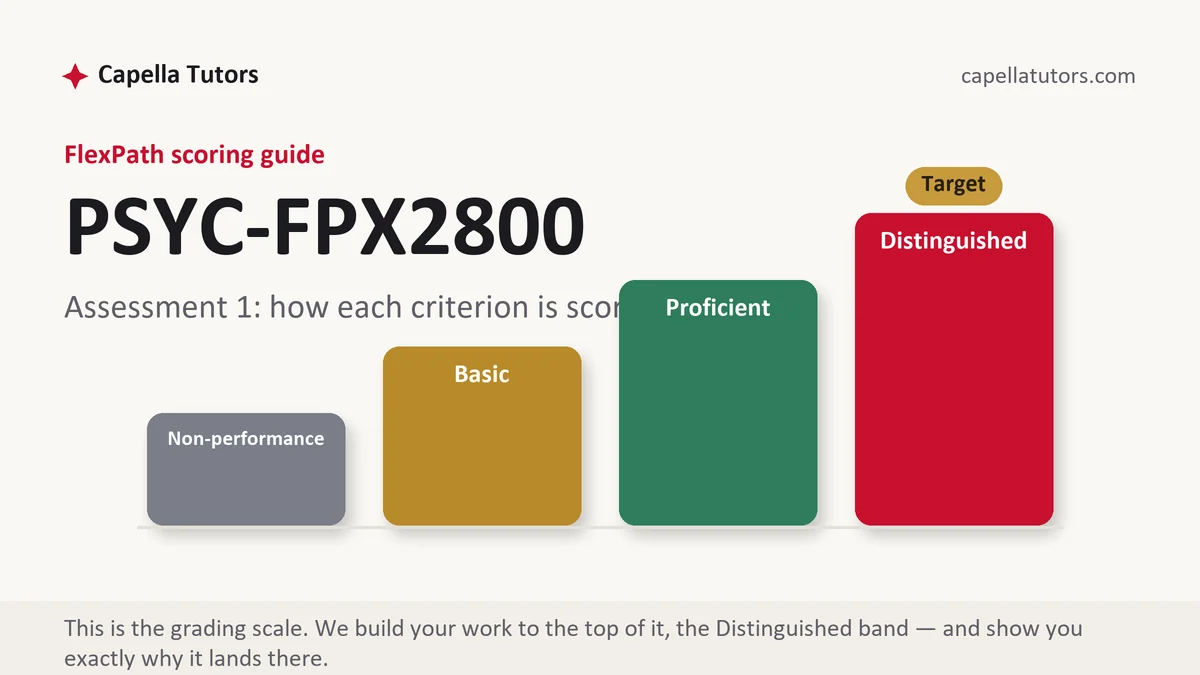
How PSYC-FPX2800 Assessment 1 is scored
There are no letter grades in FlexPath, only four columns applied one criterion at a time. On an analysis in this course the columns are testing vocabulary and method together:
| Level | What it means on an analysis built from the literature |
|---|---|
| Distinguished | Terms are defined before use and held apart for the whole paper, the question is narrow enough that evidence can reach it, each estimate arrives with its sampling, its question wording and its year, and the limits of self-report are stated rather than left to the reader. The extra move is a sentence on what the available evidence cannot establish. |
| Proficient | Correct terms, sound sources and an accurate answer, with the methods behind the numbers summarized rather than examined. |
| Basic | A confident answer resting on a familiar figure, with sex and gender used interchangeably and orientation handled as one quantity. |
| Non-performance | A required element never appears, most often the definitions or the evidence. In this course a single undefined term can put a row on the floor by itself. |
Copy the criteria into a blank document before you read the instructions a second time. The criterion wording in this course routinely names the term it expects you to define, which means the guide is telling you what your first paragraph contains, and students who work only from the prompt write around the easiest row in the assessment.
The PSYC-FPX2800 Assessment 1 method, step by step
-
Define the terms the criteria name, in your own sentences
Sex refers to biological characteristics that do not always align with each other, gender to the roles and expectations a society builds around them, gender identity to a person's own sense of their gender, expression to what others can observe. Orientation is separate again, and it has three components: attraction, behavior and identity. Four sentences, cited, and half the terminology row is closed.
-
Narrow the question until evidence can reach it
How common is something is not yet a question. Which component, in which population, over which period, measured how, is one. The narrowing is not a retreat from the topic, it is the move that lets you cite a study instead of gesturing at a field.
-
Ask what the question asked before you trust the answer
Ask people to accept a label and you get the smallest estimate. Ask about behavior over a lifetime and it rises. Ask about attraction ever experienced and it rises again, since attraction demands nothing of a person's self-concept. Those are three questions rather than three rival findings, which is why a well-run survey reports them separately, and why your sentence has to say which one you mean.
-
Read the sampling, the mode and the wording
A probability sample drawn from a defined population supports a claim about that population; a voluntary poll supports a claim about whoever answered. Private self-administered answering collects more disclosure of stigmatized behavior than an interview across a table. An undefined term in a survey item is answered differently by every respondent. Report all three in your own words rather than trusting an abstract.
-
Write it plainly, then the figure, then the two biases
Say the finding in one sentence a reader outside the course could follow, then give the number with its population and year, then name the pressures on it: sensitive questions collect underreporting where privacy is thin, and samples recruited around a topic overrepresent the people the topic already concerns. Those pressures run in opposite directions, which is worth one clause of its own.
-
Run terminology and APA as two separate passes, then self-score
One sentence using orientation to mean identity can undo three careful pages, so read once for slippage and nothing else. Then read for citations: author and date in the text, the survey named with the year the data were collected rather than the year you read it, older categories quoted as the study wrote them with the classification noted, and current bias-free language guidance checked where you are unsure. Then mark every criterion D, P, B or N and fix anything short of the top.
A structure that maps to the criteria
Planning targets our tutors use for an analysis in this course rather than Capella requirements; where your guide makes a criterion of one line below, that section grows.
| Section | What it must do | Guide |
|---|---|---|
| Question and terms | The question stated narrowly, and every term the criteria name defined and cited before it is used. | ~200 words |
| What has actually been measured | Which component of the topic the literature reports, and in which populations. | ~250 words |
| Methods behind each estimate | Sampling, mode, question wording, sample size, recall window and year, one study at a time. | ~300 words |
| The pattern once measured properly | The answer your evidence supports, in plain words first and with the figures attached second. | ~250 words |
| Limits and what stays open | What self-report cannot settle, where the samples run out, and which question the field has not answered. | ~200 words |
| Register and references | Values attributed to their holders, clinical terms kept for clinical claims, current APA both ways. | ~120 words |
Annotated sample excerpt
An original model excerpt from our team, showing how an evidence paragraph reads when a number is taken apart rather than repeated.
The claim on the residence hall noticeboard is that most students here have had four or more partners, and its source is a voluntary online poll, forwarded by link, answered by roughly a fifth of the people it reached.1 Stated plainly, that poll can support a sentence about the students who chose to answer it and nothing wider, because volunteers on a sexual topic are recruited by their interest in it, the denominator stops being knowable once a link is forwarded, and the item offered no definition of partner, so each respondent supplied one.2 The comparison that matters is the set of national probability surveys of sexual behavior, which report attraction, behavior and identity as separate items and collect answers privately rather than face to face, since disclosure of stigmatized behavior falls when an interviewer is present; cited with their collection years, they place the noticeboard figure well outside the range the better evidence describes.3
- 1The claim and its source in one sentence, with the response rate attached. A figure whose denominator is unknown cannot be evaluated, and saying so is the first evidence move available.
- 2Sampling, denominator and question wording examined separately. Wording is the one students skip, and an undefined term collects a different answer from every person who reads it.
- 3Better evidence named with its design, the three components kept apart, and mode reported because mode changes disclosure. The comparison does the arguing, so no adjective is needed.
The full premium sample for your exact assessment, written fresh to your scoring guide and issue, is free to request. Study it, revise it into your own voice, and submit work you understand.
The five mistakes that cost Distinguished
- Sex and gender used as synonyms. The criteria read the swap as missing subject knowledge rather than as a matter of style.
- Orientation reported as one quantity. Attraction, behavior and identity are three measurements, and merging them leaves your number impossible to defend.
- A percentage with no denominator and no year. Without the population, the response rate and the collection date, a figure is decoration.
- Question wording passed over. An undefined term inside a survey item produces as many definitions as it has respondents, and this row exists to catch it.
- Euphemism. Vague phrasing reads as discomfort and costs precision, while clinical terms used for clinical claims read as competence.
Pre-submission checklist
- Every term the criteria name defined and cited before its first use
- The question narrowed to one component, one population and one period
- Each estimate reported with its sampling, mode, wording and collection year
- Probability and voluntary samples labeled as such, with claims kept inside them
- Each finding written in plain words before any figure appears
- One pass for terminology slippage, one for current APA, references matched both ways
One paragraph in and the terms already tangled?
Upload the prompt with its criteria attached. A research analyst pulls estimates that state their own sampling, the writer defines every term your guide names, and the draft comes back in 24 to 48 hours after a dedicated terminology pass, with free revisions until the rows clear.