This manual is for PSYC FPX 2740 Assessment 3, start to submission. The closing deliverable in this course usually turns the evidence back on the writer: an assumption about later life named, tested against research, and followed by something you would do differently, and your scoring guide decides whether that arrives as a reflection with sources attached, a plan for supporting one adult, or both inside one document. The row students underwrite is always the same one, because good will reads as an opinion while a named habit with a named replacement reads as an answer. Below is the method our tutors use for it, a structure that carries an assumption through to a behavior, and an annotated excerpt from an original model. Prefer to hand it off? Send the prompt and the guide and a premium original sample arrives in 24 to 48 hours, revised free until every criterion clears. Capella's catalog lists the course as PSYC-FPX2740, and some courserooms print PSYC2740; both point to this same Assessment 3.
One honesty note before the manual: Capella revises courses and scoring guides over time, so always write to the exact scoring guide attached to your assessment in the courseroom. The course identity above is verified on capella.edu; the method and structure below are our tutors' approach to it, not Capella's official rubric text.
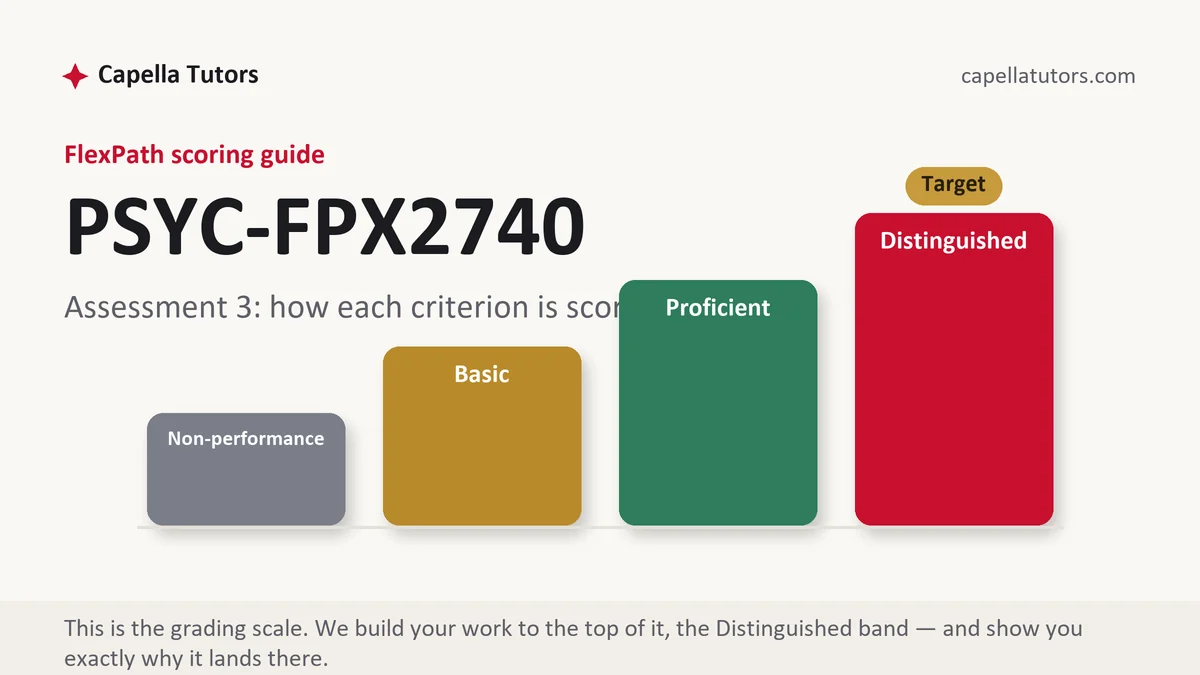
How PSYC FPX 2740 Assessment 3 is scored
Each criterion still lands in one of four columns, and a reflection is graded as strictly as an analysis. What the columns are looking for is specificity:
| Level | What it means on a reflection with a plan attached |
|---|---|
| Distinguished | The assumption is stated in a sentence a reader could argue with, its origin is identified, a cited figure is set against it, and the change proposed is a behavior with a start date and a way of noticing whether it worked. The extra move is naming what the evidence leaves unsettled. |
| Proficient | An honest reflection with the research reported correctly and a general commitment to do better attached to it. |
| Basic | A statement of respect for older adults, sincerely meant, with nothing checked against evidence and nothing to be done on Monday. |
| Non-performance | No assumption is identified, or a row that asks for evidence contains none. Sincerity is not a substitute for either. |
These rows are scored on precision rather than on agreement, so an assumption you have since dropped is worth more on the page than a virtue you always held. Nothing in the column asks you to disclose anything private, and a habit noticed in your own voice is enough material for the whole criterion.
The PSYC FPX 2740 Assessment 3 method, step by step
-
Find an assumption you genuinely held
Two tests decide whether it is usable: a reasonable person could disagree with it, and research could show it wrong. Most older adults are lonely passes both. Older people deserve respect passes neither, since nobody in the room disputes it and no study can correct it.
-
Trace the assumption to something you can point at
Origins that score are concrete: a grandmother's move into care when you were twelve, the way a former employer talked about retirement, the only sixty-year-olds on the television you grew up with. Blaming the culture in general is the sentence that turns this row into filler.
-
Test it against one figure you can cite
Pick the statistic that speaks directly to the belief, and take it from the agency that collected it rather than from an article quoting it. Living arrangements, labor force participation, disability and caregiving all have official sources, and every one of them needs the collection year in your citation because these numbers move between releases.
-
Say what the evidence does not overturn
Wellbeing across adulthood holds up better than students expect, and slower movement, hearing loss, thinning networks and the deaths of contemporaries are still real and still cumulative. A paper that answers low expectations with unbroken positivity has swapped one distortion for another, and the top column notices.
-
Convert the correction into a behavior with a measure
Name the habit, name the replacement, then name what you would count. Research on age stereotypes reports that the slow, loud, simplified register adults adopt around older people without noticing has measurable effects on performance and on how the listener sees themselves, which makes speaking at ordinary pace a change worth writing down rather than a courtesy.
-
Keep APA and consent intact, then self-score
First person does not suspend citation rules, so every figure keeps its source and its year, an interview is cited the way your APA guide handles personal communication, and your own experience needs no citation at all. Where a real adult appears, get their agreement, use a role rather than a name, then mark each criterion D, P, B or N and rewrite anything short of the top.
A structure that maps to the criteria
Our tutors' planning targets for a reflection with a plan in this course, not Capella rules; wherever your guide splits one of these into two criteria, split the section too.
| Section | What it must do | Guide |
|---|---|---|
| The assumption | State the belief in one arguable sentence, and say where you noticed you were holding it. | ~150 words |
| Where it came from | The specific experiences, people, work and media that built it, dated where you can date them. | ~200 words |
| The evidence against it | One or two figures with their collection years, plus the shape of the distribution rather than a lone average. | ~300 words |
| What the evidence leaves standing | The losses that are real, so the correction reads as accuracy rather than as cheerfulness. | ~200 words |
| The behavior and the plan | The habit replaced, what is offered rather than imposed, what gets counted, and what would show it backfiring. | ~300 words |
| Ethics and references | Consent and anonymity for any real adult, the boundary of your role, current APA both ways. | ~120 words |
Annotated sample excerpt
An original model excerpt from our team, showing what a reflection row looks like when it is written to be scored.
Before this course I assumed that most people past eighty live in nursing homes, and I can date the assumption to one visit at nineteen, when the only building I had ever entered on account of old age was one.1 National data put the share of adults sixty-five and over living in nursing facilities in the low single digits, rising steeply among the oldest group and still leaving the large majority in ordinary housing, and I cite the collection year because the figure has shifted across releases.2 The habit that assumption produced is one I heard in my own voice at a community exercise class: I greeted a woman of eighty-four at half speed, at volume, in four-word sentences, and she answered me at an ordinary pace. From the next session I speak to that class the way I speak to anyone, I ask before moving a chair, and I am counting how often the offer of help is declined.3
- 1An assumption a reader could dispute, with an origin that has a date and a place. Vague sourcing is what makes most reflections impossible to score.
- 2One figure, cited with the year the data were collected, and the shape of the distribution reported rather than a single share. That last clause is an APA habit as much as a statistics habit.
- 3The correction lands as one replaced behavior with something countable attached, which is the whole distance between a row that scores and a row that merely sounds decent.
The full premium sample for your exact assessment, written fresh to your scoring guide and issue, is free to request. Study it, revise it into your own voice, and submit work you understand.
The five mistakes that cost Distinguished
- An assumption nobody would contest. Naming a belief you never doubted leaves the evidence section with nothing to do.
- The culture blamed for the origin. This row wants a source you can point at, a family remark, a workplace, a first visit to a facility.
- Optimism standing in for evidence. Answering low expectations with relentless good news trades one distortion for another, and the real losses stay real.
- A commitment with no behavior inside it. Dignity is a value; ordinary speaking pace and asking before helping are actions an evaluator can score.
- First person treated as citation-free. A reflection still runs on current APA, and every figure in it still needs its source and its year.
Pre-submission checklist
- The assumption written in one sentence a reader could argue with
- Its origin identified specifically rather than attributed to society at large
- At least one figure cited to the body that collected it, with the collection year
- What the evidence does not overturn stated, so the correction is not a swing to cheerfulness
- One habit named, one replacement described, and one countable signal attached
- Consent and anonymity handled for any real adult, references current APA in both directions
Reflection row due and the page still blank?
Send the criteria and one sentence about what you used to assume. We build the row the way it is graded: the origin, the sourced figure that tests it, the limit on the correction, and a behavior change worth submitting, back in 24 to 48 hours with free revisions until the rows clear.