This manual is for PSYC FPX 2740 Assessment 2, start to submission. The middle deliverable in this course usually stops describing an adult and starts weighing an influence on later life, and your scoring guide decides which influence is on the table: health, sensory function, work and retirement, money, housing, or the people around the adult. The rows that separate the columns here are mostly about numbers, whether an ability was reported by type or in one lump, whether an average came with the spread around it, and whether the study design behind the figure was ever named. Below is the method our tutors use for it, a structure that carries evidence with its design attached, and an annotated excerpt from an original model. Prefer to hand it off? Upload the prompt and the guide and a premium original sample lands inside 24 to 48 hours, revised free until the criteria are satisfied. Capella's catalog lists the course as PSYC-FPX2740, and some courserooms print PSYC2740; both point to this same Assessment 2.
One honesty note before the manual: Capella revises courses and scoring guides over time, so always write to the exact scoring guide attached to your assessment in the courseroom. The course identity above is verified on capella.edu; the method and structure below are our tutors' approach to it, not Capella's official rubric text.
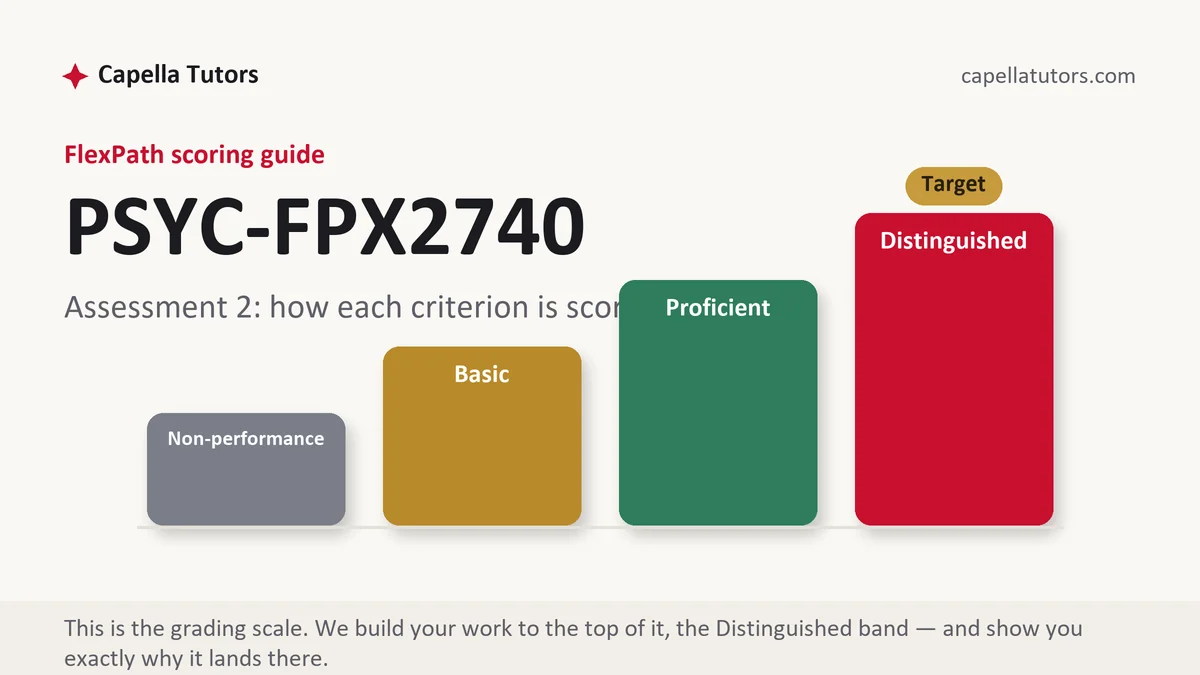
How PSYC FPX 2740 Assessment 2 is scored
Four columns, no letter grades, one column per criterion. On an evaluation the columns are testing how carefully you handle other people's numbers:
| Level | What it means on an evaluation of an influence |
|---|---|
| Distinguished | The influence is defined narrowly enough to be judged, abilities are reported by type rather than in aggregate, each average arrives with its spread and the design that produced it, and a competing explanation is ruled in or out on stated evidence. The extra move is usually a sentence on what the evidence still cannot settle. |
| Proficient | An accurate evaluation from sound sources, with averages reported and the spread around them left implied. |
| Basic | A general account of decline in later life carried by a remembered statistic, with no design behind it and no judgment attached. |
| Non-performance | The influence is described instead of evaluated, or the evidence section never appears, and a row with nothing in it to score sits on the floor. |
Read the verb in each criterion before you write to it. Describe, apply, evaluate and recommend are four different jobs, and an evaluation row wants a judgment with the evidence for and against it visible, which is how a well-organized summary of the literature still lands at Basic.
The PSYC FPX 2740 Assessment 2 method, step by step
-
Narrow the influence until it can be judged
Health is not an influence you can evaluate; six years of hearing loss with the aids never collected is. Write the influence, the function it acts on, the adult it acts on, and the period involved, all in one sentence, and every later criterion gets easier to satisfy.
-
Report ability by type before you report anything else
The abilities that depend on speed and on holding new material while working with it decline gradually on average from midlife. Vocabulary and accumulated knowledge hold, and often keep improving into later life. A criterion about cognition is asking for that split, and one sentence covering both directions is worth more than a paragraph of general decline.
-
Say it in plain English, then give the number
Write the finding the way you would tell a family member, then attach the figure and the citation behind it. Undergraduate papers lose evidence rows by leading with a statistic nobody can interpret, and this order also exposes the sentences where you do not yet know what your own number means.
-
Give every average its spread
An average with nothing around it reads as a statement about everybody in the group, which is almost never what the study found. Report the range or the overlap alongside the mean, because the distributions of younger and older adults overlap heavily on the very measures said to fall, and that overlap is why a group average cannot predict the adult in your case.
-
Name the design and its bias in the same sentence as the figure
A comparison of different age groups tested once and a study following the same adults for thirty years produce different numbers, and both are biased in known directions: repeated testing gives participants practice and the healthiest ones stay in the study, while a single comparison absorbs every difference between the birth years involved. Say which design your figure came from and what that does to it.
-
Rule the rival explanation in or out, then keep your role
Uncorrected hearing, a new medication, low mood, pain and broken sleep can all produce what a family reads as memory loss, so name the two most plausible rivals and the observation that would separate them. Then self-score each criterion and stop where your role stops, since an undergraduate paper compares with typical ranges and refers assessment to the adult's clinician.
A structure that maps to the criteria
Planning numbers from our tutors for an evaluation in this course, not Capella rules. Where your guide makes a criterion of something below, give it room.
| Section | What it must do | Guide |
|---|---|---|
| The influence and the question | Which influence, acting on which function, for which adult, across what period. | ~150 words |
| Ability reported by type | Speed and working memory kept separate from vocabulary and accumulated knowledge, each with a source that names its ages. | ~250 words |
| Averages, spreads and designs | Each figure in plain words first, then the number, the spread around it, and the design that produced it. | ~300 words |
| Competing explanations | The rivals that would produce the same appearance, and the evidence that would decide between them. | ~250 words |
| What follows for this adult | The change worth making, who is qualified to make it, and what would be watched over what interval. | ~200 words |
| Limits and references | What the evidence cannot settle, where your role ends, current APA matched in both directions. | ~120 words |
Annotated sample excerpt
An original model excerpt from our team, showing how an evidence paragraph reads when the numbers are handled properly.
The family's account is that H, seventy-one, is losing his memory; the record shows a hearing test failed six years ago and aids fitted, paid for, and never worn.1 Put plainly, the research does not describe one mind declining together: the abilities that depend on speed and on juggling new information slip gradually from midlife on average, while vocabulary and accumulated knowledge hold or improve, so a single line labeled memory is not a finding anyone reported.2 Those averages also hide their own spread, since the scores of younger and older adults overlap heavily on the measures said to fall, and the studies that follow the same adults for decades report later and gentler change than one-off comparisons between age groups, the first flattered by practice on a repeated test and by the healthiest participants staying, the second inflated by everything that differs between birth years.3
- 1The influence is narrowed to one thing with a date on it, and the family's interpretation is reported as theirs rather than adopted as the conclusion.
- 2Plain English arrives before any figure, and ability is split by type. A cognition row in this course is asking for exactly that split.
- 3The spread is stated rather than implied, and each design carries its bias in the same clause. Two sentences here answer a criterion most drafts leave open.
The full premium sample for your exact assessment, written fresh to your scoring guide and issue, is free to request. Study it, revise it into your own voice, and submit work you understand.
The five mistakes that cost Distinguished
- One number for the whole mind. Speed-dependent and knowledge-based abilities move in different directions, and an aggregate figure hides both of them.
- An average with no spread. A mean on its own reads as a claim about every person in the group, which is how a paper ends up predicting one adult from a group figure.
- The design left unnamed. A single comparison of age groups and a decades-long study of the same adults are not interchangeable, and the row wants to know which one produced your number.
- The confound never examined. Hearing, medication, mood, pain and sleep can each produce the appearance the paper is attributing to the influence.
- Evaluation written as summary. An orderly account of what the literature says is description, and this row asks what you conclude and on what basis.
Pre-submission checklist
- The influence stated narrowly, with the function and the period it covers
- Abilities reported by type, each with a source that names the ages it studied
- Every finding written in plain words before the figure appears
- Each average given with its spread or the overlap between groups
- The design behind each number named, with its known bias in the same sentence
- Two rival explanations weighed, the recommendation kept inside your role, APA matched both ways
Evaluation row due and no numbers you trust?
Send the guide and the influence you were assigned. Our research analyst pulls figures that state their design and their sample, the writer reports each one in plain English with its spread, and the draft returns in 24 to 48 hours with free revisions until the rows clear.