This manual is for PSYC FPX 2740 Assessment 1, start to submission. The opening deliverable in Adult Development and Aging usually asks you to analyze one adult's situation with research attached, and your scoring guide decides whether that arrives as a case study, a written profile, or an analysis of material the course supplies. The rows that decide the grade are the ones most first drafts skip: what in this life is aging and what is illness, what the adult is actually up against, and which sentence rests on a study rather than on a familiar assumption about older people. Below is the method our tutors use for it, a structure that keeps age and illness apart, and an annotated excerpt from an original model. Prefer to hand it off? Send the prompt and the guide and a premium original sample comes back in 24 to 48 hours, revised at no charge until every row clears. Capella's catalog lists the course as PSYC-FPX2740, and some courserooms print PSYC2740; both point to this same Assessment 1.
One honesty note before the manual: Capella revises courses and scoring guides over time, so always write to the exact scoring guide attached to your assessment in the courseroom. The course identity above is verified on capella.edu; the method and structure below are our tutors' approach to it, not Capella's official rubric text.
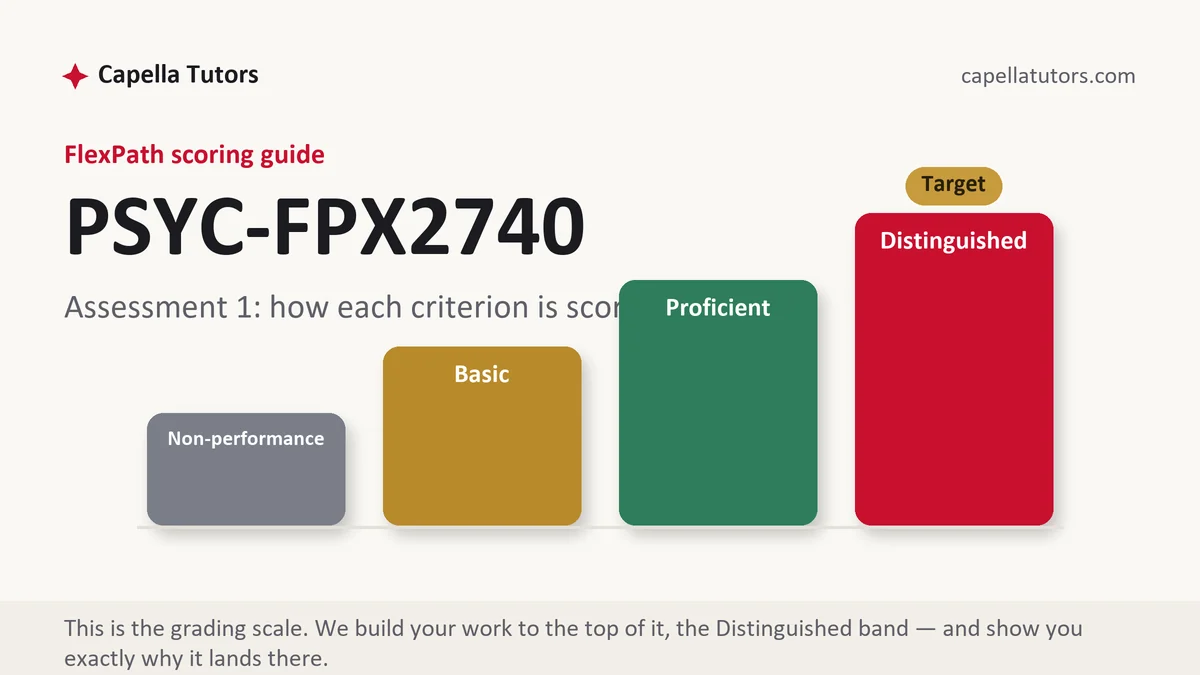
How PSYC FPX 2740 Assessment 1 is scored
FlexPath has no letter grades. Every criterion on your guide lands in one of four columns, and on a case analysis the columns test whether the explanation was built out of the case or out of what you expected the case to contain:
| Level | What it means on a case analysis of an adult |
|---|---|
| Distinguished | Aging and illness are separated inside the description, the demand on the adult is named before it is explained, coping is read against what can and cannot be changed, and each general claim arrives with the ages the study covered. The top column also wants one rival account of the same facts. |
| Proficient | An accurate case with a theory correctly applied and one reading offered. Complete, and short of the competing explanation the guide pays extra for. |
| Basic | A sympathetic summary in which age itself is doing the explaining, with adjectives standing where evidence belongs. |
| Non-performance | A required element is simply absent, most often the theory or the sourced expectation. Absence rather than weakness is what puts a row on the floor. |
Read all four columns once before drafting. Basic and Proficient often describe the same paper written with different amounts of care, while the step up to Distinguished is nearly always one named move you can plan for, and finding it before you draft saves a revision cycle later.
The PSYC FPX 2740 Assessment 1 method, step by step
-
Turn the guide into headings before writing a sentence
Instructions describe the paper; criteria award the points. Paste each criterion into your outline as a heading, copy the top-column wording underneath it, then write the adult's age and health beside every heading. Sixty-two and eighty-four both count as later adulthood, and almost nothing is equally true of the two.
-
Split the age from the illness on the first pass
Take each difficulty in the case and ask whether it belongs to gradual change everyone meets, to a diagnosed condition, or to years without use. Reading a menu at arm's length is one thing, a knee that has hurt since a fall is another, and filing both under aging loses the row that asks for the difference.
-
Name the demand precisely before you explain the person
Write down what the adult is dealing with in specifics: what the task is, how often it recurs, how long it has run, what it costs, and who else is available. A demand described that precisely can be analyzed. A demand described as stress can only be sympathized with, and sympathy is not a criterion.
-
Use the appraisal model in its own order, then evidence both halves
Richard Lazarus and Susan Folkman put two questions in sequence, what is at stake here and what do I have to meet it with, and coping follows from those answers rather than from personality. Carry the adult's own words for the first question, then show the second in behavior: a call made, a shift dropped, a task handed to a relative, an hour taken back.
-
Match coping to controllability instead of ranking it
Undergraduate drafts routinely score problem-focused coping as strong and emotion-focused coping as weak. The literature does not, since fit is what predicts outcomes: changing the situation works where the situation can be changed, and managing the reaction is the fitting response to a condition nobody can reverse. Say which kind of stressor you have, then judge the coping against it.
-
Self-score every row, then stop at the professional line
Mark each criterion D, P, B or N yourself and rewrite anything under a D. Read once more for sentences drifting toward diagnosis, because an undergraduate case analysis compares a person with typical ranges and refers the rest to a clinician. Submit early in the week, since an evaluation can take two business days and Thursday work can sit until Monday.
A structure that maps to the criteria
The word targets below are our tutors' planning numbers for a case analysis in this course rather than Capella rules; expand any section your guide treats as a separate criterion.
| Section | What it must do | Guide |
|---|---|---|
| The adult and the situation | Age, health, living and working arrangements, who is nearby, and the demand under analysis. | ~150 words |
| Aging, illness and disuse separated | Each difficulty assigned to gradual change, to a condition, or to inactivity, with the reason for the assignment. | ~250 words |
| Appraisal and coping | What is at stake, what resources exist, and the coping shown in specific actions rather than asserted. | ~350 words |
| Resources and relationships | Network size and who does the initiating, practical help, money, work status, and services within reach. | ~250 words |
| Rival reading and limits | The competing explanation for the same facts, and what one account of one adult cannot establish. | ~200 words |
| Ethics and references | Consent where a real person is involved, a role rather than a name, current APA matched in both directions. | ~120 words |
Annotated sample excerpt
An original model excerpt from our team, showing the register a description section is graded on in this course. Learn the moves, then write your own adult.
C is sixty-four, works four days a week in a school office, and has managed her husband's care at home since a stroke fourteen months ago left his left arm weak and his speech effortful.1 She holds restaurant menus at arm's length and has moved a lamp to the kitchen counter, which is ordinary change in the lens rather than a symptom of anything; the shoulder waking her at three most mornings dates from a tear and eight months without the physiotherapy she was referred for, which is not aging at all.2 Asked what worries her, she said, "I can manage the lifting, I cannot manage the phone calls," and within the same fortnight she cut her week to four days, wrote out the medication schedule so a daughter could cover Thursdays, and left an insurance appeal unopened for three weeks.3
- 1Age, work and the demand in two clauses, with the demand dated. Specific enough to be appraised later instead of summarized as a hard year.
- 2Two difficulties assigned separately, one to gradual change and one to an injury left untreated. This is the row most drafts merge, and separating it costs two sentences.
- 3Her own words carry the appraisal, and the coping is shown in what she did. One of those three actions is avoidance, which the analysis can use rather than hide.
The full premium sample for your exact assessment, written fresh to your scoring guide and issue, is free to request. Study it, revise it into your own voice, and submit work you understand.
The five mistakes that cost Distinguished
- Age doing the explaining. Most of what a case files under aging turns out to be a condition, a medication or years of disuse, and this criterion is built to catch it.
- Stress described rather than appraised. A paragraph about how hard the situation is earns nothing until the demand, the stakes and the resources sit on the page separately.
- Emotion-focused coping marked down. Where a situation cannot be altered, managing the reaction is the fitting response, and the row wants fit rather than a ranking.
- One reading left unchallenged. The move between the top two columns is the competing account of the same facts, plus the detail that would decide between them.
- Evidence from the wrong decade. A finding drawn from adults over eighty-five does no work in a criterion about someone twenty years younger.
Pre-submission checklist
- Every criterion has its own labeled section, with the adult's age written beside it
- Each difficulty assigned to gradual change, to a condition, or to disuse, with a reason
- The demand named with its frequency, its duration and the help available
- Appraisal carried in the adult's own words, coping shown in specific actions
- One rival explanation examined, with what a single case cannot establish stated plainly
- Current APA both ways, and every source drawn from the age range you are writing about
Case due and the scoring guide still unread?
Send the prompt, the criteria and whatever you can share about the adult. A research analyst pulls age-matched evidence while a writer builds the case around your criteria, eight people touch the draft, and it returns inside 24 to 48 hours written to the top column with revisions until the rows clear.