This manual is for PSYC FPX 2720 Assessment 3, start to submission. The closing deliverable turns analysis into advice: an adult who deals with adolescents needs something to do differently next week, and the criteria want that advice to come out of research rather than out of common sense. Your scoring guide decides the audience, a parent, a teacher, a coach or a program, and how much of the recommendation must be sourced. What carries this one is comparison, because a parenting practice that works in the setting it came from can land differently where a family now lives. Below is the method, a structure keyed to the rows, and an annotated excerpt. Want it written with backup? A premium original sample lands in 24 to 48 hours, revised free until your guide is met. Capella's catalog lists the course as PSYC-FPX2720, and some courserooms print PSYC2720; both point to this same Assessment 3.
One honesty note before the manual: Capella revises courses and scoring guides over time, so always write to the exact scoring guide attached to your assessment in the courseroom. The course identity above is verified on capella.edu; the method and structure below are our tutors' approach to it, not Capella's official rubric text.
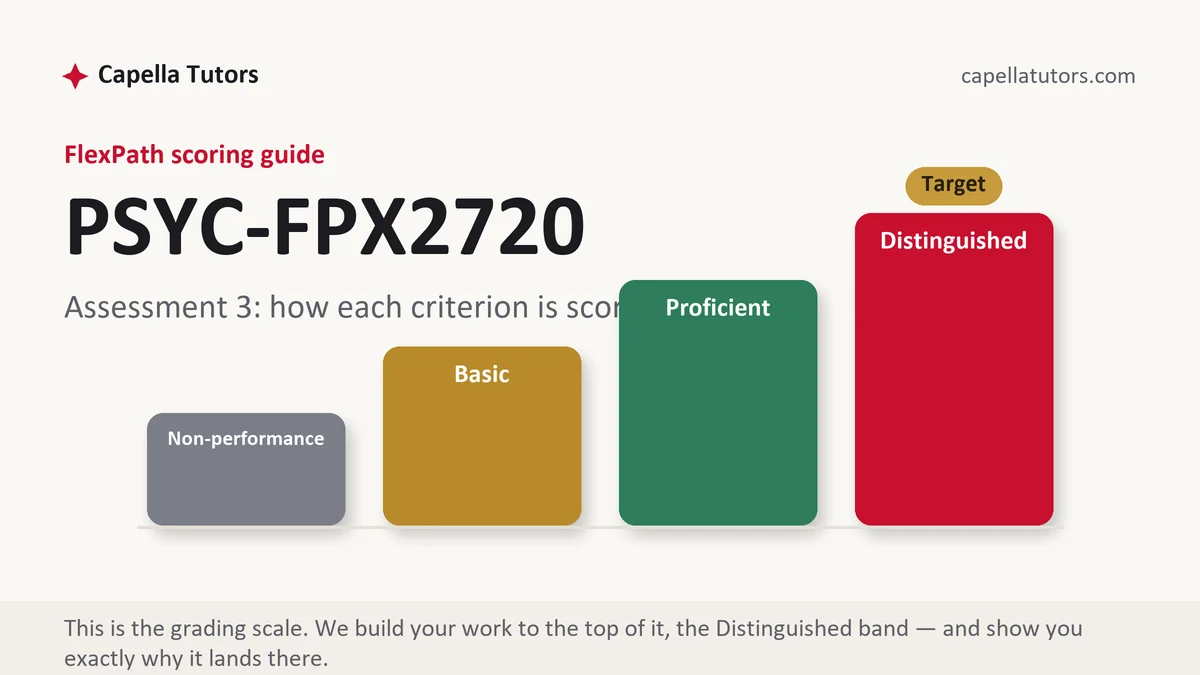
How PSYC FPX 2720 Assessment 3 is scored
Four levels, one per criterion, and no letter grade anywhere. The level descriptions tell you what to write, so read them before the instructions:
| Level | What it means on a recommendation written for an adult |
|---|---|
| Distinguished | Each recommendation names the adult's action, its timing and what would count as it working, and the evidence behind it is reported with its limits. |
| Proficient | Sound recommendations, correctly sourced, with the measure and the timeline left implicit. |
| Basic | Advice that describes a desired outcome rather than an action. Communicate more and set clear boundaries are wishes, and wishes cannot be measured. |
| Non-performance | A required element is absent, most often the evidence for the recommendation or the audience the row named. |
Comparison rows carry a second trap. A practice can be described, sourced and compared without being ranked, and the criteria want the description rather than the verdict. Report what the practice is for, where it is common, what outcomes travel with it in each setting, and how much of the difference the studies can attribute to the practice itself.
The PSYC FPX 2720 Assessment 3 method, step by step
-
Start from the rows that name an audience
Find every criterion that says parent, teacher, coach or program, because those rows decide the paper's voice and half its content. Advice written to nobody in particular reads as an essay about adolescence and scores like one. Write the audience at the top of the draft and keep the second person out of the analysis sections.
-
Describe the practice as its users would recognize it
State what the practice consists of, who does it, how often, and what it is understood to accomplish in the setting it comes from. A description a parent from that community would recognize is the condition for everything after it, and one built from stereotype fails the comparison row however many sources sit underneath.
-
Compare on outcomes, not on virtue
Put the two settings side by side on the same measures: what the practice is asked to do, and what the research reports where it is common and where it is unusual. Then be explicit that a difference between two communities carries every other difference between them along with it.
-
Read the effect size and its interval before you write the claim
Most associations you will cite here are small, and the interval around them often spans values that would not change anyone's advice. Report the effect as the study reported it, give the interval where it exists, and say plainly when the honest summary is that the practice matters less than the relationship it sits inside.
-
Convert the finding into adult behavior
Write each recommendation as an action with an owner, a setting and a frequency: what the adult does, when, in response to what. Then attach the measure. The research at this age favors arrangements that raise what an adolescent volunteers over arrangements that raise what an adult can check.
-
Name the signal that would tell you to stop
Every plan needs the observation that would show it doing harm: information drying up, the adolescent going quiet, conflict spreading from one topic to all of them. Naming it is the row about limitations, and it is the difference between advice an adult trusts and advice they quietly abandon.
A structure that maps to the criteria
Use these as planning weights for a paper of this kind rather than as limits, and give whichever row your guide scores hardest the extra words it needs.
| Section | What it must do | Guide |
|---|---|---|
| Introduction and audience | Who the advice is for, the adolescent's age and situation, and the practice in question. | ~150 words |
| The practice described | What it consists of, who performs it, how often, and what it is meant to achieve in its own setting. | ~200 words |
| Comparison across settings | The same practice in the second setting, with outcomes reported on the same measures and the confounds named. | ~300 words |
| What the evidence supports | Effect sizes and intervals as the studies reported them, with association language where the designs were correlational. | ~250 words |
| Recommendations | Two or three actions, each with an owner, a timing, a measure and the finding it follows from. | ~300 words |
| Limits and references | What would show the plan failing, what a comparison cannot settle, current APA both ways. | ~150 words |
Annotated sample excerpt
An original excerpt from our writers, showing how a recommendation row reads when the evidence is doing the work.
The practice at issue is chaperoned socializing: in the community where this father grew up, a sixteen-year-old daughter's outings were attended by an older cousin or aunt, and the arrangement carried no suggestion of distrust.1 At her current school the same rule marks her out, and the studies reporting worse outcomes alongside strict parental control were largely run where the practice is unusual, with small associations that weaken once the local norm is accounted for, so the finding does not transfer intact.2 The recommendation is therefore not to drop the practice but to change what it is for: he keeps the requirement that he knows the address and the company, replaces the attending relative with a fixed check-in and an agreed pickup time for two months, and reads success as her volunteering plans rather than complying with them.3
- 1States the practice in the family's own terms and records the meaning it carries at home, which keeps a comparison from becoming a ranking.
- 2Puts the effect size, the moderator and the sampling into one sentence, so the advice rests on what the evidence can bear.
- 3Advice as adult behavior, with an owner, a window and a measure, and the measure is disclosure rather than obedience because that is what the research supports.
The full premium sample for your exact assessment, written fresh to your scoring guide and issue, is free to request. Study it, revise it into your own voice, and submit work you understand.
The five mistakes that cost Distinguished
- Advice addressed to the adolescent. A recommendation the teenager would have to implement is not a plan; the adult can change the setting.
- A practice ranked instead of compared. The row wants what the practice does in each setting, not a verdict on the community it came from.
- Cause read off a cross-national difference. Two settings differ in everything at once, which is why these comparisons describe well and explain badly.
- An effect size left out of the sentence. A small association reported as a strong one is the failure this row is best at catching.
- No measure and no stopping rule. If nothing in the plan says what would count as working or as backfiring, the limitations row has nothing to score.
Pre-submission checklist
- The audience for the advice named in the first paragraph and held throughout
- The practice described as its own community would recognize it
- Both settings compared on the same outcomes, with the confounds stated
- Effect sizes reported as the studies reported them, with intervals where available
- Each recommendation carrying an owner, a timing and a measure
- One signal that would show the plan backfiring, plus APA matched both ways
Recommendation paper due and no plan yet?
Send the family or program, the audience and the scoring guide. A premium original sample comes back inside 24 to 48 hours with the practice described fairly and every recommendation written as something an adult can do on a Tuesday. Revisions are free until the criteria clear.