This manual is for PSYC FPX 2720 Assessment 2, start to submission. The second deliverable moves from explaining a behavior to weighing an influence, and in this course the influence most often on the table is the family: who holds authority, how that is being renegotiated, and what the research says about conflict in early adolescence. Your scoring guide decides whether you are evaluating a household, a peer group, a school or a program, but the graded skill holds either way, which is to treat one influence as a claim and test it against the others visible in the case. Below sits our tutors' method, a criterion-keyed structure and an annotated excerpt. Prefer it done with backup? A premium original sample returns inside 24 to 48 hours with free revisions until the criteria clear. Capella's catalog lists the course as PSYC-FPX2720, and some courserooms print PSYC2720; both point to this same Assessment 2.
One honesty note before the manual: Capella revises courses and scoring guides over time, so always write to the exact scoring guide attached to your assessment in the courseroom. The course identity above is verified on capella.edu; the method and structure below are our tutors' approach to it, not Capella's official rubric text.
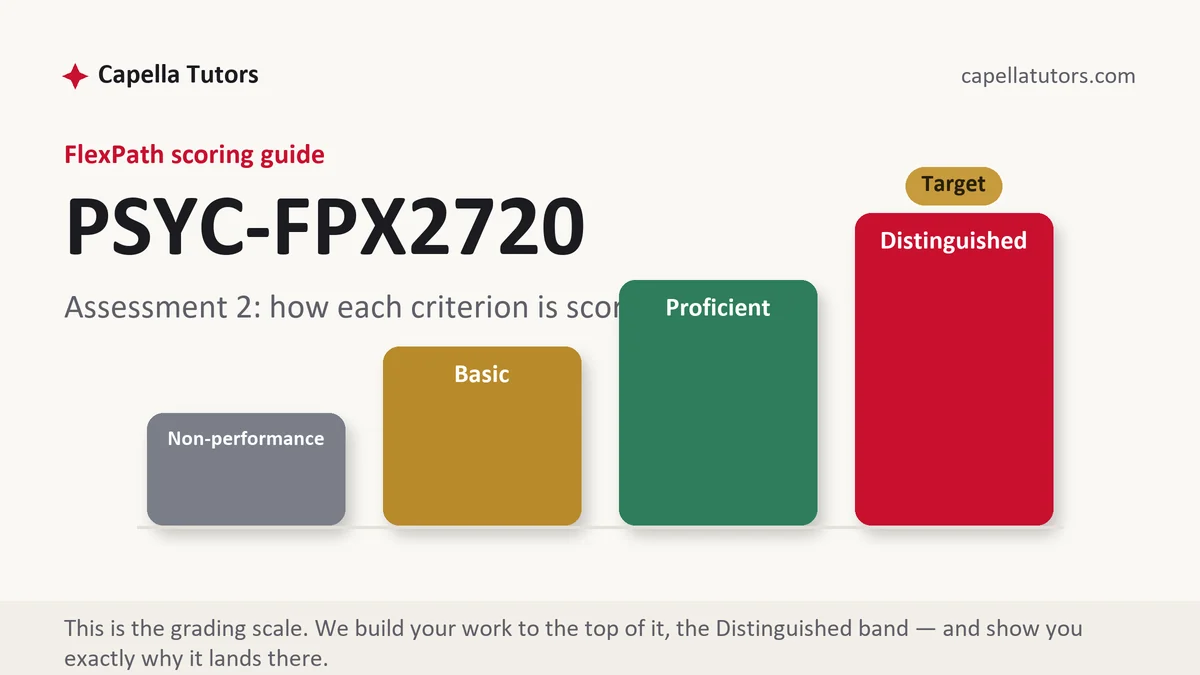
How PSYC FPX 2720 Assessment 2 is scored
Nothing here is graded on length. Each criterion is judged at one of four levels, and the level wording is the closest thing to model text you will be given:
| Level | What it means when you are evaluating an influence |
|---|---|
| Distinguished | The influence is defined, its size estimated from research rather than asserted, and at least one rival influence in the case is weighed on the same evidence. |
| Proficient | The influence is explained correctly and applied to the case with support, leaving the comparison for the reader to make. |
| Basic | A description of the household with an influence implied. The row asks what the influence did; the draft answers what the situation was. |
| Non-performance | A named part of the row is not on the page, most often the evidence for the influence or the alternative it was supposed to outrank. |
There is a second reason to take the comparison seriously. The conflict a family case turns on is usually normative rather than pathological, so writing an ordinary renegotiation of authority as a household in crisis is the quickest way to lose an evaluation row. The criterion is checking whether you can tell those apart with evidence.
The PSYC FPX 2720 Assessment 2 method, step by step
-
Sort the rows into description, evidence and judgment
Read the guide once with three highlighters. Description rows want the case laid out, evidence rows want cited research, judgment rows want a conclusion you will defend. Mixing them is why competent drafts land mid-column: an evaluator reading for a judgment finds a summary, and reading for evidence finds an opinion.
-
Map the household before you interpret it
List every member, their age, who lives in the home and who does not, how long the current arrangement has held, and what each person says the argument is about. Do it as a plain list. Half the analysis in a family case is visible the moment the household is on paper.
-
Name the pattern, not the argument
Write the sequence: who raises the matter, who answers, who is appealed to, who leaves the room, and how often the loop repeats. A pattern with a frequency attached is evidence; an anecdote is not. This is where you stop describing the curfew and start describing what it stands in for.
-
Separate normative conflict from a household under strain
Conflict rises in early adolescence and clusters on ordinary matters like timing, chores and appearance, while agreement on larger values usually survives. Say which of those your case shows, and name the observations that decide it: whether the disagreements generalize, and whether warmth persists between rounds.
-
Weigh the family against the other influences in view
An evaluation is a comparison. Put the peer group, the school, pubertal timing and the adolescent's own temperament on the same page as the family, give each the evidence it deserves, then say which one your case supports. Report effect sizes in the words the study used, and keep association language where the design was correlational.
-
Mark your own rows before an evaluator does
Reread the draft with the guide beside it and grade yourself row by row, in the evaluator's order rather than yours. Anything under the top level gets one more pass, and note which rows you had to argue yourself into, because those are the ones that come back.
A structure that maps to the criteria
These lengths are our planning targets for a case of this size rather than Capella rules, and any row your guide weights heavily deserves more than the number beside it.
| Section | What it must do | Guide |
|---|---|---|
| Case summary | Ages, household composition, how long the arrangement has held, and the disagreement as each member describes it. | ~200 words |
| The influence defined | What you mean by the influence you are evaluating, in the terms the research uses for it. | ~150 words |
| Evidence for the influence | What developmental research reports about this influence at this age, with samples and reported effect sizes rather than adjectives. | ~300 words |
| The case weighed | The pattern read against that evidence, including the parts of the case that fit it poorly. | ~300 words |
| Competing influences and limits | Peers, school, pubertal timing or temperament considered on the same evidence, and what one case cannot establish. | ~200 words |
| References | Current APA both ways, frameworks cited to their authors, survey figures cited to their collection year. | as needed |
Annotated sample excerpt
A short original model from our team, written to show the analytic register these rows reward. Study the moves, then build your own case the same way.
The disagreement is presented as a curfew, and the curfew is not what this household is arguing about.1 A fourteen-year-old asks her mother for a later Friday return, her mother defers the answer to a stepfather of two years, and the refusal arrives as a stranger's ruling rather than a parent's; the loop has repeated most weeks since spring, with the same three moves in the same order.2 Read as a system, the dispute is about where authority sits after a remarriage, which explains why granting the extra hour twice failed to settle it, and why the research on early adolescent conflict points to renegotiation over daily matters rather than to a collapse of shared values.3
- 1Opens on the distance between the stated topic and the actual one, which is the move an evaluation row is built to notice.
- 2Gives the sequence, its duration and its frequency, so a claim about a pattern arrives as evidence rather than impression.
- 3Names the systems reading, uses it to explain something the surface reading cannot, then ties it to what the literature reports about conflict at this age.
The full premium sample for your exact assessment, written fresh to your scoring guide and issue, is free to request. Study it, revise it into your own voice, and submit work you understand.
The five mistakes that cost Distinguished
- Taking the stated dispute at face value. Curfews, phones and chores are the surface of most family cases, and the row is asking what sits underneath.
- Ordinary renegotiation written as crisis. Rising conflict over daily matters in early adolescence is a citable finding, not a diagnosis waiting to be made.
- One influence and no rivals. An evaluation that never weighs peers, school or pubertal timing against the family has not evaluated anything.
- Monitoring described as surveillance. What parents know comes largely from what an adolescent volunteers, and the evidence on intrusive control does not support a tighter grip.
- A clinical label in an undergraduate case. Describe what is observable, compare it to typical ranges, and leave diagnosis to clinicians.
Pre-submission checklist
- The household mapped on paper before any interpretation is offered
- The influence defined in research terms, not in everyday ones
- The repeating sequence stated with a frequency and a start point
- Normative conflict and household strain distinguished, with the deciding observations named
- At least one competing influence weighed on the same evidence
- Reference list matched to the text both ways, self-scored row by row
Family case due this week?
Upload the prompt, the guide and the details you have on the household. Eight people touch the draft, from the literature pull to the final read, and a premium original sample comes back in 24 to 48 hours with the pattern named, the influence weighed against its rivals, and no diagnosis anywhere in it. Free revisions until every criterion is satisfied.