This manual is for PSYC FPX 2720 Assessment 1, start to submission. The opening deliverable in Adolescent Psychology asks you to explain something a teenager actually did, using developmental research rather than developmental vocabulary, and your scoring guide decides how much of that explanation has to be sourced. The graded skill is narrow and learnable: define the behavior, fix the age band, name one mechanism, and keep every claim inside what the study behind it measured. Below is the method our tutors use on this deliverable, a structure keyed to the criteria, and an annotated excerpt from an original model. Would rather hand it over? A premium original sample for your exact prompt comes back in 24 to 48 hours, revised free until the guide is satisfied. Capella's catalog lists the course as PSYC-FPX2720, and some courserooms print PSYC2720; both point to this same Assessment 1.
One honesty note before the manual: Capella revises courses and scoring guides over time, so always write to the exact scoring guide attached to your assessment in the courseroom. The course identity above is verified on capella.edu; the method and structure below are our tutors' approach to it, not Capella's official rubric text.
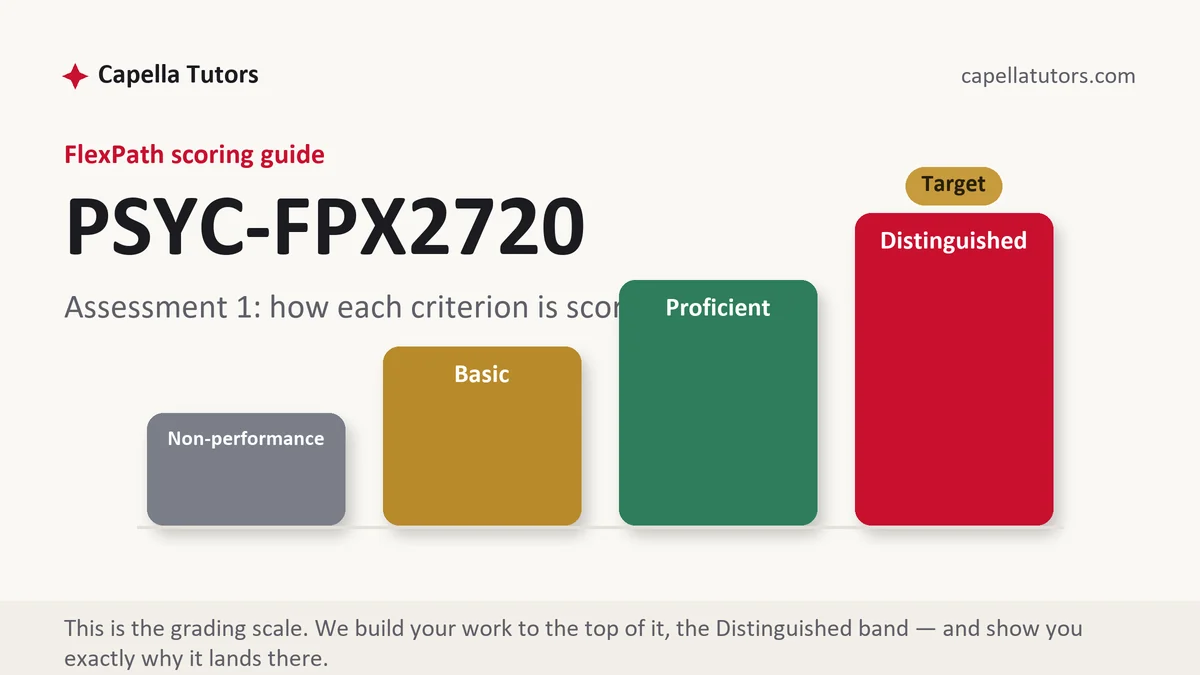
How PSYC FPX 2720 Assessment 1 is scored
FlexPath does not award letter grades. Every criterion on the guide lands on one of four levels, and the wording of those levels is your writing brief:
| Level | What it means on an adolescent behavior analysis |
|---|---|
| Distinguished | The mechanism is stated as a process, tested against details of the case that could have contradicted it, and bounded by what it does not explain. |
| Proficient | The right concept applied accurately to the right case, with sources that fit the age. Complete, and one move short of the top of the column. |
| Basic | A correct summary of a theory followed by an assertion that the teenager fits it. The most common landing place for a first draft at this level. |
| Non-performance | Something the row names is simply absent, usually the definition of the behavior or the age-appropriate evidence. Missing, rather than thin, puts a criterion on the floor. |
This deliverable also sets the habits the rest of the course grades. Attach a population and a period to every number here and you will not relearn it when a later assessment asks for a program evaluation or for advice a parent can use.
The PSYC FPX 2720 Assessment 1 method, step by step
-
Turn the criteria into headings before you draft a word
The prompt tells you what to produce; the guide decides what it is worth. Copy each criterion into an empty document as a heading, paste its top-level description underneath, and treat any paragraph that does not sit under a heading as unpaid writing.
-
Define the behavior before you try to explain it
Write one sentence naming what happened, how often, over what stretch of time, and where. Experimenting with alcohol is a category and cannot be analyzed; drank at two of four unsupervised gatherings over six weeks can be. That sentence also decides which literature is relevant to you.
-
Write the age band at the top and hold it there
Thirteen and eighteen share a textbook chapter and very little else, so put the age in the draft and check every source against it. A result from a sample of college students is not evidence about a fifteen-year-old, and the row asking for developmentally appropriate research is where that substitution gets caught.
-
Choose one mechanism and state it as a process
A mechanism says what leads to what under which conditions, written so a reader could disagree with it. Naming three theories in a paragraph reads as coverage and scores as coverage. Carrying one account to a prediction, then checking whether the prediction holds in your case, is what an analysis row rewards.
-
Attach a denominator and a window to every number
A percentage means nothing until the reader knows who was counted, how many there were, over what recall period, and how the behavior was defined. Put the survey, the ages sampled, the window and the collection year in the sentence itself. Then keep the verbs honest, since a survey supports association language and not cause.
-
Score your own draft before an evaluator does
Work down the guide one row at a time and mark your own draft D, P, B or N without generosity. Anything short of the top gets another pass. Evaluations can take two business days, so leave room for a second attempt inside the same week.
A structure that maps to the criteria
The targets below are planning numbers our tutors use for an analysis of this kind, not Capella requirements; stretch whichever row your scoring guide weights most heavily.
| Section | What it must do | Guide |
|---|---|---|
| Introduction | Name the age, the setting and the behavior, then close on the question this paper answers. | ~150 words |
| The behavior described | What happened, how often, since when, who was present, and the definition you are working from. | ~200 words |
| Developmental mechanism | One account, attributed to the researchers who proposed it, stated as a process with its conditions. | ~350 words |
| Evidence and rates | Each figure with its survey, population, definition, recall window and collection year, plus the trend direction. | ~300 words |
| Limits and alternatives | What the account does not explain, one competing explanation, and the observation that would separate them. | ~200 words |
| References | Current APA, citations matched both ways, survey data credited to the year the data were collected. | as needed |
Annotated sample excerpt
An original model excerpt from our writers, showing the register that reaches the top of a guide. Take the moves, then write your own.
The behavior at issue is specific enough to count: across six weeks a fifteen-year-old attended four gatherings at friends' homes with no adult present, and drank on two of those occasions.1 A national survey of students in grades nine through twelve puts past-30-day drinking at a minority of respondents rather than most of them, and the same series has recorded a decline across the past decade, so this pattern is neither rare nor typical and the paper has to say which.2 The analysis explains it as a function of unstructured, unsupervised time in company rather than as a trait of the adolescent, then tests that account against the two details of the case that could sink it.3
- 1The behavior arrives counted and dated rather than labeled. An analysis row cannot be satisfied by a noun phrase.
- 2The rate carries its population, its recall window and the direction of the trend, and the sentence stops short of the causal claim a survey cannot support.
- 3States the mechanism and, in the same breath, promises the details that could contradict it, so the paper will test itself rather than confirm itself.
The full premium sample for your exact assessment, written fresh to your scoring guide and issue, is free to request. Study it, revise it into your own voice, and submit work you understand.
The five mistakes that cost Distinguished
- A label standing in for a definition. Risky behavior is a category, and a category cannot be explained, only restated at greater length.
- The unfinished-brain shortcut. An account that predicts risk in every setting cannot explain a behavior that appears in one setting and not others.
- A rate with no denominator. A percentage without its population, its definition and its recall window will not hold up the sentence it was hired to support.
- Causal verbs on survey data. Cross-sectional figures support association language only, and promoting them to cause is the most common evidence failure at this level.
- Sources drawn from the wrong decade of life. Evidence about adults or undergraduates, applied to a fourteen-year-old, loses the row about developmentally appropriate research.
Pre-submission checklist
- Every scoring-guide criterion has its own labeled heading in the draft
- The behavior defined by frequency, setting and time span in the first section
- The age band written down, with every source checked against it
- One mechanism attributed to its authors and stated with its conditions
- Each figure carrying its survey, population, definition, recall window and year
- One competing explanation named, with the observation that would rule it out
Analysis due and the case not cooperating?
Send the prompt, the scoring guide and whatever you know about the adolescent in the case. A team of eight, including a research analyst and two QA reviewers, returns a premium original sample written to the top column in 24 to 48 hours, with the mechanism tested rather than asserted and every rate carrying its denominator. Revisions stay free until the guide is clear.