How to write PSYC-FPX2700 Assessment 3

The short answer

This manual is for PSYC-FPX2700 Assessment 3, start to submission. Assessment 3 often changes the reader rather than the topic: you write for a caregiver instead of for a faculty evaluator, while the criteria still grade you as a psychology student. The result has to be plain enough to use and honest enough to defend, which means keeping association language intact while a worried parent reads it. Below is the method our tutors use for it, a structure that serves both readers, and an annotated excerpt from an original model. Prefer to hand it off? Send the prompt and the guide and a premium original sample arrives in 24 to 48 hours, revised free until the rows clear. Your courseroom may print this as PSYC FPX 2700 Assessment 3 or PSYC2700 Assessment 3; it is the same deliverable, and PSYC-FPX2700 Assessment 3 is what this manual walks through.

One honesty note before the manual: Capella revises courses and scoring guides over time, so always write to the exact scoring guide attached to your assessment in the courseroom. The course identity above is verified on capella.edu; the method and structure below are our tutors' approach to it, not Capella's official rubric text.
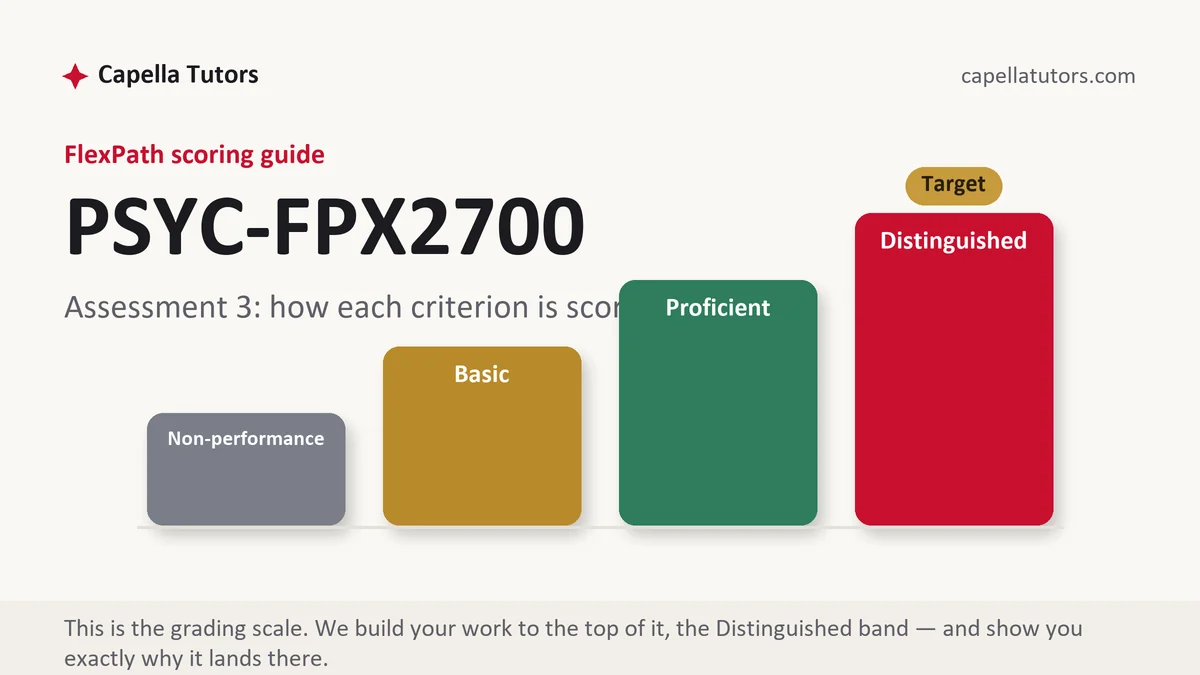
PSYC-FPX2700 Assessment 3 grading scale at Capella FlexPath, the criterion levels this assessment is scored on, from Capella Tutors
How Capella FlexPath grades PSYC-FPX2700 Assessment 3, visualized by Capella Tutors.

How PSYC-FPX2700 Assessment 3 is scored

Four columns, one grade per criterion, and here two of them pull in opposite directions, because the communication row wants plain language while the evidence row wants precision:

LevelWhat it means on caregiver-facing guidance
DistinguishedRecommendations a caregiver could act on tomorrow, each one traceable to research reported at its actual strength, with association kept distinct from cause and the uncertainty stated without hedging the advice into uselessness.
ProficientAccurate, usable guidance grounded in the literature, with the strength of the evidence left unexamined.
BasicConfident advice in a warm voice, with correlational findings written as causes and no numbers a reader could check.
Non-performanceThe guidance has no research behind it, or the audience the criterion names is never actually addressed.

The failure this assessment punishes is a sentence a parent would repeat to somebody else and get wrong. Write every claim in the form you would be willing to hear quoted back.

The PSYC-FPX2700 Assessment 3 method, step by step

  1. Write the caregiver's actual question at the top

    Guidance answers a question, so put the question in the document: how much of this is a problem, what should we do instead, and how would we know it was working. A paper organized around a topic rather than a question reads as a lecture and loses the audience row.

  2. Say what the studies measured before you say what they found

    Most of this literature measures exposure by caregiver report, sometimes as a single estimated daily total and sometimes as a diary kept across a week, and the two do not agree well. Name the method and the window, since a claim about hours per day rests entirely on how the hours were collected.

  3. Report the size, not just the direction

    Give the association its magnitude and an interval around it, in your own sentence, from the study you read. Reporting that a relationship was statistically significant tells a caregiver nothing about whether it is worth changing an evening over, and a large sample will find differences too small to act on.

  4. Keep association and cause in different sentences

    Homes differ in a dozen ways besides screen time, and the same family characteristics that predict exposure also predict the outcomes being measured, so the defensible sentence is that heavier exposure is associated with lower measured language scores in these samples, after some adjustment, and that the direction cannot be settled by this design. Then say what would settle it.

  5. Convert the honest finding into something usable

    A caregiver cannot act on a correlation, so translate it: what to substitute, when, and what to watch. The literature supports specific moves better than global limits, including watching alongside the child and talking about what is on the screen, keeping the hour before sleep clear, and protecting the routines that are being displaced rather than counting minutes.

  6. Stay inside the role and say so once

    Guidance from a student compares a child to typical ranges and points toward the professionals who assess, and one plain sentence saying so is what the criteria want rather than a disclaimer paragraph. Anything that reads as screening or diagnosis is outside the assignment, and where a caregiver's question is clinical, the answer is a referral rather than a paragraph.

A structure that maps to the criteria

Word targets here are our tutors' planning numbers for a caregiver-facing document rather than a Capella instruction; expand whichever section your guide asks more of.

SectionWhat it must doGuide
The question and the childThe caregiver's question in their own terms, the child's age, and what the document will and will not answer.~200 words
What the research measuredThe methods behind the findings, including how exposure was recorded and over what window.~250 words
What the research foundThe associations with their sizes and intervals, reported plainly and without causal verbs.~300 words
What it does not establishThe confounds, the direction problem, and the study that would settle the question.~200 words
What to do insteadSpecific, actionable moves the evidence supports, with what to watch for and over what period.~250 words
Role, referral and referencesThe boundary of student guidance, where to go for assessment, current APA matched both ways.~120 words

Annotated sample excerpt

An original model excerpt from our team, written for a parent and graded as psychology. Study how the hedge and the recommendation sit in the same paragraph.

Sample excerpt: reporting an association to a caregiver Original model · Capella Tutors

You asked whether the two hours your four year old spends on a tablet most evenings is doing damage, and the honest answer starts with how that number is usually collected: most of the studies behind the headlines asked a parent to estimate a daily total, some used a week of diary entries, and the two methods disagree enough that a single reported average should be read as a rough band rather than a figure.1 Within those limits, heavier reported exposure at this age is associated with slightly lower scores on language measures, a small association that shrinks further once household income and the amount of adult talk in the home are accounted for, and it remains an association rather than a demonstrated effect.2 What that leaves you is a practical question rather than a verdict: two hours with a parent watching alongside and talking about what is on the screen is a different two hours from two hours alone before bed, and the change I would make first is the hour before sleep, watched across three or four weeks with nothing else altered.3

  • 1Answers the question that was asked, in the caregiver's own terms, and puts the measurement method and window before the finding so the number is read at the right precision.
  • 2Gives the direction and the size, notes what happens when confounds are accounted for, and keeps the verb associated where the design can support it.
  • 3Turns an honest association into one specific action with a window attached, which is what makes the document usable without overstating the evidence.

The full premium sample for your exact assessment, written fresh to your scoring guide and issue, is free to request. Study it, revise it into your own voice, and submit work you understand.

Get the full sample free

The five mistakes that cost Distinguished

  • A correlation written as a cause. Screen time damages language is a sentence this design cannot support, and a caregiver will repeat it exactly as written.
  • Significance offered as size. A parent needs to know whether an effect is worth an evening, and a p value does not answer that.
  • A number with no method behind it. Hours per day means one thing from a week of diary entries and another from a single parental estimate.
  • Advice with nothing to watch. A recommendation without a period and an observable outcome cannot be evaluated by the reader or by the criterion.
  • A paragraph that reads as diagnosis. Student guidance compares against typical ranges and refers onward; it does not assess.

Pre-submission checklist

  • The caregiver's question appears in the document in their own terms
  • Measurement method and window stated before any finding
  • Every association reported with a size and an interval, plainly worded
  • Causal verbs absent, with the study that would settle the question named
  • Recommendations specific, with what to watch and for how long
  • The boundary of student guidance stated once, with a referral route, and APA matched both ways

Writing for a parent and a grader at once?

Send the prompt and the criteria. Our team returns a premium original document in 24 to 48 hours that a caregiver could act on and an evaluator cannot fault on evidence, with free revisions until both rows clear.

Keep going

Online now