This manual is for PSYC FPX 2700 Assessment 2, start to submission. Assessment 2 usually keeps the child and changes the job: instead of recording behavior you explain it, and the criteria want one mechanism carried through the case rather than three theorists named in passing. Below is the method our tutors use for it, a structure that stops a theory application from becoming a summary of the chapter, and an annotated excerpt from an original model. Prefer to hand it off? Send the case with the guide and a premium original sample comes back in 24 to 48 hours, revised free until every criterion is satisfied. Capella's catalog lists the course as PSYC-FPX2700, and some courserooms print PSYC2700; both point to this same Assessment 2.
One honesty note before the manual: Capella revises courses and scoring guides over time, so always write to the exact scoring guide attached to your assessment in the courseroom. The course identity above is verified on capella.edu; the method and structure below are our tutors' approach to it, not Capella's official rubric text.
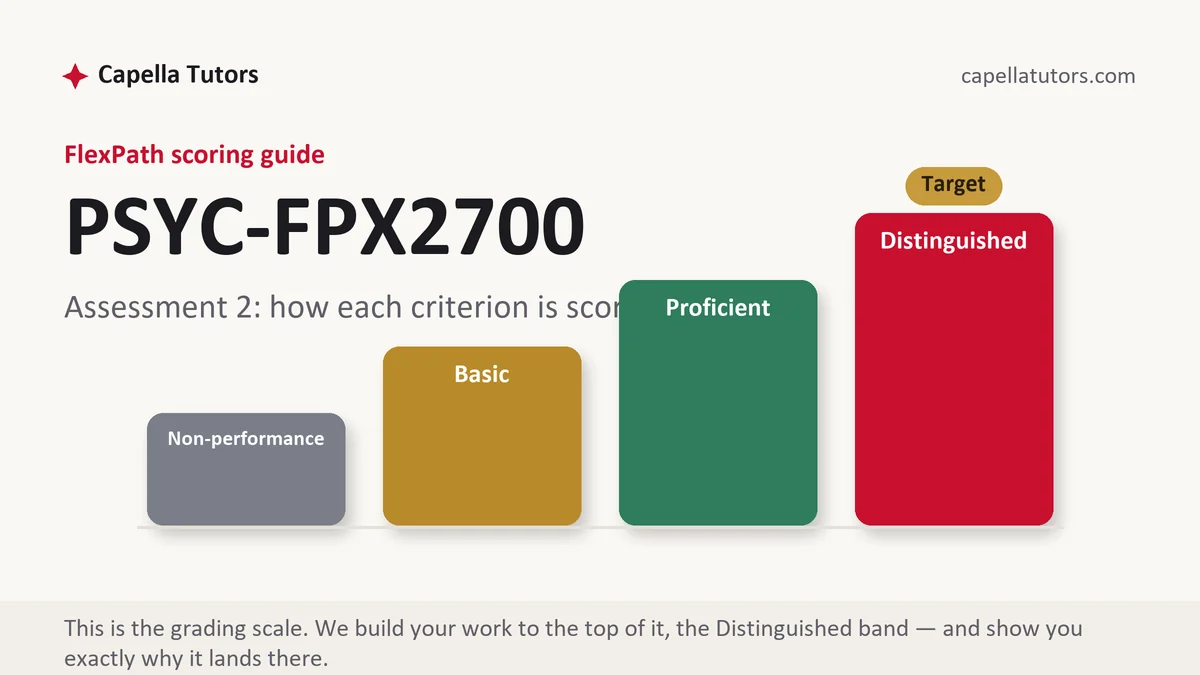
How PSYC FPX 2700 Assessment 2 is scored
Each criterion in the guide is scored into one of four columns, and on a theory application the columns test depth rather than breadth:
| Level | What it means on a theory application |
|---|---|
| Distinguished | One mechanism explained in the theorist's terms and carried through the whole case, with the behavior it predicts and the behavior it does not, plus a second account weighed where the criteria ask for one. |
| Proficient | The right theory applied accurately to the right age, complete, with the mechanism stated once and then used. |
| Basic | Three theorists named a sentence each, or one theory summarized and then attached to the case by assertion. |
| Non-performance | The theory never reaches the case, or the case detail the criterion asks about is absent. |
Depth is the currency here. One mechanism worked through a single episode outscores a tour of the chapter every time an evaluator has both in front of them.
The PSYC FPX 2700 Assessment 2 method, step by step
-
Fix the age in months or years before choosing a theory
The mechanism you can use depends on where the child is, so write the age down first. A criterion about a five year old is not satisfied by an accurate statement about toddlers, and this is the fastest way students lose an otherwise strong paper.
-
Pick one mechanism and say what it claims
Piaget's claim is that a child acts, meets a result that does not fit, and reorganizes, so a stage is the consequence rather than the explanation. Vygotsky's claim is that what a child can do with help today marks what she will do alone later, and that the help is dismantled as it stops being needed. Write the claim out; do not name it and move on.
-
Choose an episode where the mechanism is visible
You need a moment with a task, a difficulty and a response. A child assembling a marble run beside an older sibling gives you all three, because the difficulty is public, the help is observable, and the withdrawal of the help can be described as it happens.
-
Carry the mechanism through the whole episode
Take the episode in order and say what the mechanism predicts at each turn: what the child tried, what result contradicted the attempt, what the helper did, what the child then did alone. A mechanism that appears in one paragraph and disappears has been named rather than applied.
-
Report what the theory does not explain
Every mechanism has a boundary, and naming it in a sentence reads as command of the material. Later studies that simplified the task find competence earlier than the original stage boundaries allow, which means the useful claim is about the order of the changes rather than the calendar.
-
Keep the evidence and the theory in different sentences
The theorist supplies the mechanism; studies supply what children of this age actually do, with a sample and a design in your own sentence. Where the criteria ask for a second account, run it across the same episode rather than in a separate section, and commit to which one explains the detail you recorded.
A structure that maps to the criteria
These word figures are planning targets our tutors use for a theory application of this size rather than Capella rules; weight the sections your guide weights.
| Section | What it must do | Guide |
|---|---|---|
| The child and the episode | Age, setting, the task, the difficulty and the sequence, written as record before analysis. | ~250 words |
| The mechanism | The claim in the theorist's own terms, cited to the theorist, with any translation date noted. | ~250 words |
| The mechanism through the episode | Each turn of the episode matched to what the mechanism predicts, including the turns it does not cover. | ~350 words |
| The second account | A rival mechanism on the same episode and the detail that decides between them. | ~200 words |
| Boundaries and research support | Where the theory has been revised by later studies, with sample and design named. | ~200 words |
| Limits, ethics and references | Consent, confidentiality, what one episode cannot show, current APA both ways. | ~120 words |
Annotated sample excerpt
An original model excerpt from our team, written to show a mechanism doing work rather than being introduced. It is study material: take the structure and supply your own case.
Working at the kitchen table with a sibling of nine, the child, five years and two months, tried four times to seat a curved chute on a straight support, each time letting go before the joint held and each time watching the piece fall.1 The sibling then said, "hold the bottom while I push," took the support, and left the chute in the younger child's hands; two attempts later she seated the next joint alone, holding the base without being told.2 That sequence is what Vygotsky's account predicts, since the task moved from impossible alone to possible with support and then to independent once the support was withdrawn, and it is worth adding that the same sequence does not require the stage boundaries Piaget proposed, whose original procedures later studies have shown to understate what young children manage once a task is made concrete.3
- 1The age in years and months, the task and the repeated failure are recorded first, so the mechanism has something specific to be applied to.
- 2The help is quoted and the withdrawal of the help is described as it happened, which is the observable part of the mechanism most papers leave out.
- 3Names what the mechanism predicts and adds the boundary of the rival account in one sentence, without dismissing it and without drifting into a chapter summary.
The full premium sample for your exact assessment, written fresh to your scoring guide and issue, is free to request. Study it, revise it into your own voice, and submit work you understand.
The five mistakes that cost Distinguished
- Theorists listed rather than used. Three names mentioned once each is a survey, and a survey answers none of the application rows.
- The mechanism named and abandoned. If the theory does not appear in the middle of the analysis, it was decoration.
- Help described without its withdrawal. Support that is never dismantled is not the mechanism, and the criteria are looking for the handover.
- The wrong age carried through. An accurate account of a two year old scores nothing where the criterion names a five year old.
- A stage boundary treated as a fact about calendars. Later work using simpler tasks found competence earlier, and the defensible claim is about order rather than dates.
Pre-submission checklist
- The age is stated in years and months and honored in every claim
- One mechanism written out as a claim, cited to the theorist
- An episode with a task, a difficulty and a response, recorded before it is analyzed
- The mechanism carried through every turn of the episode, including what it does not explain
- A second account run across the same episode where the criteria ask for one
- Empirical claims sourced with sample and design, consent and confidentiality handled
One mechanism, one child, one deadline?
Upload the case and the scoring guide. A premium original sample returns in 24 to 48 hours with the mechanism carried through the episode, the boundary stated and the evidence sourced, and it is revised free until the criteria are met.