This manual is for PSYC FPX 2700 Assessment 1, start to submission. Assessment 1 in Child Development is usually the observation, and it is graded on discipline rather than on insight. The criteria want what you saw written as a record, what it means written separately, and the difference between the two visible on the page. Below is the method our tutors use for it, a structure that keeps description clean of interpretation, and an annotated excerpt from an original model. Prefer to hand it off? Send the prompt and the guide and a premium original sample returns in 24 to 48 hours, with the observation slots marked for your own notes rather than filled with an invented child. Capella's catalog lists the course as PSYC-FPX2700, and some courserooms print PSYC2700; both point to this same Assessment 1.
One honesty note before the manual: Capella revises courses and scoring guides over time, so always write to the exact scoring guide attached to your assessment in the courseroom. The course identity above is verified on capella.edu; the method and structure below are our tutors' approach to it, not Capella's official rubric text.
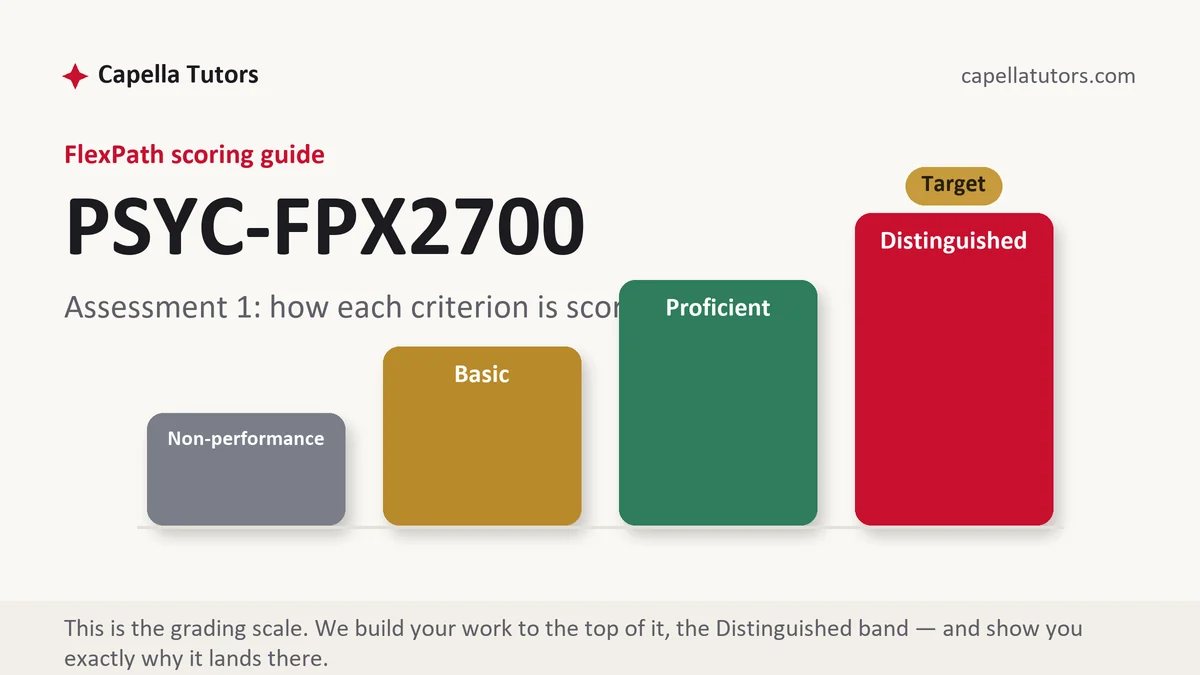
How PSYC FPX 2700 Assessment 1 is scored
FlexPath sorts each criterion into one of four columns, and on an observation the columns mostly test whether you can keep two kinds of writing apart:
| Level | What it means on an observation report |
|---|---|
| Distinguished | The conditions are reported precisely enough to be repeated, the description is behavioral and quoted exactly, the age expectations are sourced and written as ranges, and at least one alternative reading of the behavior is examined. The top column usually asks for interpretation with its limits attached. |
| Proficient | A clean, accurate observation with the theory correctly applied and one reading offered. Complete, and missing the alternative. |
| Basic | A narrative with feelings and motives inside it, where inference has replaced the behavior a grader wanted to see. |
| Non-performance | Consent, setting or the observation itself is missing, or the analysis has nothing recorded to work from. |
Ten minutes of properly recorded behavior supports more analysis than an hour of impressions, and the difference is visible to an evaluator inside the first paragraph.
The PSYC FPX 2700 Assessment 1 method, step by step
-
Settle the route and the permission before you go
Read the guide to see whether a public setting, a provided video or an arranged session is what it wants. Where a caregiver is involved, ask first, say what the paper is for and who will read it, and write in the report that permission was obtained and that the child is unidentifiable.
-
Record conditions like a method section
Date, start and end time, the setting in general terms, who else was present, where you were sitting, and what the child was doing when you started. A reader who could not repeat your session cannot evaluate your conclusions, and this is the cheapest criterion in the assessment to satisfy.
-
Write behavior as a camera would record it
He pushed the board book away with the flat of his hand and turned his shoulder to the circle, not he was bored. Quote speech exactly rather than reporting the gist, note the sequence, and time-stamp what you can, since the order of two actions is often the whole evidence for a later claim.
-
Count what repeats
Tally the behaviors your criteria care about and give each count its window: four approaches to the shelf in eleven minutes, two of them ending in a returned book. Counts with denominators turn an anecdote into evidence, and they let you write about frequency without the words often or always.
-
Interpret in a separate labeled section
Move every inference out of the description and into its own part of the paper, then attach the developmental expectation for the exact age in months, sourced and written as a range. A child of twenty six months is a different subject from a three year old, and a criterion about one earns nothing from evidence about the other.
-
Name the alternatives and stop at the boundary
A child who ignores an instruction may not have heard it, may not have parsed it, may be finishing something else, or may be refusing, and saying which readings your record cannot rule out is what the top column describes. An undergraduate observation describes and compares against typical ranges; it does not screen and does not diagnose, and anything that worries you belongs in a conversation with your instructor.
A structure that maps to the criteria
The word targets below are our tutors' planning numbers for an observation report in this course rather than Capella rules; follow your guide wherever it asks for more.
| Section | What it must do | Guide |
|---|---|---|
| Setting, consent and conditions | Where, when, how long, who was present, your own position, and the permission you obtained. | ~150 words |
| The observation | Behavior, exact speech and sequence as description, with counts and timings and no inference. | ~350 words |
| Age expectations | What the literature reports as typical for this age in months, written as a range and sourced. | ~250 words |
| Theory applied | One mechanism from Piaget, Vygotsky or information processing carried through what you recorded. | ~250 words |
| Interpretation and alternatives | Your reading, the competing readings the record cannot exclude, and what one session cannot show. | ~250 words |
| Limits, ethics and references | Confidentiality, the boundary of an undergraduate observation, current APA matched both ways. | ~120 words |
Annotated sample excerpt
An original model excerpt from our team, showing the register a conditions and description section is graded on. Learn the discipline, then record your own session.
Story hour, Saturday, 10:32 to 10:51, in the children's room of a public library, with roughly fourteen children and their caregivers present and the observer seated three meters from the reading circle; the caregiver of the child described here gave permission before the session and the child is identified as R.1 R, twenty six months, left the circle four times in nineteen minutes, each time walking to the same low shelf, and on two of those trips carried a board book back and set it in the reader's lap without speaking.2 At 10:44 the reader said, "one more page," and R sat down on the carpet with his back to her, then turned to face the book eight seconds later.3
- 1Conditions written as a method section, precise enough for another observer to repeat, with consent recorded and an initial rather than a name.
- 2Counts with a window attached, and description limited to what a camera would have caught. No motive has been assigned yet.
- 3Speech quoted exactly and the sequence timed, so the eight second gap is available as evidence later instead of being summarized away as compliance.
The full premium sample for your exact assessment, written fresh to your scoring guide and issue, is free to request. Study it, revise it into your own voice, and submit work you understand.
The five mistakes that cost Distinguished
- Inference inside the description. Writing that a child felt shy records your guess and loses the behavior the criterion wanted.
- Conditions left vague. A session with no time, length or observer position cannot be repeated, and the conditions row is the easiest one in the assessment.
- Speech reported as gist. The exact words are the evidence, and paraphrase quietly deletes what the analysis needed.
- Expectations pinned to the wrong age. A well-sourced statement about three year olds earns nothing in a criterion about a child of twenty six months.
- Anything that reads as a diagnosis. An undergraduate observation compares a child to typical ranges and stops, and a sentence hinting at a disorder is outside what this course asks.
Pre-submission checklist
- Caregiver permission obtained and stated, with the child unidentifiable
- Date, times, length, setting, who was present and your position all recorded
- Description behavioral throughout, with speech quoted exactly and the sequence timed
- Repeated behaviors counted, each count with its window
- Age expectations given in months, sourced, and written as ranges
- One alternative reading examined, with what a single session cannot show stated
Observation due and no session booked?
Send the prompt and the criteria. We build the paper around the structure, source the age expectations, and leave the observation slots marked for your own notes, back in 24 to 48 hours and revised free until the rows clear.