This manual is for PSYC FPX 2600 Assessment 2, start to submission. The worksheet on the impact of technology on child development asks you to apply course concepts to how technology and screen use affect children's development across domains and ages, for example sleep and physical development in infants and toddlers, cognitive development, and social and emotional development, answering the worksheet's sections with research. The grade turns on age-specific, evidence-based answers. Linking specific developmental processes to research on technology scores above general warnings about screens. Below is the method our tutors use, a structure that maps to the criteria, and an annotated sample excerpt. Prefer to hand it off? A premium original sample for this exact assessment comes back in 24 to 48 hours, revised free until it meets the guide. Capella's catalog lists the course as PSYC-FPX2600, and some courserooms print PSYC2600; both point to this same Assessment 2. In current courserooms this assessment typically appears as "Worksheet: Impact of Technology on Child Development".
One honesty note before the manual: Capella revises courses and scoring guides over time, so always write to the exact scoring guide attached to your assessment in the courseroom. The course identity above is verified on capella.edu; the method and structure below are our tutors' approach to it, not Capella's official rubric text.
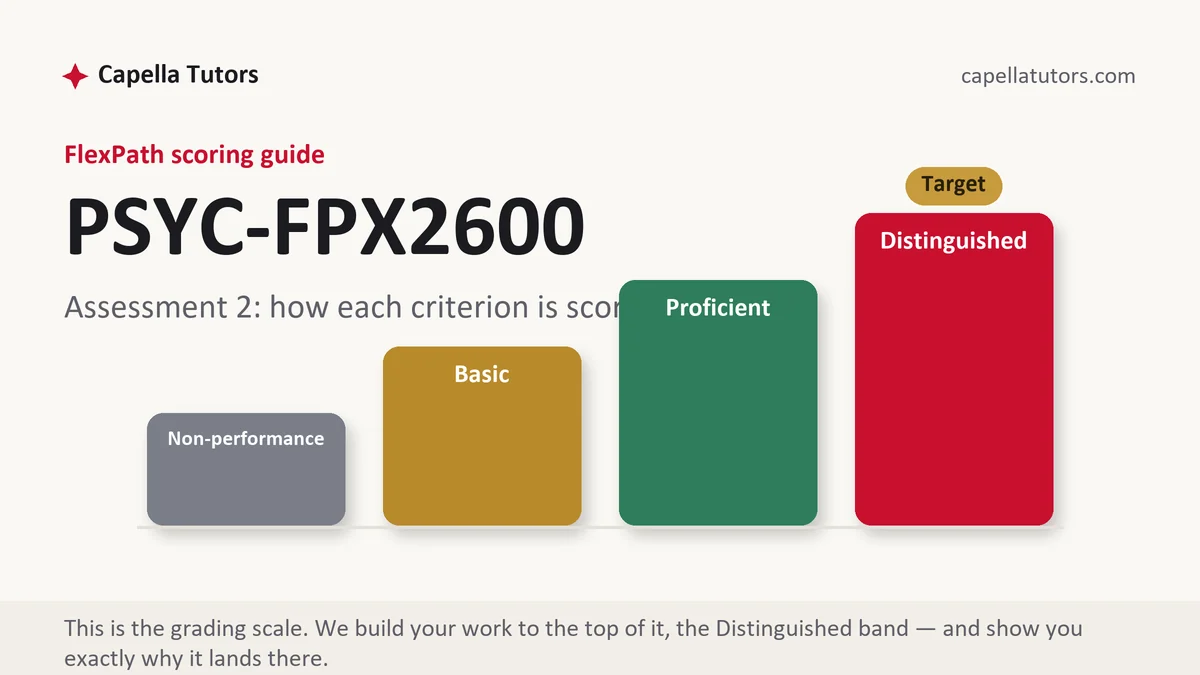
How PSYC FPX 2600 Assessment 2 is scored
FlexPath does not use letter grades. Each criterion in the scoring guide lands on one of four levels, and the level descriptions are the real writing brief:
| Level | What it means on a worksheet |
|---|---|
| Distinguished | The worksheet is specific to the organization or case, applies course concepts accurately with credible sources, and ends in justified conclusions or recommendations. |
| Proficient | The worksheet is accurate, but the application or recommendations are general. |
| Basic | The worksheet describes concepts with little application. |
| Non-performance | A required part of the worksheet is missing. |
Use the course text and peer-reviewed research, and answer every section.
The PSYC FPX 2600 Assessment 2 method, step by step
-
Read each section
Note the age and domain.
-
Apply course concepts
From the relevant chapter.
-
Bring in research
Studies on technology effects.
-
Distinguish effects
Benefits and risks by age.
-
Give recommendations
Such as AAP guidance.
-
Cite sources
Course text and research.
A structure that maps to the criteria
The worksheet in your courseroom sets the parts; answer each in full sentences with sources where asked.
| Section | What it must do | Guide |
|---|---|---|
| Section 1: infants and toddlers | Physical and cognitive. | worksheet |
| Section 2: early childhood | Development and technology. | worksheet |
| Remaining sections | Social and emotional development. | worksheet |
Annotated sample excerpt
An original model excerpt from our team, written to show the register that reaches the top of the guide. Learn the moves, then write your own version.
Screen use before bed is linked to shorter and later sleep in toddlers, partly because evening light exposure delays the release of melatonin.1 Since the course text emphasizes that sleep supports brain development and memory consolidation in the first years, reduced sleep is one of the most direct ways technology can affect early development.2 This is why the American Academy of Pediatrics recommends avoiding screens for children under 18 months other than video chatting, and keeping screens out of bedtime routines.3
- 1Links technology to a physiological process.
- 2Connects it to a course concept.
- 3Cites current guidance.
The full premium sample for your exact assessment, written fresh to your scoring guide and topic, is free to request. Study it, revise it into your own voice, and submit work you understand.
The five mistakes that cost Distinguished
- Definitions without application. Apply each concept to the organization or case.
- No sources. Cite credible business sources.
- Vague recommendations. Make them specific and justified.
- General warnings. Give age-specific evidence.
Pre-submission checklist
- Every section answered
- Course concepts applied
- Research cited
- Benefits and risks
- Recommendations
- Sources
Want the worksheet written?
Send the scoring guide and any materials from your courseroom. Our team returns a premium original worksheet in 24 to 48 hours, revised free until it meets the guide.