This manual is for PSYC FPX 2600 Assessment 1, start to submission. Assessment 1 in Development Across the Lifespan is usually where you take one person at one age and explain what is happening to them with a developmental theory rather than with sympathy. The assessment tends to supply a case or ask you to bring one, and the criteria reward a writer who keeps the age in view from the first paragraph to the last. Below is the method our tutors use for it, a structure built from the criteria outward, and an annotated excerpt from an original model. Prefer to hand it off? Send the case and the scoring guide and a premium original sample returns in 24 to 48 hours, revised free until the criteria are met. Capella's catalog lists the course as PSYC-FPX2600, and some courserooms print PSYC2600; both point to this same Assessment 1. In current courserooms this assessment typically appears as "Worksheet: Lifespan Development Insights".
One honesty note before the manual: Capella revises courses and scoring guides over time, so always write to the exact scoring guide attached to your assessment in the courseroom. The course identity above is verified on capella.edu; the method and structure below are our tutors' approach to it, not Capella's official rubric text.
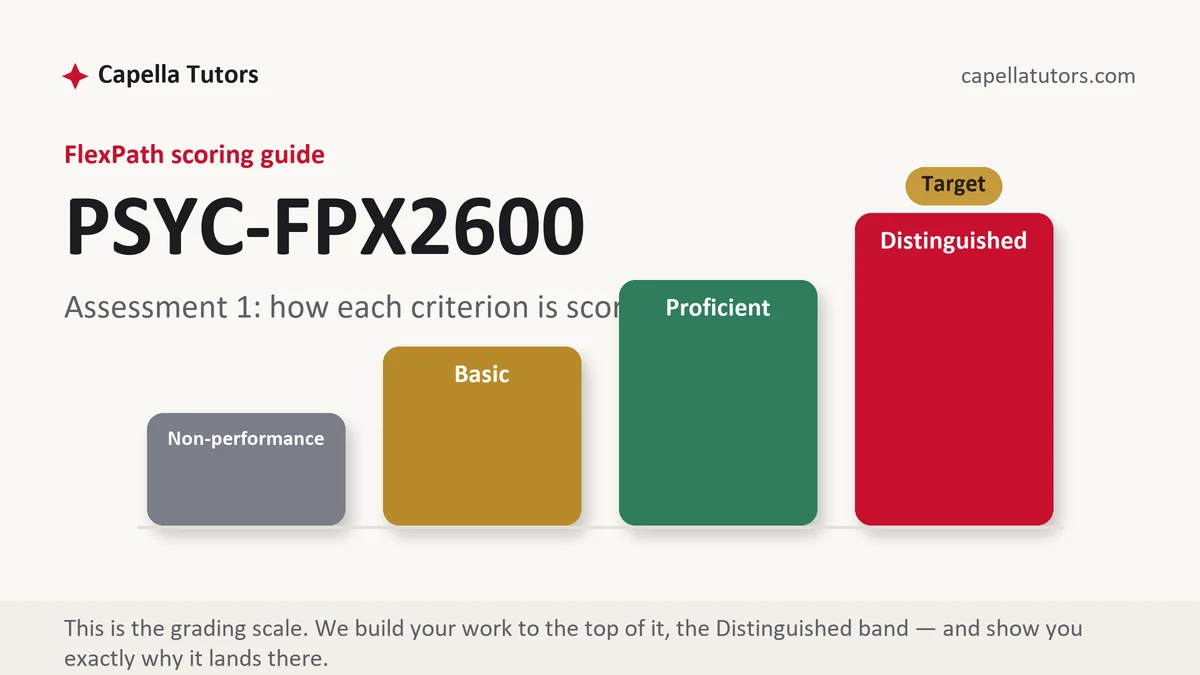
How PSYC FPX 2600 Assessment 1 is scored
Nothing here is graded on a curve. Every criterion in the guide lands in one of four columns, and the wording of the column tells you what to write:
| Level | What it means on a lifespan case analysis |
|---|---|
| Distinguished | The theory is explained as a mechanism, the case supplies behavioral evidence for and against the reading, a second developmental account is weighed, and the age claims are written as ranges. The extra move sits in the column text; find it and make it. |
| Proficient | The right theory applied to the right age, complete and accurate, with the case used as illustration. Good work that leaves the weighing undone. |
| Basic | A stage assigned to a person because of their birthday, with the theory summarized around it. The standard landing spot for a first draft in this course. |
| Non-performance | A required element is absent, most often the research support or the evidence from the case itself. |
This course grades coverage as well as correctness, so the habits Assessment 1 builds, naming the age, sourcing the age claim and writing timing as a range, are the same habits the later rows keep checking.
The PSYC FPX 2600 Assessment 1 method, step by step
-
Put the age at the top of the page and leave it there
Most lost points in this course are age mistakes. Write the exact age of your case where you can see it while drafting, and treat any sentence that is true of people in general rather than of people at this age as belonging to a different paper.
-
Convert each criterion into a heading before drafting
The guide is the outline. Give every row its own labeled section, park the top column wording underneath it, and write to that wording. Anything produced outside those headings is unpaid work, however good it is.
-
Turn the stage into a mechanism with a strength attached
Erikson framed each period as a tension resolved in one direction or the other, with a specific strength as the outcome, so the writing job is the tension and the resolution rather than the label. In later midlife the question is whether a person can find something outside themselves to invest in, and what happens when the investment has nowhere to go.
-
Quote the case for evidence, including the parts that do not fit
Pull three or four specific details, what the person said, what they now do with a week, what they stopped doing, and say which way each one points. Then report the detail that contradicts your reading, because a person can look stalled in one area and generative in another, and these stages are not examinations that get passed.
-
Run a second developmental account across the same facts
Keep the case fixed and let another model explain it. Narrowing commitments can be read as a crisis or as the selection and compensation that lifespan models treat as ordinary adaptation, and choosing between them on the person's own details is the evaluation the criteria want.
-
Source the age claims and write timing as a range
Every empirical statement about what happens at an age needs a study behind it, with the design, the sample and the age range in your own sentence. Then write norms as ranges rather than deadlines, since a paper that treats an average as a schedule will misread an ordinary life as a delayed one.
A structure that maps to the criteria
The word counts below are planning targets our tutors use for a case analysis in this course rather than Capella rules; follow your guide wherever it asks for more.
| Section | What it must do | Guide |
|---|---|---|
| The person and the situation | Age, work, health, relationships and the event that brought the case forward, with the domain the criteria ask about marked. | ~200 words |
| The theory, stated properly | The stage or process, its author, the tension or mechanism, and the strength it is supposed to produce. | ~250 words |
| Evidence from the case | The specific behaviors, quotations and changes that support the reading, and the ones that do not. | ~300 words |
| The second account | A rival developmental reading of the same facts and the reason you prefer one of them. | ~250 words |
| Research support | The studies behind each age claim, with design, sample and age range named in your own sentences. | ~200 words |
| Variation, ethics and references | Individual and cultural variation, consent if the person is real, current APA matched both ways. | ~150 words |
Annotated sample excerpt
An original model excerpt from our team, written to show what case evidence looks like when it is doing work. It is study material rather than a submission.
Fourteen months after the plant closed, the subject, a man of sixty one who had expected to work until sixty seven, describes his week in terms of what he no longer does: he sold the truck he used for side work, he has not gone back to the union hall, and he says the mornings are the part he cannot get through.1 Two details point the other way and both belong in the analysis, since he has been teaching his nephew to weld on Saturdays and keeps a written list of the tools he intends to pass on, which is investment in someone else rather than withdrawal.2 Read through Erikson, these facts show a tension resolving unevenly across domains; read through a lifespan model of selection and compensation, the dropped side work is an ordinary narrowing of goals after an involuntary loss, and the coping literature would predict the pattern from the fact that the stressor was uncontrollable rather than from his age.3
- 1The age and the interval since the event arrive in the first clause, and the losses are reported in the subject's own terms rather than as the writer's verdict.
- 2Puts the disconfirming evidence in the paper. Confirming and contradicting details reported together is the difference the top column describes.
- 3Runs two developmental accounts across one fixed set of facts and adds the coping variable both accounts have to answer to, which sets up an adjudication instead of assuming one.
The full premium sample for your exact assessment, written fresh to your scoring guide and issue, is free to request. Study it, revise it into your own voice, and submit work you understand.
The five mistakes that cost Distinguished
- A stage assigned and left standing. The criterion asks what the tension does in this person's life, not which box a birthday puts them in.
- Sympathy in place of analysis. A respectful account of a hard year with no mechanism in it answers none of the theory rows.
- Only the details that fit. A case with no contradicting evidence reads as edited, and the mismatch is where the higher columns live.
- Theory cited as if it were data. Erikson proposed the tension; the claim that people at this age behave this way needs a study with a sample.
- Norms written as deadlines. Timing in adulthood varies widely, and a paper that misses this will call an ordinary path a delay.
Pre-submission checklist
- The exact age is stated once and honored in every later claim
- Each criterion has its own labeled section written to the top column wording
- The theory appears as a tension and a mechanism, cited to the theorist
- Three or more specific details from the case, including at least one that does not fit
- A second developmental account weighed on the case details
- Every age claim carries a study with its design, sample and age range, and timing is written as a range
Case analysis due this week?
Send the case and the scoring guide. Eight people, including a research pull and two quality reviews, return a premium original sample in 24 to 48 hours with the mechanism, the case evidence and the design caveats already in place, revised free until the rows clear.