This manual is for PSYC FPX 2240 Assessment 3, start to submission. Assessment 3 usually asks for the hardest thing this course teaches, which is choosing between explanations that all fit the same facts. A turnover figure, a satisfaction survey or a complaint about appraisals will support three accounts at once, and the criteria reward the writer who names the evidence that separates them. Below is the method our tutors use to reach a defended verdict, the structure the criteria reward, and an annotated excerpt. Prefer to hand it over? A premium original sample written against your own scoring guide arrives in 24 to 48 hours, revised free for as long as the guide asks. Capella's catalog lists the course as PSYC-FPX2240, and some courserooms print PSYC2240; both point to this same Assessment 3.
One honesty note before the manual: Capella revises courses and scoring guides over time, so always write to the exact scoring guide attached to your assessment in the courseroom. The course identity above is verified on capella.edu; the method and structure below are our tutors' approach to it, not Capella's official rubric text.
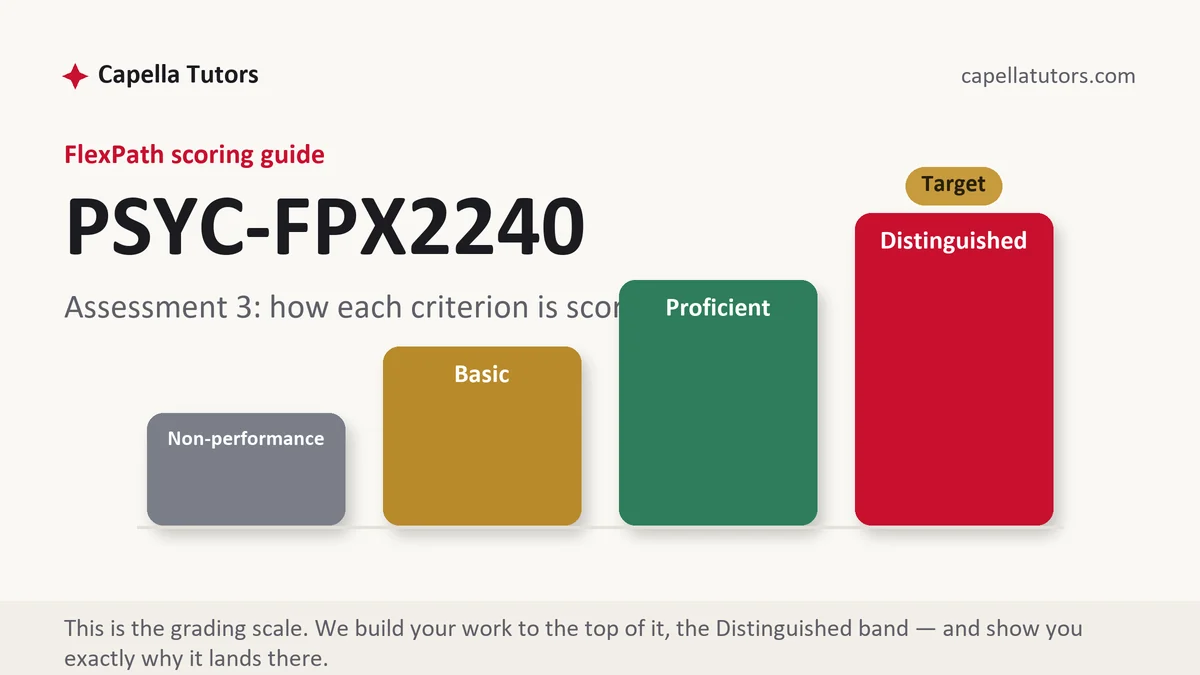
How PSYC FPX 2240 Assessment 3 is scored
There is no curve and no letter grade. Each criterion is scored at one of four levels, and the top level reads as an instruction:
| Level | What it means on a diagnosis and recommendation |
|---|---|
| Distinguished | Every number is written with its denominator and the period it covers, the competing explanations are separated by evidence rather than by preference, and the writer names what would overturn the verdict. |
| Proficient | One explanation supported with data and applied to the workplace. Defensible, with the alternatives acknowledged rather than tested. |
| Basic | A rate quoted without its base, a cause asserted, and a general improvement recommended. The usual first attempt at work of this kind. |
| Non-performance | A required element is missing, most often the alternative explanations or the measure that would show the recommendation worked. |
Read the evidence row and the evaluation row together before drafting. This deliverable is graded less on the answer than on whether the reasoning could have produced a different one.
The PSYC FPX 2240 Assessment 3 method, step by step
-
Write the measure out in full before interpreting it
A rate is a numerator over a denominator across a period. Nineteen separations against an average headcount of fifty over twelve months means something. Thirty-eight percent on its own means whatever the reader assumes, so say who was counted and who was left out.
-
Lay the competing accounts side by side
Selection, job design and supervision each explain a high separation rate, and so do pay and a local labor market. Write them all out before choosing, because an account you never considered cannot be ruled out later.
-
Read the pattern, not the total
Each account leaves a different signature. Exits clustered inside the first ninety days point one way, exits clustered at a common tenure point another, exits concentrated under one supervisor a third. The distribution decides what the total cannot.
-
Weigh accumulated evidence over the convenient study
When a meta-analysis and a single study disagree, the accumulated estimate usually wins, and when a finding came out of one setting, name the setting before carrying it anywhere else. Report relationships as associations unless the design earned a stronger verb.
-
Recommend narrowly and attach the measure
One change, one owner, one start date, and the number that should move with the period you would read it over. Then name what the change cannot fix, because a recommendation that claims to solve turnover has claimed too much.
-
Name the confound, then self-score
Say what else was happening in the same window, a seasonal peak, a plant nearby hiring, a supervisor on leave, and say what evidence would overturn your verdict. Then score each criterion yourself, D, P, B or N, and rewrite anything below the top level.
A structure that maps to the criteria
The word targets below are our tutors' planning figures for a deliverable of this kind, not Capella rules; stretch the section your own criteria lean on hardest.
| Section | What it must do | Guide word target |
|---|---|---|
| Introduction | The organization in general terms, the number that prompted the paper, and the verdict the paper will defend. | ~150 words |
| The measure defined | Numerator, denominator, period, who was counted, who was excluded, and where the data came from. | ~200 words |
| The competing accounts | Every explanation that fits the facts, stated fairly enough that a reader could argue for it. | ~250 words |
| The evidence that separates them | The pattern in the data, the accumulated research behind each account, and the verdict it supports. | ~350 words |
| The recommendation | One change with an owner, a start date, a cost, the measure that should move, and what it cannot fix. | ~250 words |
| Confounds, ethics, references | What else moved in the same window, what would overturn the verdict, confidentiality, current APA. | ~200 words |
Annotated sample excerpt
An original model passage from our team, written to show a rate defined properly and a verdict reached from the pattern rather than the total.
Turnover in the warehouse is quoted as 38 percent, and the figure means nothing until it is written out: 19 separations against an average headcount of 50 across the twelve months ending in June, voluntary exits only, with the seasonal drivers hired for two weeks in December left out.1 Three accounts fit that number and they leave different fingerprints, so the separation dates decide between them: 14 of the 19 left inside their first ninety days, which is the signature of a hiring process or an unrealistic preview rather than of job design, since a design problem empties a crew at a common tenure point instead of at the beginning.2 Accumulated evidence supports a realistic job preview and a structured first week as modest and reliable improvements, modest being the honest word for effects this size, and no single study of one warehouse would carry that recommendation on its own.3
- 1Rebuilds the rate from its parts and says who was excluded, which is what turns a headline number into evidence.
- 2Chooses between accounts using the distribution of exit dates and explains what the losing account would have looked like. Visible reasoning is what the evaluation row rewards.
- 3Sizes the recommended change honestly and refuses to lean on one study. Calling an effect modest costs nothing and buys the top column.
The full premium sample for your exact assessment, written fresh to your scoring guide and issue, is free to request. Study it, revise it into your own voice, and submit work you understand.
The five mistakes that cost Distinguished
- A rate quoted with no base and no window. Thirty-eight percent of what, over how long, counting whom. Without those three the number supports nothing.
- The first available explanation adopted as the answer. The competing accounts have to be written down before one of them can be defended.
- The total read instead of the distribution. Where in a tenure curve the exits sit is usually the whole finding, and an average hides it.
- One convenient study carrying a general claim. A single study describes what it did in the setting it ran in, and accumulated evidence carries claims about what generally works.
- A recommendation that promises to fix turnover. Name the part it addresses and the part it leaves alone, or the evaluation row will do that for you.
Pre-submission checklist
- Every rate written as numerator, denominator and period, with exclusions stated
- All the explanations that fit the facts listed before one of them is chosen
- The verdict reached from a pattern in the data, with the losing accounts answered
- Association language used everywhere a design did not earn something stronger
- One change with owner, start date, cost and the measure that should move
- The confound in the same window named, employer anonymized, every criterion self-scored D
Synthesis deliverable due and every explanation fits?
Send the criteria and whatever numbers you have, however rough. We rebuild each rate from its parts, separate the competing accounts on the pattern in the data, and write the verdict alongside the evidence that could overturn it. Premium original sample in 24 to 48 hours, free revisions until every row clears.