This manual is for PSYC FPX 2240 Assessment 2, start to submission. Assessment 2 usually turns the course toward motivation: one theory, one job, and an account of why effort is or is not showing up in the work. The failure mode is the survey, four theories named and none of them applied, which answers a knowledge criterion several times and the application criterion not at all. Below is how our tutors run a motivation case, the structure the criteria reward, and an annotated excerpt. Prefer to hand it over? A premium original sample matched to your own scoring guide returns in 24 to 48 hours, with free revision until it lands. Capella's catalog lists the course as PSYC-FPX2240, and some courserooms print PSYC2240; both point to this same Assessment 2.
One honesty note before the manual: Capella revises courses and scoring guides over time, so always write to the exact scoring guide attached to your assessment in the courseroom. The course identity above is verified on capella.edu; the method and structure below are our tutors' approach to it, not Capella's official rubric text.
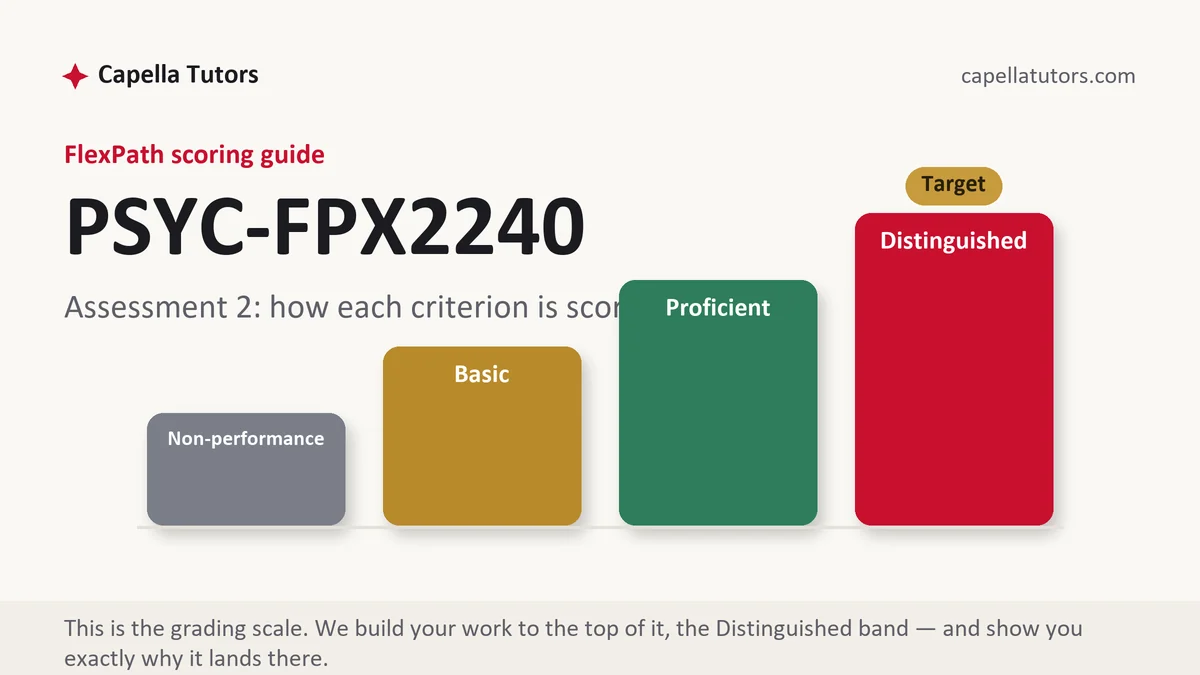
How PSYC FPX 2240 Assessment 2 is scored
No letter grades appear anywhere in FlexPath. Every criterion sits at one of four levels, and the level text is the specification:
| Level | What it means on a motivation case |
|---|---|
| Distinguished | Every component of the theory is tested against something observable in the job, the component that actually failed is identified, and the fix is aimed at that component rather than at the whole problem. |
| Proficient | The theory applied to the job accurately and completely. Sound, and treating all of its components as equally in play. |
| Basic | A theory summarized, then the job asserted to lack motivation. The shape most first drafts take here. |
| Non-performance | A required element is missing, most often the application to the role or a recommendation of any kind. |
Diagnosis is what separates the columns. Two drafts can name the same theory and describe the same job, and the one that says which link is broken and how that would show up in the data takes the row.
The PSYC FPX 2240 Assessment 2 method, step by step
-
State the problem in things you could count
Not low morale. Overtime refused on three of four weekends, two of nine operators reaching the target, a suggestion box with nothing in it since March. Counting turns a complaint into a case, and the criteria are scored against a case.
-
Choose the theory whose parts you can actually see
Expectancy theory when effort seems to lead nowhere, goal-setting theory when targets are vague or nobody agreed to them, the job characteristics model when the work itself is the problem, organizational justice when the argument is about how a decision was made. Then give one sentence on why that theory fits this job, because choosing on evidence is itself graded.
-
Test each component one at a time
Walk the components through the job in order and mark each one intact, broken or unverified. A component you cannot check is still a finding, provided you say what you would need in order to check it.
-
Rule out the rival account
A motivation problem and a design problem look identical from a distance. Ask what else would produce the same behavior, a tool that jams, an instruction nobody understood, a supervisor who reverses decisions, then say which evidence would separate them.
-
Aim the recommendation at the broken link, with the cost said
Repair the component that failed instead of everything at once. Name what it costs in money or hours, who signs it off, when it starts, and what should improve. A change that costs nothing and requires a supervisor to hand over control still has a price, and naming that price is part of the answer.
-
Say what would change your mind, then self-score
Write the observation that would tell you the diagnosis was wrong. Keep clinical vocabulary out, describe behavior rather than character, and stay inside your own role. Then grade each criterion D, P, B or N and lift anything short of the top before you submit.
A structure that maps to the criteria
Treat the targets below as planning figures for a case of this length rather than as Capella requirements; expand whichever section your criteria weight most heavily.
| Section | What it must do | Guide word target |
|---|---|---|
| Introduction | The job, the behavior anybody could observe, and the question this paper is going to answer. | ~150 words |
| The setting and the behavior | What the work is, how it is measured, what is paid for it, and the pattern that prompted the paper. | ~250 words |
| The theory and its components | The theory, the people who proposed it, and its components listed because each one is about to be used. | ~250 words |
| Component by component | Each part tested against the job, marked intact, broken or unverified, with the evidence behind each verdict. | ~350 words |
| The recommendation | The repair aimed at the failed component, its owner, its cost, its start date, and the measure that should move. | ~250 words |
| Rival accounts, ethics, references | What else could produce the same behavior, the confidentiality boundary, and current APA both ways. | ~200 words |
Annotated sample excerpt
An original model passage from our team, written to show a theory tested component by component instead of summarized.
Expectancy theory splits the question into three links, and on the night shift only the first one holds.1 Effort to performance is intact, since an operator running the press well reaches the per-job target and seven of nine do; performance to outcome is broken, because the bonus is calculated on a plant-wide monthly total that two other shifts also move, so a good night disappears into somebody else's bad week; and the outcome is worth less than the plant assumed, since the crew, asked directly, put a predictable finish time ahead of the money.2 That reading points at a narrow fix rather than a larger bonus: calculate the incentive on the shift's own completed jobs and post the running figure where the crew walks past it, which repairs the link that actually failed.3
- 1Commits to a verdict in the first sentence, so the evaluator reads the analysis already knowing what it concluded.
- 2Tests all three links with a number or a quotation behind each verdict, and treats the value of the reward as evidence rather than as an assumption.
- 3Aims the recommendation at the broken link only. Fixing the part that failed is what separates the top of the guide from a competent middle.
The full premium sample for your exact assessment, written fresh to your scoring guide and issue, is free to request. Study it, revise it into your own voice, and submit work you understand.
The five mistakes that cost Distinguished
- Four theories named, none applied. A survey answers the knowledge row repeatedly and leaves the application row untouched.
- Motivation offered as the diagnosis. Nobody can act on low motivation, while a broken link between performance and reward is something a supervisor can repair.
- A component skipped in silence. If you cannot verify part of the theory, say what evidence you would need. Silence reads as an omission instead of a limit.
- A coworker described in clinical terms. Undergraduate work describes behavior, and borrowed diagnostic vocabulary costs the ethics row while gaining nothing.
- A fix with no cost and no owner. Free changes still spend somebody's authority and somebody's hours, and the recommendation row is graded on whether that was thought about.
Pre-submission checklist
- The problem written in counts, dates or rates rather than in adjectives
- One sentence saying why this theory fits this particular job
- Every component marked intact, broken or unverified with its evidence
- One rival explanation named, plus the evidence that would separate it
- The recommendation aimed at the failed component, with owner, cost and start date
- No clinical vocabulary, employer unnamed, every criterion self-scored D
Motivation case due on a job you know too well?
Tell us the shift pattern, what performance is measured on, what pay is tied to and what people say about it. We test the theory link by link against your job and aim the recommendation at the part that broke. Anonymized as we write, back in 24 to 48 hours, revised free until the criteria are met.