This manual is for PSYC FPX 2240 Assessment 1, start to submission. The first deliverable in Psychology of the Workplace usually asks you to hold one thing still: a real job described in observable detail, what the work actually requires, and an evaluation of how people are chosen for it. Explaining a theory correctly and stopping there answers the lighter criterion and leaves the heavier one blank. Below is the method our tutors use, the sections that satisfy the criteria, and an annotated excerpt from an original model. Prefer to hand it over? A premium original sample written to your own scoring guide comes back in 24 to 48 hours, revised free until every row clears. Capella's catalog lists the course as PSYC-FPX2240, and some courserooms print PSYC2240; both point to this same Assessment 1.
One honesty note before the manual: Capella revises courses and scoring guides over time, so always write to the exact scoring guide attached to your assessment in the courseroom. The course identity above is verified on capella.edu; the method and structure below are our tutors' approach to it, not Capella's official rubric text.
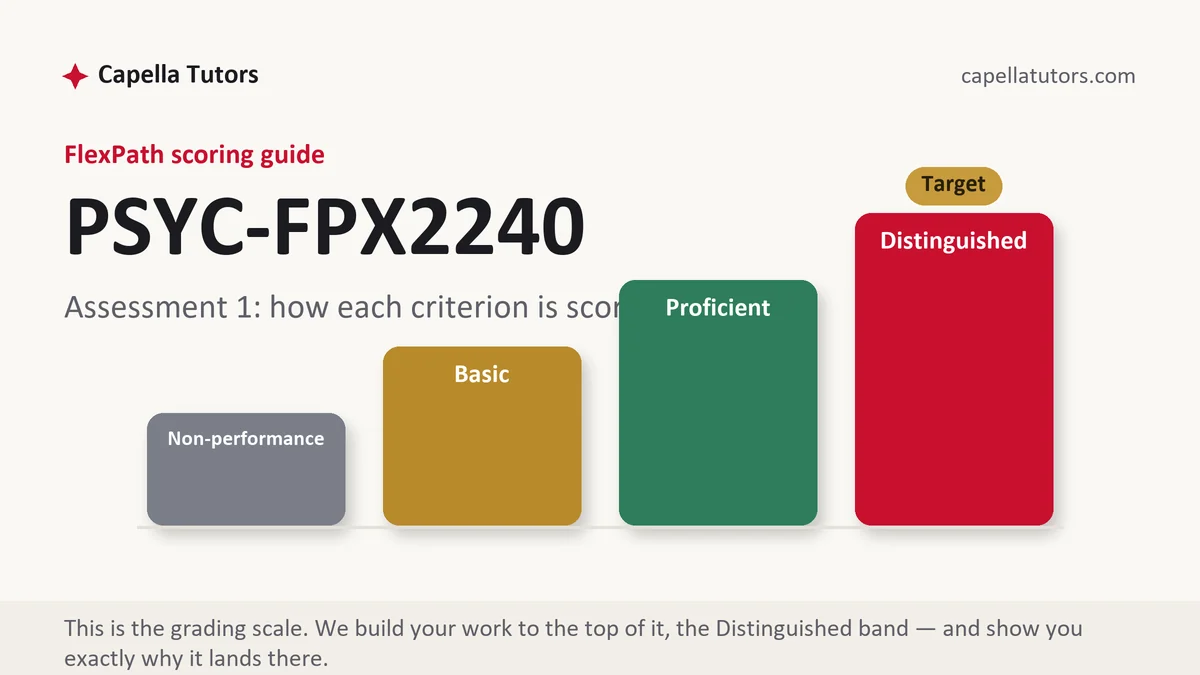
How PSYC FPX 2240 Assessment 1 is scored
FlexPath does not issue letter grades. Each criterion is placed on one of four levels, and the level wording is the brief you write to:
| Level | What it means on a role and selection analysis |
|---|---|
| Distinguished | The job is described in terms somebody could verify, the requirements trace back to what the work involves rather than to a wish list, and the selection methods are compared on accumulated evidence with the size of the relationship stated. |
| Proficient | The role described and the hiring process evaluated accurately. Complete, and argued as though one study settled the matter. |
| Basic | A job summarized in adjectives with a theory attached afterward. The most common first attempt in this course. |
| Non-performance | A required element is absent, most often any analysis of the job itself or any evidence behind the recommendation. |
Two habits move a draft up this table faster than a longer reference list. Write the job in things a stranger could count, and give every claim about what predicts performance the size the research actually reported.
The PSYC FPX 2240 Assessment 1 method, step by step
-
Read the criteria, then choose a job you can see
Copy each criterion in as a heading before committing to a workplace. Then pick a role you have watched from close range: shifts, headcount, what gets measured, who signs off on what. Observable detail is the ingredient no other submission will have, and the application criteria are built to reward it.
-
Do the job analysis before you have an opinion
List the tasks in the order the work happens, then the knowledge, skills, abilities and other characteristics each task calls for. O*NET is the citable source for what a role generally involves and the Bureau of Labor Statistics for wages and employment levels, each with its year attached. A requirement nobody can tie back to a task is somebody's preference wearing a job description.
-
Write down how candidates are chosen now
Who screens, what gets asked, in what order, and what is written down afterward. Describe the process that runs rather than the one in the handbook, because the evaluation criterion is scored against a real procedure.
-
Compare methods on accumulated evidence, with the size said out loud
A validity coefficient is a correlation between a selection method and later performance, so figures in the .3 to .5 range describe a method that helps on average and settles nothing about one applicant. Prefer a meta-analysis when the claim is about what generally works, and cite a single study only for what that study did.
-
Propose the change somebody could authorize
Name what changes, who owns it, what it costs in money or hours, and when it could start. A structured question set with written anchors and a short work sample sits inside a branch manager's authority; a new applicant tracking system does not, and the difference is worth marks.
-
Guard the confidentiality line, then self-score
Leave the employer unnamed, keep pay records, personnel files and disciplinary matters out, and if a real episode is too identifiable, write a composite and label it as one. Then grade each criterion yourself, D, P, B or N, rewrite anything short of D, and submit early in the week since an evaluation can take two business days.
A structure that maps to the criteria
These word targets are our tutors' planning figures for an analysis of this size rather than Capella rules; give the extra words to whichever row your own guide weights hardest.
| Section | What it must do | Guide word target |
|---|---|---|
| Introduction | The role, the organization in general terms, the problem visible in the hiring, and what the paper will recommend. | ~150 words |
| The job described | Tasks in sequence, hours, volume, supervision, and how performance is currently judged. | ~250 words |
| What the work requires | The knowledge, skills and abilities each task calls for, sourced rather than assumed. | ~250 words |
| The current selection process | Every step a candidate passes through now, who runs it, and what record it leaves behind. | ~200 words |
| The evidence on methods | What accumulated research says about the methods on the table, with the size of each relationship given. | ~300 words |
| Recommendation, limits, references | The change, its owner, its cost, the measure that would show it worked, plus confidentiality and current APA. | ~250 words |
Annotated sample excerpt
An original model passage from our team, written to show a comparison of selection methods that reports sizes instead of implying them.
The credit union fills its member service openings from one thirty-minute conversation with the branch manager, unstructured, different questions each time, and nothing written down about what was asked.1 Accumulated research places structured interviews and work samples ahead of that conversation as predictors of later performance, with validity coefficients commonly reported between roughly .3 and .5 and intervals wide enough to keep arguing about, which describes a method that helps across many hires and says nothing certain about the applicant in front of you.2 The change is small enough to authorize in a morning: four questions asked of every candidate in the same order and scored one to five against written anchors, plus a twelve-minute exercise in which the applicant works through a scripted dispute over a duplicated charge.3
- 1Describes the process that exists rather than the one in the handbook, and names the three features that weaken it without calling it weak.
- 2Reports the relationship as a range with an interval, then translates it: helpful across many hires, silent about one person. That translation is the sentence the evidence row wants.
- 3Puts the recommendation inside one person's authority and specifies it far enough that somebody could run it on Monday. Vague improvements score as Basic.
The full premium sample for your exact assessment, written fresh to your scoring guide and issue, is free to request. Study it, revise it into your own voice, and submit work you understand.
The five mistakes that cost Distinguished
- A theory explained and the job left alone. The application row usually carries the most weight here, and a correct theory section cannot cover for an empty one.
- Requirements that came from a wish list. Every knowledge, skill or ability has to trace back to a task somebody performs, or the analysis row has nothing to check.
- A validity coefficient read as a guarantee. It describes an average across many hires and stays silent about the person in front of you, and writing that down earns the row.
- A recommendation with nobody attached. If no named role could carry it out this quarter, what you have written is a wish rather than a recommendation.
- A consulting white paper standing in for research. Marketing with a sample size printed on the cover is still marketing, and the citation row treats it that way.
Pre-submission checklist
- Each criterion from the guide appears in the draft as its own heading
- The role described in details a stranger could count
- Every requirement traced back to a task inside the job
- The current hiring steps written down as they actually run
- Method comparisons carrying the size of the relationship, not only its direction
- Employer and individuals unnamed, references matched both ways, every criterion self-scored D
Workplace analysis due and the job is hard to describe?
Send the criteria and a handful of observable facts: shifts, headcount, how performance is judged, how people get hired. We build the analysis around your role, anonymized as we write, with every claim about selection sourced to accumulated evidence. Premium original sample in 24 to 48 hours, revised free until the guide clears.