This manual is for PSYC FPX 1540 Assessment 3, start to submission. The closing deliverable in The Psychology of Human Differences and Society usually asks what should be done: a recommendation aimed at one named group in one named place, resting on a framework whose conditions are stated rather than implied, carrying the outcome it is meant to move and the measure that would show it moved. A slogan is not a recommendation; a plan a dean could sign is. Below is our tutors' method, a structure assembled criterion by criterion, and an annotated excerpt. If you would rather have backup, a premium original sample written to your prompt is delivered inside 24 to 48 hours and revised until every line clears. Capella's catalog lists the course as PSYC-FPX1540, and some courserooms print PSYC1540; both point to this same Assessment 3.
One honesty note before the manual: Capella revises courses and scoring guides over time, so always write to the exact scoring guide attached to your assessment in the courseroom. The course identity above is verified on capella.edu; the method and structure below are our tutors' approach to it, not Capella's official rubric text.
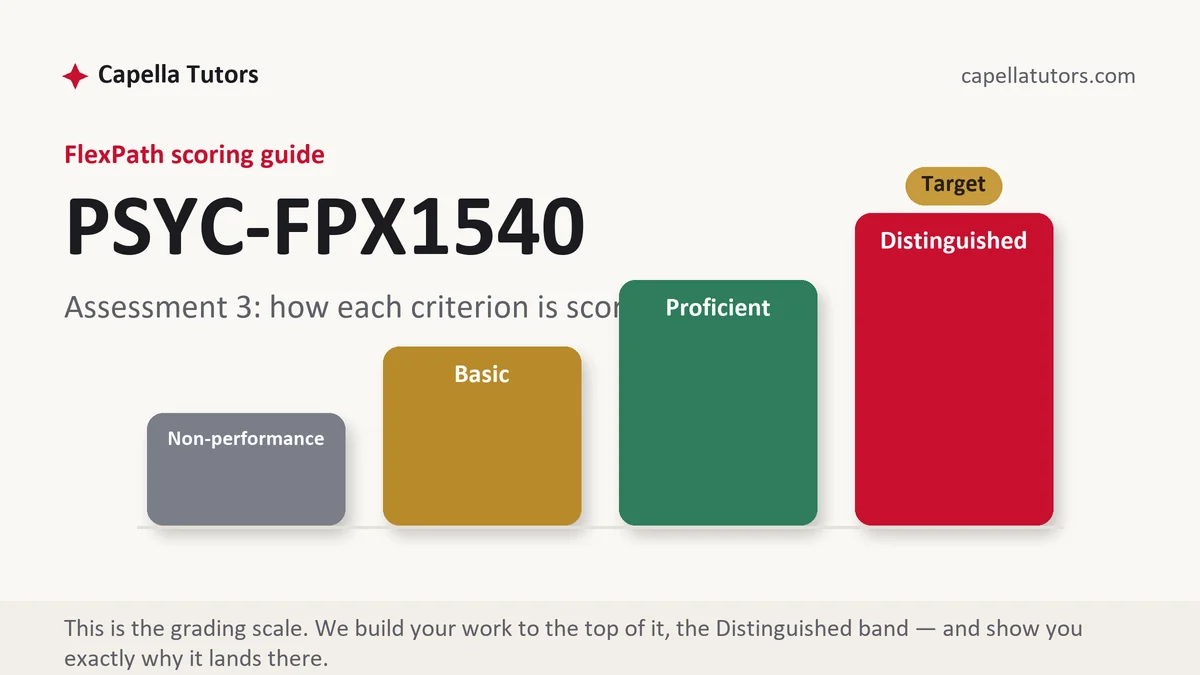
How PSYC FPX 1540 Assessment 3 is scored
Four levels per criterion, no letter grade over the top of them, and the wording of the level you want is the closest thing you have to a brief:
| Level | What it means on a recommendation |
|---|---|
| Distinguished | The plan is sized to the setting, the framework's conditions are named one at a time and matched to features of the plan, an outcome and a measure are attached, and the writer says what the arrangement cannot separate. |
| Proficient | A sound recommendation with evidence behind it, missing either the conditions or the measure that the column above asks for. |
| Basic | Encourage more interaction, raise awareness, provide training. True of everywhere, actionable nowhere. |
| Non-performance | The recommendation, the evidence behind it, or the stated limitation is not on the page at all. |
Contact between groups is the framework this course reaches for most often, and its value sits in the conditions rather than in the headline. The 1954 formulation attached requirements to the claim, and the meta-analytic work half a century later reported the association across a wide range of settings while treating those requirements as helpful rather than mandatory. Write the conditions into the plan and one paragraph produces both a hedged claim and something a committee could approve.
The PSYC FPX 1540 Assessment 3 method, step by step
-
Choose one group, one place, one outcome
A recommendation for society is not a recommendation. Name who does what, where, and what is supposed to change: eight pairs of students, one shared course, willingness to work with the other group again. Every criterion after this one is scored against that sentence, so write it before you write anything else.
-
Pick a framework that arrives with conditions
Frameworks carrying conditions are worth more here than frameworks carrying slogans, because the conditions turn straight into the design of your plan. If the framework you have chosen has no conditions attached to its claim, you are about to write advice rather than a recommendation, and the criteria can tell those apart.
-
Map each condition onto a feature of the plan
Take the conditions one at a time and point at the part of the plan that satisfies each one: the same role inside the activity, a task neither person can finish alone, the institution's name on the arrangement, and nobody asked to represent a category. A condition with no matching feature is a hole, and it is the first hole an evaluator finds.
-
Attach an outcome and a measure
Say what should change and how you would know it had. Three items asked before and after beats a page of hoped-for benefits, and a measure somebody could actually collect beats an ideal one nobody can. Where the outcome is an attitude, say that you are measuring what people report rather than what they do.
-
Name what the plan cannot separate
Anything that runs inside a course cannot be told apart from the course itself, and any before-and-after comparison sits alongside whatever else happened that term. Say so, then name the comparison that would separate them. That pair of sentences is usually the extra act the criterion is paying for.
-
Write the ethics constraint, then letter the guide
Say who could decline without cost, what becomes of anything you collect, and why nobody in the plan is being asked to educate anybody else. Then take the criteria one line at a time, letter each honestly, and rewrite whatever sits below the top column before you submit rather than after.
A structure that maps to the criteria
Our planning targets for a short undergraduate recommendation paper. They are tutor arithmetic, not school policy, and a criterion asking for more overrides any row here.
| Section | What it must do | Guide word target |
|---|---|---|
| Introduction | The setting, the group, and the change the recommendation is aimed at, inside one paragraph. | ~140 words |
| The problem, evidenced | What happens now, with counts, and the research that makes the pattern recognizable rather than anecdotal. | ~250 words |
| The framework and its conditions | The framework, where it came from, and the conditions it attaches to its own claim. | ~250 words |
| The recommendation | Who does what, with whom, how often, and under whose authority, at a scale the setting can staff. | ~300 words |
| Outcome, measure and limits | What should change, how it would be visible, and what the arrangement cannot separate. | ~250 words |
| Ethics, language and references | Consent and the cost of declining, bias-free language, current APA with frameworks cited to their authors. | ~180 words |
Annotated sample excerpt
A model passage of ours, at the register the top column describes. It is here to be dismantled, not copied.
What the college should build is small enough to staff: eight pairs, each one a student veteran and a student who enrolled straight from high school, working together on a single graded project inside a shared course rather than meeting to discuss difference.1 The conditions matter more than the pairing does. Both students hold the same role and the same stake in the grade, the project cannot be finished by either one alone, the syllabus names the arrangement so it carries the institution's authority instead of one instructor's enthusiasm, and neither student is asked to speak for a category.2 The outcome is narrow as well, willingness to work with the other group again, measured with the same three items before and after, and the arrangement cannot be told apart from the course around it, which a comparison section would fix.3
- 1The plan is sized to what the setting can actually staff, and the mechanism is a shared task rather than a conversation about difference. An evaluator can picture somebody running it.
- 2The framework's conditions are named one at a time and each is matched to a feature of the plan, which is how a citable framework turns into something an administrator could authorize.
- 3An outcome, a measure, and the limit of the design, all supplied by the writer. Naming what the plan cannot separate is the sentence that lifts this criterion a column.
The full premium sample for your exact assessment, written fresh to your scoring guide and issue, is free to request. Study it, revise it into your own voice, and submit work you understand.
The five mistakes that cost Distinguished
- Raise awareness. A recommendation that would fit any campus in the country has not been written for this one.
- A framework quoted without its conditions. Contact reduces prejudice is the headline; the conditions are the material your plan is actually built from.
- An outcome with no measure. If nothing would look different afterward, there is nothing to evaluate, and the criterion will say so.
- A plan the setting cannot staff. Twelve workshops and a full-time coordinator is not a recommendation for an office with two advisors.
- One group assigned to teach the other. A plan should not turn anyone's participation into a service they owe, which is an ethics problem before it is a design problem.
Pre-submission checklist
- One group, one setting and one intended change, all named in the opening
- The framework's conditions listed, each matched to a feature of the plan
- The plan states who does what, with whom, how often, and under whose authority
- An outcome and a measure somebody could actually collect
- One sentence naming what the arrangement cannot separate, and the comparison that would
- Consent and the cost of declining addressed, APA current, each criterion self-lettered D
Recommendation due and nothing to recommend?
Send the criteria and the setting you have in mind. A team of eight, including a research analyst and two QA reviewers, returns a premium original sample in 24 to 48 hours with the conditions mapped onto a plan and a measure fastened to the outcome, revised free until the criteria clear.