How to write PSYC-FPX1540 Assessment 2

The short answer

This manual is for PSYC-FPX1540 Assessment 2, start to submission. The second deliverable in The Psychology of Human Differences and Society usually moves from defining a construct to catching one at work: a single decision, made by real people in a named setting, explained through a mechanism the literature supports, then bounded by what that literature can and cannot say about those particular people. The method our tutors use follows, along with a structure drawn from the criteria and an annotated excerpt. Want it off your desk instead? A premium original sample for this deliverable is back with you inside 24 to 48 hours, revised free until the guide is satisfied. Your courseroom may print this as PSYC FPX 1540 Assessment 2 or PSYC1540 Assessment 2; it is the same deliverable, and PSYC-FPX1540 Assessment 2 is what this manual walks through.

One honesty note before the manual: Capella revises courses and scoring guides over time, so always write to the exact scoring guide attached to your assessment in the courseroom. The course identity above is verified on capella.edu; the method and structure below are our tutors' approach to it, not Capella's official rubric text.
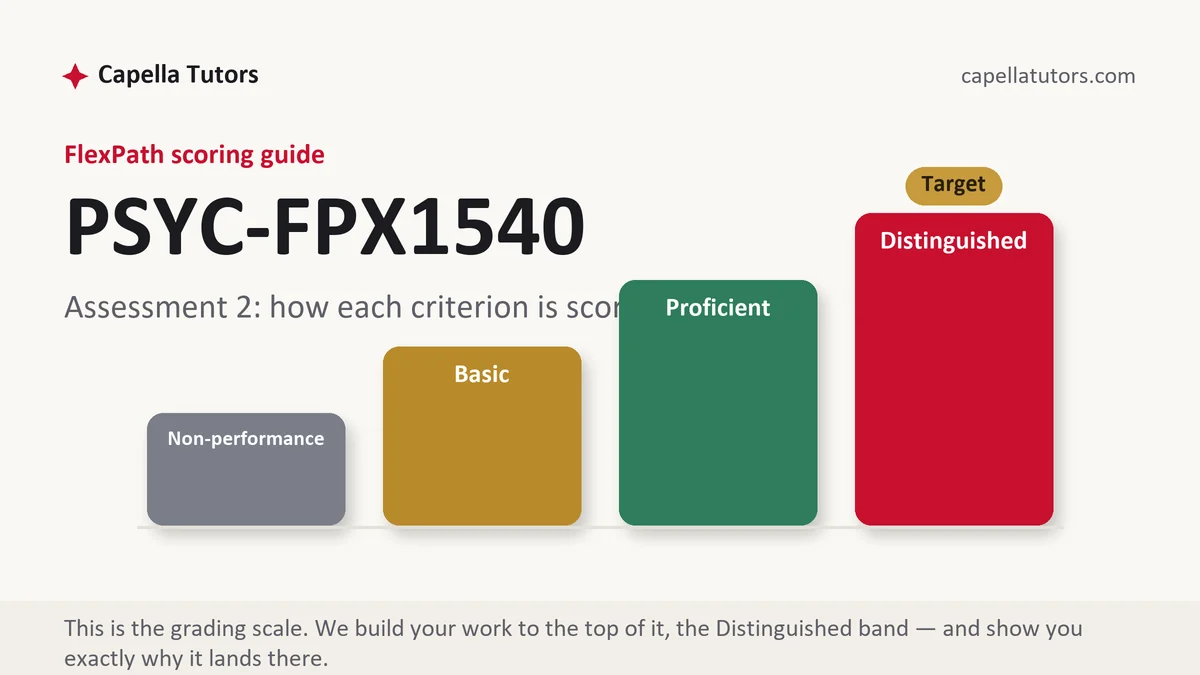
PSYC-FPX1540 Assessment 2 grading scale at Capella FlexPath, the criterion levels this assessment is scored on, from Capella Tutors
How Capella FlexPath grades PSYC-FPX1540 Assessment 2, visualized by Capella Tutors.

How PSYC-FPX1540 Assessment 2 is scored

Every criterion is marked on its own line at one of four levels, and the level you land on depends less on how the paper reads than on which sentences are present in it:

LevelWhat it means on an applied analysis
DistinguishedThe decision is recorded with counts before it is interpreted, the stereotype content is named rather than the category, the mechanism runs as a sequence, the evidence is sized, and the step from a group average to these individuals is refused out loud.
ProficientThe construct is correctly applied and properly supported. Accurate work, short of the sizing and the refusal the top column asks for.
BasicA description of something unfair with a citation appended, or an explanation that runs on the actors' presumed feelings instead of on a process.
Non-performanceA required element is missing, most often the mechanism or the limitation on what the evidence can support.

Most of the distance between the middle columns in this course is the distance between a motive and a mechanism. A motive says the supervisor did not care for older workers. A mechanism says an ambiguous signal was read in line with an expectation and then converted into a preference nobody checked. The second version can be supported or undercut by evidence, and it is usually the fairer description of what happened.

The PSYC-FPX1540 Assessment 2 method, step by step

  1. Write the decision as a record rather than a story

    Before any interpretation, put down who decided what, on what date, with what counts, and in whose words. A record can be checked against your later claims, and every criterion after this one is scored against it. If the prompt supplies the case, take the particulars from the prompt instead of improving on them.

  2. Name the content of the stereotype, not just the category

    The category is age, or language, or parental status. The content is the specific belief attached to it, that learning new software is young people's work, or that a strong accent signals weak reasoning. Content is the part a mechanism can be built out of, and a paper that names only the category has nothing to explain with.

  3. Build the mechanism as a sequence

    Write it in steps a reader could check: an ambiguous signal arrives, an expectation supplies the reading, the reading becomes a decision, and the decision then produces the evidence that confirms the expectation next time. Sequences invite disagreement about a specific step, which is exactly what an evaluator reads a mechanism for.

  4. Size the evidence and say where it came from

    A pattern documented across many decisions is a statement about averages, and a review or meta-analysis outranks a single study whenever both exist. Report how large the pattern is and how much variation sits inside each group, because a difference between averages can be small next to the spread within either one.

  5. Refuse the step to these individuals, in writing

    Say plainly that a pattern found across workplaces constrains what this office should assume and settles nothing about the two people in the case. That sentence is not a retreat from your argument. It is the sentence that shows you know what kind of claim you have been making.

  6. Run the language pass last, then letter the guide

    Search the finished draft for every label describing a person or a group, prefer the specific term and the self-identified one, and put the person before the category. Then read the criteria one line at a time, letter each one honestly, and give any line below the top column one more pass before you submit.

A structure that maps to the criteria

The targets below are our planning arithmetic for a short applied paper, not a rule from the school. Where a criterion asks for more, the criterion decides.

SectionWhat it must doGuide word target
IntroductionThe setting, the decision under analysis, and the question the paper answers about it.~140 words
The decision, recordedWho decided what, with counts, dates and the wording actually used, ahead of any interpretation.~220 words
The construct and its contentThe dimension of difference, the specific belief in play, and the neighboring terms this is not.~230 words
The mechanism, step by stepThe sequence from signal to reading to decision, written so a reader could dispute one step.~300 words
The evidence, sizedDesigns and samples behind the pattern, how large it is, and how much variation sits inside each group.~250 words
Limits, ethics and referencesWhat the evidence cannot say about these people, the boundary on your own inference, current APA.~200 words

Annotated sample excerpt

A model passage from our team. Read the order of the sentences as closely as the content, because the order is doing half the scoring work.

Sample excerpt: the mechanism inside the decision Original model · Capella Tutors

Eleven clerks handle billing in the district office, and when the vendor offered six seats at the new-system training the supervisor filled three of them from the four clerks under thirty five, left the two clerks over sixty off the list, and described them afterward as people who would rather not.1 The stereotype content is competence, specifically the belief that learning new software is young people's work, and the mechanism is not dislike: an ambiguous signal, one hesitant question asked in a staff meeting, was read in line with an expectation and then converted into a preference nobody checked.2 Research on age stereotypes in workplace decisions supports that pattern at the level of averages across many decisions and reports wide variation in trainability inside every age band, so the finding constrains what this office should assume and settles nothing about these two clerks.3

  • 1The decision is recorded with counts and with the supervisor's own words before a single interpretive sentence appears, so every later claim can be checked against this one paragraph.
  • 2Content is named instead of the category, and the mechanism runs as a sequence rather than as a motive, which is what makes it something evidence could support or undercut.
  • 3The evidence is sized and located, and the step from average to individual is refused in the writer's own sentence rather than left for the feedback to supply.

The full premium sample for your exact assessment, written fresh to your scoring guide and issue, is free to request. Study it, revise it into your own voice, and submit work you understand.

Get the full sample free

The five mistakes that cost Distinguished

  • A motive where a mechanism belongs. Putting the decision down to dislike explains nothing anyone could test, and the mechanism criterion is usually the one paying most.
  • The verdict written before the record. An analysis that opens on unfairness has nothing left to find out, and an evaluator reads the opening for precisely that.
  • The category doing the content's work. Age on its own predicts nothing in this case; the belief fastened to it does the predicting.
  • An effect reported without its variation. A pattern that holds on average across thousands of decisions can be swamped by the spread inside one office, and reporting that is not a concession.
  • Group evidence used to indict one person. The literature can say what panels do on average and cannot say what this supervisor was thinking.

Pre-submission checklist

  • The decision recorded with counts, dates and quoted wording before any interpretation
  • Stereotype content named, and kept separate from prejudice and from discrimination
  • The mechanism written as a sequence whose steps could each be disputed
  • The evidence sized, with the variation inside each group reported
  • One sentence refusing the move from the group finding to these individuals
  • Person-first and specific language throughout, APA current, each criterion self-lettered D

Applying a construct to a real workplace?

Send the criteria and the setting, or ask us to build a setting that fits the prompt. A team of eight, including a research analyst and two QA reviewers, returns a premium original sample in 24 to 48 hours with the mechanism written as a sequence and every finding sized, revised free until the criteria clear.

Keep going

Online now