This manual is for PSYC-FPX1540 Assessment 1, start to submission. The opening deliverable in The Psychology of Human Differences and Society usually asks you to take one dimension of difference, define it the way psychology defines it, show how the discipline has studied it, and put it to work inside a single setting. The subject is not diversity in general and it is not your view of it; the criteria want a construct, a sample, a mechanism and a stated limit. Below you get the method our tutors use, a structure lifted from the criteria, and an annotated excerpt. Prefer to hand the whole thing over? A premium original sample written to your own guide arrives in 24 to 48 hours, with free revisions until it scores. Your courseroom may print this as PSYC FPX 1540 Assessment 1 or PSYC1540 Assessment 1; it is the same deliverable, and PSYC-FPX1540 Assessment 1 is what this manual walks through.
One honesty note before the manual: Capella revises courses and scoring guides over time, so always write to the exact scoring guide attached to your assessment in the courseroom. The course identity above is verified on capella.edu; the method and structure below are our tutors' approach to it, not Capella's official rubric text.
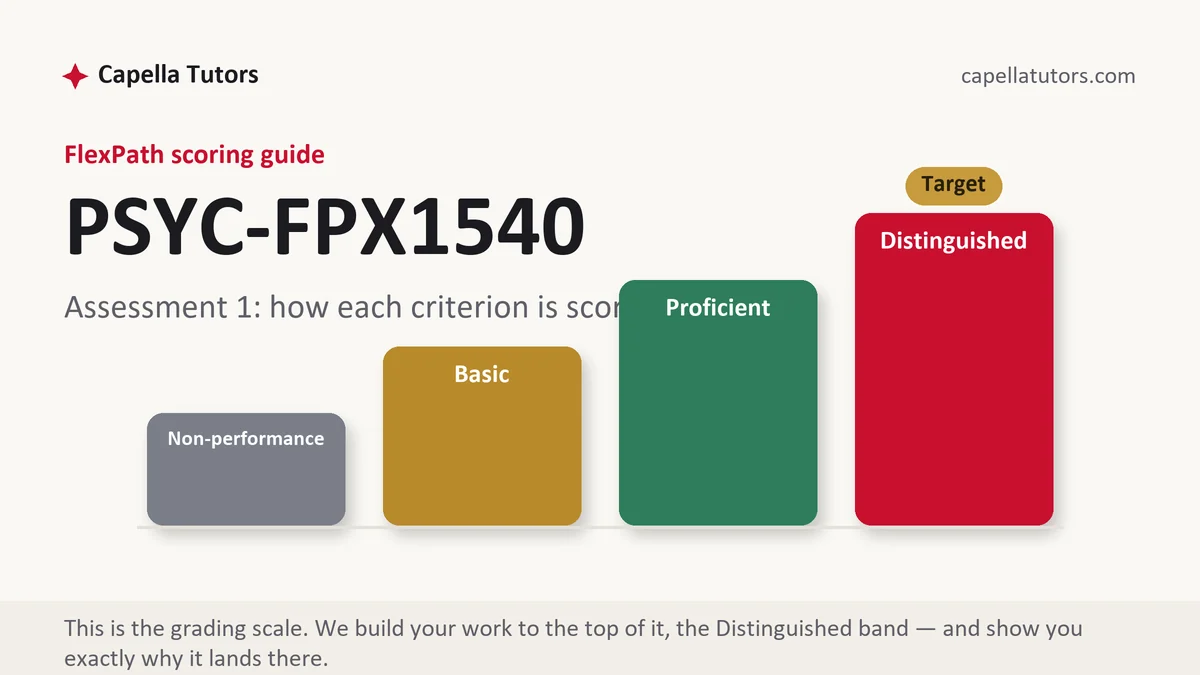
How PSYC-FPX1540 Assessment 1 is scored
FlexPath marks criteria rather than papers. Each line of the guide lands at one of four levels, and the language inside those levels is the specification you are building to:
| Level | What it means on a construct-and-evidence paper |
|---|---|
| Distinguished | The construct is defined tightly enough to be told from its neighbors, the evidence arrives with its samples attached, one setting is described concretely, and a group-level finding is never allowed to become a claim about an individual. One further act sits in the criterion wording; make it on purpose. |
| Proficient | Definition, evidence and application are all correct and complete, without the extra care the column above describes. |
| Basic | A term defined correctly and then discussed in general, or a strongly felt verdict with a citation attached to it. The usual first-attempt landing spot here. |
| Non-performance | A required part is not on the page, most often the limitation or the setting the construct was supposed to be applied to. |
Precision about groups of people is the thing being marked. A finding that describes an average has to be written so nobody can read it as a description of one person, and a term borrowed from everyday speech has to be tightened until it means what psychology means by it. Each move costs a clause, and both are visible to an evaluator by the end of your first page.
The PSYC-FPX1540 Assessment 1 method, step by step
-
Narrow to one dimension, one setting, one question
Difference is not a topic and neither is inequality. One dimension, one place, one answerable question is the shape that scores: whether first-generation students ask for help at a two-year college advising desk, and what makes the asking expensive. Write the question down as a question before you write anything else.
-
Define the construct against its neighbors
A definition earns marks by excluding things. Say what the construct is, then say what it is not, because a belief about a group is a stereotype, a feeling toward that group is prejudice, and treating someone differently is discrimination. A paragraph that has not chosen among the three cannot satisfy a mechanism criterion.
-
Collect the evidence with its samples attached
For every study, record who was studied, where, when and by what design, then keep those details inside the sentence that reports the finding. A result from one country's undergraduates is a result about that population until somebody shows otherwise, and naming the sample is what converts a sweeping claim into a defensible one.
-
Describe the setting before you explain it
Give the place counts, hours and roles: two advisors, a counter open four afternoons a week, appointment slots of fifteen minutes. An explanation of a setting the reader cannot picture reads as theory practising on itself, and application criteria are scored against the specifics you supplied.
-
Report group findings as distributions
Write the overlap out loud. A dependable difference between two groups still leaves most of their two distributions sitting on top of each other, so a group average tells you very little about the next person through the door. The sentence is short, it is reusable, and it is most of the reason this course exists.
-
State your standpoint, then letter the draft
Say briefly what your own position lets you see and what it does not, then go back to the evidence rather than staying with yourself. Read the guide one criterion at a time and letter each honestly, and search the draft for every group label before you submit, checking each against current guidance instead of against habit.
A structure that maps to the criteria
Word targets from our tutors, planning aids rather than requirements, sized for a short undergraduate paper in this course.
| Section | What it must do | Guide word target |
|---|---|---|
| Introduction | The dimension of difference, the setting, and the question the paper answers, in that order. | ~140 words |
| The construct defined | The psychological definition, the terms it gets confused with, and why the distinction matters in this setting. | ~230 words |
| How psychology studied it | Designs, samples and measures given before findings, each finding sized to the population it came from. | ~300 words |
| The setting, described | Counts, roles and routines for one place, written from observation rather than from adjectives. | ~200 words |
| Application and mechanism | The construct mapped onto what happens inside that setting, written as a sequence a reader can follow. | ~300 words |
| Limits, language and references | What the evidence cannot support, what your standpoint affords, bias-free language, current APA throughout. | ~200 words |
Annotated sample excerpt
Our own model passage. Notice how little room the definition takes and how much room the setting gets, because that ratio is itself a scoring decision.
First-generation status is not a trait, it is a description of what a household could hand a student in advance: neither parent finished a bachelor's degree, so the procedural knowledge other students arrive holding has to be assembled on site.1 At the advising counter of a two-year college, open four afternoons a week in fifteen minute slots, that difference shows up inside one behavior, asking a stranger for help, which is cheap when you already believe the desk exists for you and expensive when you suspect the question will mark you as out of place.2 The evidence for that reading comes from experiments that varied how a task was framed and from survey work on help-seeking, mostly with samples of four-year students in the United States, so it supports a claim about what tends to happen to students framed one way rather than another and cannot tell an advisor which of the four people waiting is carrying it.3
- 1The construct is defined as a circumstance rather than a personality, which is the distinction this course grades ahead of every other.
- 2The setting arrives with counts and hours, and the mechanism is written as a sequence, so a reader watches the construct operate instead of being told that it matters.
- 3Designs and samples are named, then the claim is trimmed to the size they support. Group level and individual level are held apart inside one sentence, which is the move the top column keeps rewarding.
The full premium sample for your exact assessment, written fresh to your scoring guide and issue, is free to request. Study it, revise it into your own voice, and submit work you understand.
The five mistakes that cost Distinguished
- Diversity as the subject. A dimension, a setting and a question can be answered in the space you have; a category that broad cannot be answered anywhere.
- Belief, feeling and behavior used interchangeably. Stereotype, prejudice and discrimination name three different things, and a paragraph that has not chosen among them explains none of them.
- A group average read onto a person. Overlapping distributions make that step wrong, and preventing it is close to the whole purpose of the course.
- Evidence chosen for its conclusion. A source picked because it agrees with you, with no look at who it studied, is the sourcing error this course marks hardest.
- Umbrella or dated labels. Current guidance prefers the specific term and the self-identified one, and the language line is scored as seriously as the argument lines above it.
Pre-submission checklist
- One dimension, one setting and one question, all named in the opening
- The construct defined against the two terms it is usually confused with
- Every finding reports its sample and its design before its result
- The setting described with counts and routines a reader can picture
- At least one sentence stating the overlap between the group distributions
- Group labels checked against current guidance, APA current, each criterion self-lettered D
Writing about a group you do not belong to?
Send the criteria and the setting you want used. A team of eight, including a research analyst and two QA reviewers, returns a premium original sample in 24 to 48 hours with every generalization tied to the sample it came from and the language checked against current guidance, revised free until the criteria clear.