This manual is for PM FPX 5018 Assessment 3, start to submission. The final deliverable covers what happens once the plan meets reality, and it usually asks for four things: risk written as entries somebody owns, change routed through a threshold instead of absorbed quietly, progress reported in the form each audience can act on, and a project shut down properly rather than left to fade into operations. These criteria carry more marks per word than any others in the course, largely because most submissions treat them as an afterthought. Your scoring guide decides whether the result is a risk and communications plan, a control and closure document, or a briefing with speaker notes. What comes next is the tutors' method, a structure organized around the criteria, and an annotated sample excerpt. Prefer to hand it off? A premium original sample for this exact assessment arrives in 24 to 48 hours, with free revisions until every criterion is satisfied. Capella's catalog lists the course as PM-FPX5018, and some courserooms print PM5018; both point to this same Assessment 3.
One honesty note before the manual: Capella revises courses and scoring guides over time, so always write to the exact scoring guide attached to your assessment in the courseroom. The course identity above is verified on capella.edu; the method and structure below are our tutors' approach to it, not Capella's official rubric text.
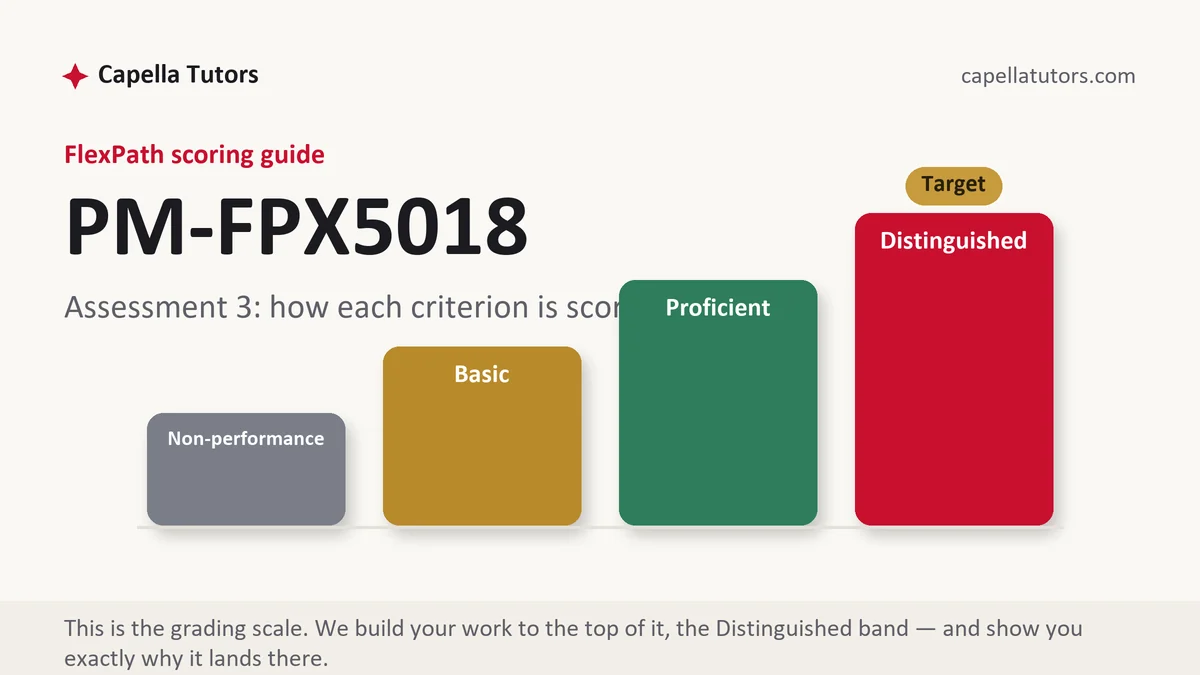
How PM FPX 5018 Assessment 3 is scored
One of four levels per criterion, and on a risk, control and closure package they distinguish themselves like this:
| Level | What it means on a risk, control and closure package |
|---|---|
| Distinguished | Risks are written as cause and effect with a quantified impact, a response, a firing trigger and one owner, change has a threshold and an approver, and closure hands the result to a named department on a date. |
| Proficient | A complete register and a workable control process. Impacts are ranked in words rather than in weeks or dollars, so nothing can be sequenced by exposure. |
| Basic | A list of concerns with high, medium and low beside them, a change section that says changes will be managed, and lessons written as feelings about the project. |
| Non-performance | An element simply missing: no owners at all, no closure section, or a communications plan that never says who receives what and when. |
The habit that lifts this whole deliverable is refusing to write anything a reader cannot act on. High is not an impact, soon is not a trigger, and the team is not an owner. Replace each of those with a number, a condition and a person and most of the criteria move a column on their own.
The PM FPX 5018 Assessment 3 method, step by step
-
Harvest risks from the plan you already built
Read your own schedule and budget looking for single points of failure: an activity on the critical path with one qualified person, an estimate with a wide spread, a dependency on a vendor you do not control, a resource borrowed from clinical work. The register should be a reading of the plan, not a list of generic project worries.
-
Write each risk as cause, event and effect
Because of a stated condition, an event may occur, which would produce a specific consequence. That grammar forces you to know which of the three you are actually worried about, and it makes the response obvious: causes get mitigated, effects get insured against or accepted.
-
Quantify exposure and rank by it
Give each entry a probability and an impact in weeks or dollars, multiply for exposure, and sort. Ranking is the point of the exercise. An unranked register tells a sponsor that all fifteen risks deserve equal attention, and it will be read once and never again.
-
Attach a response, a trigger and one name
Avoid, mitigate, transfer or accept, then the condition that fires the response and the single person accountable for watching for it. Two owners means no owner. A trigger written as a measurable threshold means the plan can act before the impact arrives rather than after.
-
Give change a threshold and reporting an audience
State who may approve what value of change, what happens to a request that is declined, and how an approved change revises the baseline. Then build the communication table by audience: what the sponsor gets and how often, what the steering group gets, what the affected departments get, and through which channel.
-
Close the project on paper, then self-score
Acceptance signed against the charter's success criteria, handover to a named operating owner on a date, contracts and staff released, and lessons written as instructions a future project manager could follow. Then mark yourself against each criterion and submit early in the week.
A structure that maps to the criteria
Working ranges for a risk and closure package; the register itself is usually a table, and its rows do not count against the prose you owe elsewhere.
| Section | What it must do | Guide |
|---|---|---|
| Risk identification method | Where the risks came from, who was consulted, and why the register is specific to this project. | ~200 words |
| The register | Cause and effect statements, probability, quantified impact, exposure, response, trigger, one owner. | ~350 words |
| Response planning | The top entries expanded, the cost of each response and what it buys, plus what is deliberately accepted. | ~250 words |
| Change control | Thresholds, approvers, the route for a declined request, and how an approval revises the baseline. | ~200 words |
| Communications | Audience, content, format, frequency and channel, with the escalation threshold set in advance. | ~200 words |
| Closure, lessons and references | Acceptance against charter criteria, handover owner and date, releases, lessons as instructions. | as needed |
Annotated sample excerpt
A single register entry from an original model our team wrote, printed in full because the fields are the lesson.
Risk L-04. Because method verification for the chemistry line depends on one applications specialist who is shared with the reference laboratory contract, verification may finish after the courier routing change takes effect, which would leave outreach specimens arriving at a site no longer able to result them.1 Probability 45 percent, impact 3 weeks of schedule and about 28,500 dollars in send-out testing at 1,900 dollars per working day, giving an exposure of roughly 12,800 dollars before any response.2 Response: mitigate, by purchasing 120 hours of vendor specialist time at 18,000 dollars before verification begins; trigger: any slip of more than five working days against the verification plan; owner: the laboratory operations manager, reviewed every Tuesday at the control meeting until the line is signed off.3
- 1Cause, event and effect in one sentence, with the consequence stated in operational terms. Nobody reading it has to ask why the risk matters.
- 2Impact quantified in both weeks and dollars, with the daily rate shown so the figure can be checked, and exposure computed rather than described.
- 3Response type, its price, a numeric trigger and one named owner with a review cadence. The response costs more than the exposure, which is a decision the sponsor is now able to make.
The full premium sample for your exact assessment, written fresh to your scoring guide and issue, is free to request. Study it, revise it into your own voice, and submit work you understand.
The five mistakes that cost Distinguished
- Generic risks. Scope creep, budget overrun and stakeholder resistance, none of which came from reading the plan and none of which anyone can act on.
- Impact scored in adjectives. High, medium and low with no weeks and no dollars behind them, which makes ranking by exposure impossible.
- The team as owner. Responsibility spread across a group, so no single person is watching for the trigger and the response never fires.
- Change control without a number. A process described in principle, with no approval threshold, no declined route and no statement of how the baseline is revised.
- Closure as sentiment. Lessons written as reflections on teamwork rather than as instructions a future project manager could actually follow.
Pre-submission checklist
- Every risk traceable to something in your own schedule, budget or resource plan
- Each entry written as cause, event and effect rather than as a label
- Probability and impact quantified, exposure computed, the register sorted by it
- A response type, a numeric trigger and exactly one named owner on every top entry
- Change thresholds, approvers and baseline revision stated, with a communication table by audience
- Acceptance tied to the charter's success criteria and a dated handover owner, self-scored D before submitting
Risk register due and it reads like a worry list?
Send the project, the plan you have and the scoring guide. Eight people, research through two QA reads, return a premium original sample in 24 to 48 hours with exposure computed, triggers set and one accountable name against every entry.