This manual is for PM FPX 5018 Assessment 2, start to submission. This is the arithmetic deliverable, and the one where partial credit disappears fastest, because a schedule either identifies the longest path or it does not and a variance figure is either right or wrong. The assessment usually asks you to turn a scope into activities with defensible dependencies, produce a duration that respects who is actually available, set a cost baseline with contingency you can justify, and show how progress will be measured against it. Your scoring guide decides whether that is delivered as a schedule and budget package, a planning document with tables, or a status briefing to a sponsor. Below sit the tutors' method, a structure that answers the criteria in order, and an annotated sample excerpt. Prefer to hand it off? A premium original sample for this exact assessment is returned in 24 to 48 hours, with free revisions until the criteria clear. Capella's catalog lists the course as PM-FPX5018, and some courserooms print PM5018; both point to this same Assessment 2.
One honesty note before the manual: Capella revises courses and scoring guides over time, so always write to the exact scoring guide attached to your assessment in the courseroom. The course identity above is verified on capella.edu; the method and structure below are our tutors' approach to it, not Capella's official rubric text.
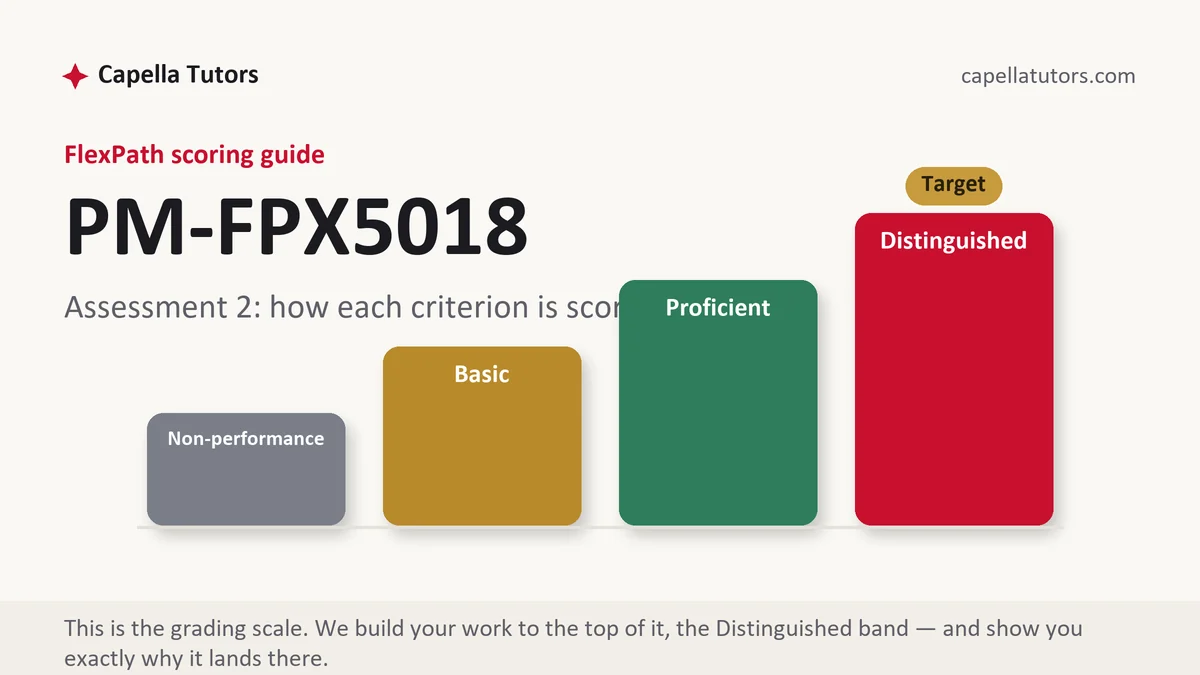
How PM FPX 5018 Assessment 2 is scored
Four levels, one per criterion, and on a schedule and cost deliverable the difference between them is unusually easy to see:
| Level | What it means on a schedule and cost baseline |
|---|---|
| Distinguished | The longest path is identified and named, float is quoted on the paths that are not critical, every figure recomputes, and the paper says which lever it would pull and what that lever costs. |
| Proficient | A complete schedule and a defensible budget. The critical path is present but not used, so compression and contingency decisions are made without reference to it. |
| Basic | Dates arranged on a calendar. Durations copied from effort hours, dependencies implied by row order, contingency set at a round percentage with no reasoning. |
| Non-performance | A required computation missing: no float anywhere, or no measurement method for progress against the baseline. An absent calculation cannot be marked generously. |
Show the working. A schedule that arrives as a finished picture invites a reader to check it; a schedule that walks through its own paths, states the total for each and quotes the difference as float has already answered the question the criterion was going to ask.
The PM FPX 5018 Assessment 2 method, step by step
-
Turn each criterion into a table you owe
Activity list, dependency table, network totals, cost baseline, variance summary. Write the list before you write prose, because this deliverable is graded on artifacts and a paragraph explaining a table you did not build earns nothing at all.
-
Derive activities from the deliverables, not from memory
Take each work package and ask what has to be done to produce it. Activities that appear because they feel like part of a project, without a package to attach to, are the reason schedules drift out of scope before the first week is planned.
-
Write the dependency and say why it exists
For every link, record what makes it mandatory: a physical requirement, a data requirement, a contract, a regulator. Order of habit is not a dependency, and a network built from habit produces a critical path nobody can compress because half its links are imaginary.
-
Convert effort to duration through availability
An activity needing 80 hours from a clinical informaticist released one day a week is not two weeks of work, it is ten. Health care projects break here more than anywhere else, so state the availability assumption for every borrowed contributor and put the arithmetic in the table.
-
Total the paths and quote the float
Add every route from start to finish, take the longest, and publish the totals rather than only the answer. Then state the float on each non-critical path and use it: sequence the risky work early where float exists, and aim any compression money at the path that controls the finish date.
-
Baseline the cost, then measure and self-score
Set the budget by period, justify contingency from the risks that produced it rather than from a habitual percentage, and state how completion will be measured before work starts. Compute a variance and a forecast on the figures you have, then grade yourself criterion by criterion and submit early in the week.
A structure that maps to the criteria
Planning ranges for a schedule and cost package of ordinary length; the tables usually take more room than these numbers imply, and that is the correct trade.
| Section | What it must do | Guide |
|---|---|---|
| Scope input and activity list | Each work package decomposed into activities, with the package it belongs to beside it. | ~200 words |
| Dependencies and the network | Every link recorded with the reason it is mandatory, then the paths listed with totals. | ~300 words |
| Duration, effort and availability | Effort hours, the availability assumption per contributor, and the duration that follows. | ~250 words |
| Critical path and float | The controlling path named, float quoted for the rest, the compression option costed. | ~250 words |
| Cost baseline and contingency | Spend by period, the basis of each estimate, contingency traced to the risks behind it. | ~250 words |
| Measurement, forecast and references | The measurement rule, variance and index figures, the forecast, standards cited by edition. | as needed |
Annotated sample excerpt
An original model paragraph our team wrote to show what a schedule sounds like when the numbers are doing the talking.
The four wave implementation cannot complete in fewer than 28 weeks: configuration build runs 11 weeks, data migration and validation cannot start until the build is frozen and runs 14, and the first wave cutover adds 3, while the training package that runs alongside migration takes only 6 weeks and therefore carries 8 weeks of float.1 The clinic directors have asked for the training work to be accelerated, and accelerating it would move the finish date by nothing at all, so the 46,000 dollars of overtime under discussion belongs on migration, where each week bought is a week off the go-live.2 At the week 20 review the budget at completion is 1,240,000 dollars, planned value is 620,000, earned value is 545,600 and actual cost is 664,000, which gives a cost performance index of 0.82 and a schedule performance index of 0.88, so the estimate at completion is about 1,509,000 dollars and the number the sponsor needs on Thursday is an overrun near 269,000 rather than the 118,400 currently visible in the ledger.3
- 1Every duration stated, the binding dependency named, and the float computed rather than asserted. A reader can rebuild the network from this one sentence.
- 2Float turned into a spending decision. This is the sentence that separates a schedule that exists from a schedule that is being used to manage something.
- 3Both indices given, the forecast derived from achieved performance, and the gap between the visible overrun and the projected one made the headline. That gap is the reason earned value is taught.
The full premium sample for your exact assessment, written fresh to your scoring guide and issue, is free to request. Study it, revise it into your own voice, and submit work you understand.
The five mistakes that cost Distinguished
- Every activity critical. A network with no real dependencies, which produces no float anywhere and leaves the scheduling criterion unanswerable.
- Effort hours written into the date column. Forty hours of work booked as one week, ignoring that the person owning it is released two days a month.
- Compression aimed at the comfortable task. Money spent shortening work that has weeks of float, while the path controlling the finish date is left alone.
- Contingency by reflex. Ten percent added to everything, traceable to no risk, defensible to no sponsor, and the first line a finance reviewer deletes.
- A forecast made of hope. The remaining budget assumed to perform perfectly, when the achieved index is the only honest basis for projecting the finish.
Pre-submission checklist
- Every activity traceable to a work package, with nothing orphaned in the list
- Each dependency recorded with the reason it is mandatory
- Effort, availability and duration shown as three separate columns
- All paths totaled, the longest named, and float quoted for the others
- Contingency tied to named risks, with the basis of each estimate stated
- Variances, indices and a forecast recomputed by a second reader, self-scored D, submitted early in the week
Schedule due and the numbers will not reconcile?
Send us the scenario, the numbers you have and the guide. Our team of eight includes a reader who does nothing but recompute every duration, variance and index, and the premium original sample comes back in 24 to 48 hours with the float quoted.