This manual is for PM FPX 5018 Assessment 1, start to submission. The opening deliverable is where a project gets its authority and its edges, and it is graded as a document rather than as an essay, so a well-written paragraph earns nothing where a charter field was wanted. The assessment usually asks you to establish that the work is a project rather than ongoing operations, name a sponsor and say what that person may decide alone, write objectives whose completion can be checked, and bound the work with an explicit list of what sits outside it. Your scoring guide decides whether that arrives as a charter, a charter plus scope statement, or a scope and work breakdown package. The method below is the one our tutors use, with a criterion-mapped structure and an annotated sample excerpt. Prefer to hand it off? A premium original sample for this exact assessment comes back in 24 to 48 hours, revised free until the criteria clear. Capella's catalog lists the course as PM-FPX5018, and some courserooms print PM5018; both point to this same Assessment 1.
One honesty note before the manual: Capella revises courses and scoring guides over time, so always write to the exact scoring guide attached to your assessment in the courseroom. The course identity above is verified on capella.edu; the method and structure below are our tutors' approach to it, not Capella's official rubric text.
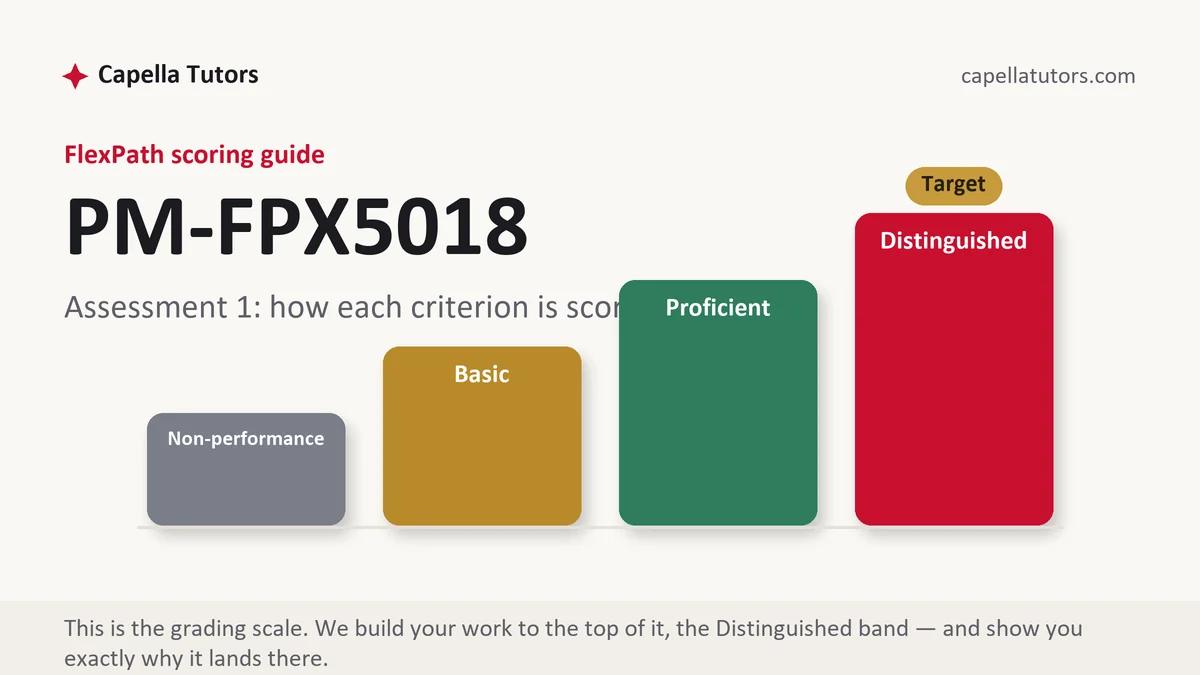
How PM FPX 5018 Assessment 1 is scored
Nothing here is graded on a curve. Each criterion falls on one of four levels, and on a charter and scope deliverable the levels read like this:
| Level | What it means on a charter and scope package |
|---|---|
| Distinguished | The charter grants authority in specific terms, an approver is named on a date, the out of scope list is long enough to have cost something, and every objective states the condition under which it counts as met. |
| Proficient | All the required fields are present and correctly written. Authority is described in general terms, and nothing in the boundary section would settle an argument in month four. |
| Basic | A project summary wearing a charter's headings. Objectives phrased as intentions, a sponsor listed with no powers attached, and scope written only as what will be included. |
| Non-performance | A required field simply absent, most often the funding limit, the assumptions or the out of scope statement. Missing scores below imprecise. |
The quickest way to move a criterion up a column is to make it checkable. Replace improve patient access with reduce the median wait for a routine appointment from 21 days to 10 by the second month after opening, and the objective now tells a reader both what to build and how to know when to stop.
The PM FPX 5018 Assessment 1 method, step by step
-
Read each criterion as a document field
Go through the guide and write beside every criterion the artifact or field it wants: sponsor, business case, objective, success criterion, boundary, assumption, constraint, milestone, funding limit. That annotated list is your outline. Anything you write that does not fill one of those fields is unpaid work.
-
Prove it is a project before you charter it
Temporary, unique result, definite end. Say when it starts, what exists at the end that did not exist before, and the day it stops being a project and becomes somebody's department. Running a service is not a project; standing one up is, and the criteria in this course usually test that distinction early.
-
Write the business reason in money or capacity
Volumes, referrals leaving the network, contribution per case, hours recovered, a licensure date that cannot move. A reason a sponsor could defend at a budget meeting is a number attached to a consequence, not a sentence about strategic alignment.
-
Give the sponsor real powers, in writing
Name the person, then state the ceiling: what value of change they may approve alone, what must go to a committee, and who may commit the named resources. Authority written as a threshold is what turns a charter into a mandate, and it is the field most drafts leave as an adjective.
-
Build the out of scope list until it hurts
Four or five things a reasonable person might have assumed were included, each excluded on purpose, each with a note on how it will be handled instead. This is the cheapest paragraph in the whole plan and it prevents more disputes than any other. If your exclusions cost you nothing to write, they are not real exclusions.
-
Decompose by deliverable, then self-score
Break the scope into things that can be accepted rather than into tasks in the order they occur to you, and stop at the level where a package has one owner and an estimate. Then grade each criterion yourself against the guide, fix anything under the top column, and submit early in the week.
A structure that maps to the criteria
These are working ranges our tutors use when the deliverable is a charter with a scope package attached; adjust to whichever artifact your guide actually names.
| Section | What it must do | Guide |
|---|---|---|
| Project justification | The business reason in figures, the problem or opportunity, and why now rather than next year. | ~200 words |
| Authority and governance | Sponsor named, approval threshold stated, authority over named resources, escalation route. | ~250 words |
| Objectives and success criteria | Each objective written so completion is checkable, with the measure the sponsor judges it by. | ~250 words |
| Scope boundary | The scope statement plus an explicit out of scope list, each exclusion with its alternative route. | ~250 words |
| Work breakdown | Deliverables decomposed to packages with one owner and a definition of done. | ~300 words |
| Assumptions, constraints and references | What the plan rests on, what it cannot move, known risks at approval, standards cited by edition. | as needed |
Annotated sample excerpt
Three charter fields from an original model our team wrote, printed as they would appear in the document rather than as narrative.
Sponsor: the vice president of ambulatory operations, who may approve scope changes valued at up to 40,000 dollars and any schedule change that does not move the licensure inspection date, with anything beyond either threshold going to the capital committee at its monthly meeting.1 Business reason: 1,340 outpatient magnetic resonance studies were referred outside the network in the preceding twelve months at an average contribution of 610 dollars each, and the fit-out of the leased unit at Halstead Row is approved on the basis of recapturing 60 percent of that volume within four quarters of opening.2 Out of scope: interventional procedures, weekend and evening staffing, the second scanner pad shown on the architectural drawings, and any modification to the referral system, each of which will be raised as a separate authorization rather than absorbed into this project.3
- 1Authority written as two thresholds and a named escalation body. A reader can tell which decisions will reach the committee and which will not.
- 2The business case as arithmetic with a target and a window. This is the sentence the sponsor is held to, so it names a percentage rather than a direction.
- 3Exclusions that plainly cost something, each with the route it takes instead. The second pad appears on the drawings, which is why it has to be excluded in words.
The full premium sample for your exact assessment, written fresh to your scoring guide and issue, is free to request. Study it, revise it into your own voice, and submit work you understand.
The five mistakes that cost Distinguished
- An operations problem chartered as a project. Ongoing work with no end date dressed in project headings, which fails the first criterion before anything else is read.
- A sponsor with no powers. A title in a field, no approval ceiling, no statement of who may commit the people the schedule depends on.
- Objectives nobody could mark. Improve, enhance and streamline, none of which can ever be shown to have happened or not happened.
- Scope written only as inclusions. No exclusion list, so every request in month four is arguably inside the boundary and the baseline dies quietly.
- A task list called a work breakdown. Activities in narrative order rather than deliverables anybody could accept, which makes estimating and assignment impossible later.
Pre-submission checklist
- Every criterion mapped to the charter field or artifact it is asking for
- The work shown to be temporary, unique and finite, with the handover point named
- Business reason expressed in volumes, money or a date that cannot move
- Sponsor named with an approval threshold and a stated escalation route
- Objectives written so a reader can verify completion, each with its success measure
- An out of scope list of four or five real exclusions, self-scored D, submitted early in the week
Charter due and the scope keeps sliding?
Send the scenario and the scoring guide. Eight people return a premium original sample in 24 to 48 hours with authority, thresholds, checkable objectives and a boundary that would survive an argument.