This manual is for PHI FPX 2000 Assessment 1, start to submission. Ethics, Happiness, and the Good Life asks you to define happiness and a well-lived life in your own terms, explain an ethical theory, often utilitarianism or virtue ethics, and how it relates to that definition, identify your core values and the most important one, and explain the ethical obligations you have to others because of how you define the good life. The grade turns on connecting theory to your own view. Summarizing a theory scores lower than using it to examine what you believe. Below is the method our tutors use, a structure that maps to the criteria, and an annotated sample excerpt. Prefer to hand it off? A premium original sample for this exact assessment comes back in 24 to 48 hours, revised free until it meets the guide. Capella's catalog lists the course as PHI-FPX2000, and some courserooms print PHI2000; both point to this same Assessment 1. In current courserooms this assessment typically appears as "Ethics, Happiness, and the Good Life".
One honesty note before the manual: Capella revises courses and scoring guides over time, so always write to the exact scoring guide attached to your assessment in the courseroom. The course identity above is verified on capella.edu; the method and structure below are our tutors' approach to it, not Capella's official rubric text.
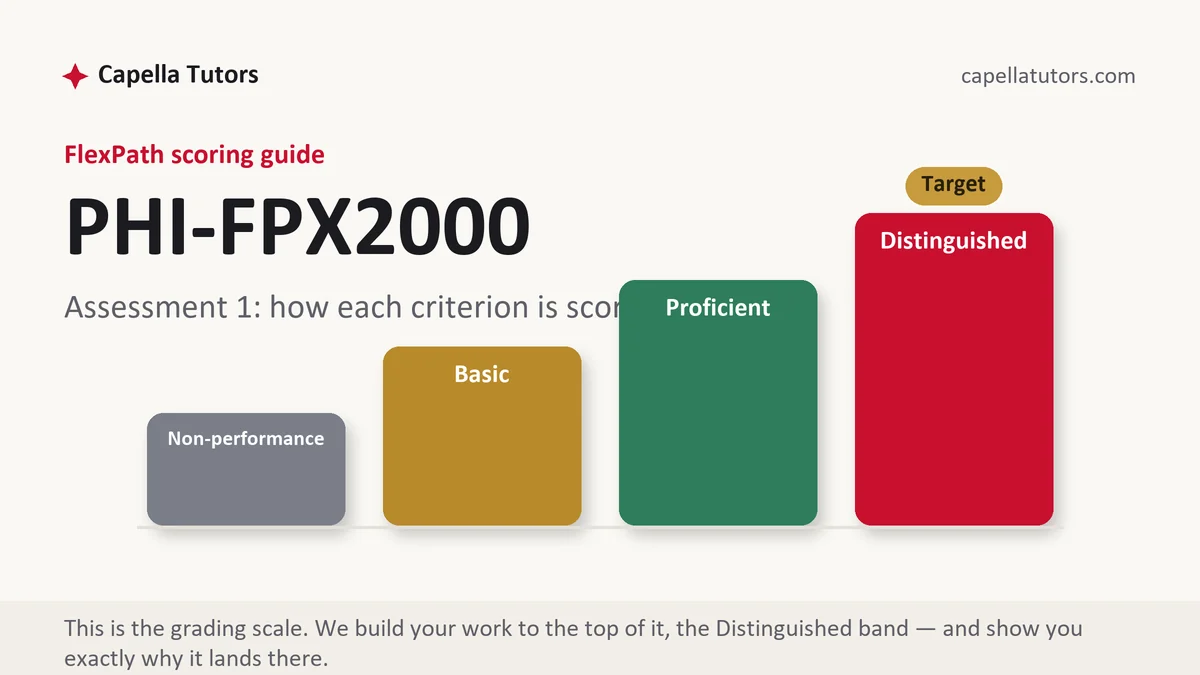
How PHI FPX 2000 Assessment 1 is scored
FlexPath does not use letter grades. Each criterion in the scoring guide lands on one of four levels, and the level descriptions are the real writing brief:
| Level | What it means on an ethics and the good life paper |
|---|---|
| Distinguished | Happiness and the good life are defined clearly, the theory is explained accurately and applied to the definition, values are connected with examples, and obligations to others follow logically. |
| Proficient | All parts are accurate, but the connections are brief. |
| Basic | The paper summarizes a theory with little personal analysis. |
| Non-performance | The definition, the theory, the values or the obligations are missing. |
Write in the first person where your guide allows, and cite the philosophers whose ideas you use.
The PHI FPX 2000 Assessment 1 method, step by step
-
Define happiness and the good life
Your definition, with how it compares to a philosopher's.
-
Explain the theory
For example utilitarianism: actions are right if they produce the greatest good for the greatest number.
-
Apply the theory
How the theory supports or challenges your definition.
-
Name your core values
Two or three, and which matters most.
-
Explain obligations to others
What your view requires you to do for other people.
-
Cite sources
Mill, Aristotle or course readings.
A structure that maps to the criteria
Word counts are planning targets our tutors use, not Capella rules; follow the length and format your scoring guide states.
| Section | What it must do | Guide |
|---|---|---|
| Introduction | Your question and approach. | ~50 words |
| Happiness and the good life | Your definition. | ~100 words |
| Ethical theory | Explained and applied. | ~125 words |
| Core values | Values and the most important one. | ~100 words |
| Obligations to others and conclusion | What follows, then references. | ~125 words |
Annotated sample excerpt
An original model excerpt from our team, written to show the register that reaches the top of the guide. Learn the moves, then write your own version.
Mill argued that happiness is the only thing desirable as an end, and that right actions are those that tend to promote it, counting everyone's happiness equally.1 My own definition of a good life, meaningful work and close relationships, fits Mill's view in one way, since both promote my happiness and that of people around me, but it strains against his equal counting, because I give my family more weight than strangers.2 Recognizing that tension makes my obligation clearer: if I take Mill seriously, my concern for others cannot stop at the people I love.3
- 1Explains the theory accurately with its source.
- 2Applies it to the personal definition and finds a tension.
- 3Draws an obligation from the analysis.
The full premium sample for your exact assessment, written fresh to your scoring guide and topic, is free to request. Study it, revise it into your own voice, and submit work you understand.
The five mistakes that cost Distinguished
- Summary without application. Use the theory to examine your view.
- A vague definition. Define happiness clearly.
- Values without examples. Show values in action.
- Obligations that do not follow. Derive them from your view.
- No sources. Cite the philosophers you use.
Pre-submission checklist
- Clear definition of happiness and the good life
- Theory explained accurately
- Theory applied to your view
- Core values with the most important
- Obligations to others
- Sources cited
Want the ethics paper written?
Send the scoring guide and any materials from your courseroom. Our team returns a premium original ethics paper in 24 to 48 hours, revised free until it meets the guide.