This manual is for NURS FPX 9040 Assessment 3, start to submission. Assessment 3 usually asks the question a doctorate ends on: what happens to this change after you leave. That means a named successor, the standing report that keeps producing the measure, a review interval, a threshold that triggers someone to act again, and implications stated so a second site could decide whether to repeat the work. It is also where the rehearsal for hard questions belongs, because sustainability is the area a panel probes hardest. What follows is our doctoral method for closing out, a structure tied to the criteria, and an annotated sample excerpt. If you would rather we closed it out, a premium original sample for this exact assessment comes back inside 24 to 48 hours, with free revisions until every criterion is met. Capella's catalog lists the course as NURS-FPX9040, and some courserooms print NURS9040; both point to this same Assessment 3.
One honesty note before the manual: Capella revises courses and scoring guides over time, so always write to the exact scoring guide attached to your assessment in the courseroom. The course identity above is verified on capella.edu; the method and structure below are our tutors' approach to it, not Capella's official rubric text.
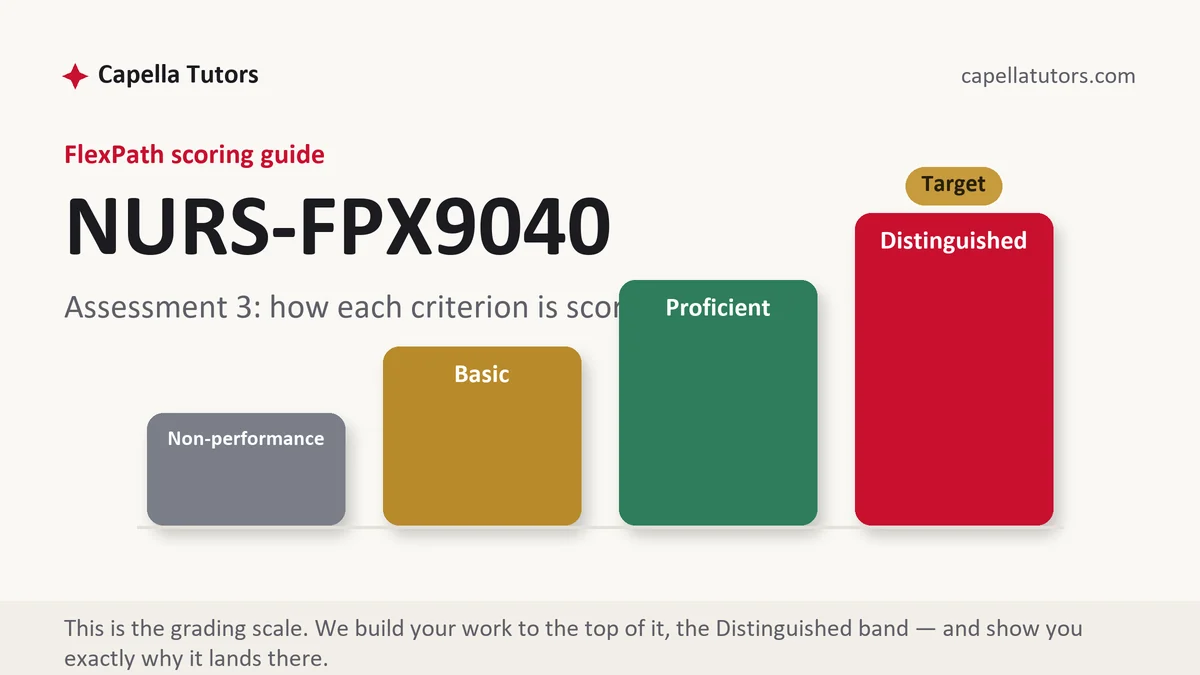
How NURS FPX 9040 Assessment 3 is scored
Four descriptors per criterion, and at the close of a doctorate they are asking whether the work outlives the student:
| Level | What it means on sustainability and handoff |
|---|---|
| Distinguished | A named owner, an existing report that produces the measure without you, a stated review interval, a numeric threshold that triggers re-intervention, and implications written so another unit could judge whether to adopt. The extra move is a handover a director could act on the week after graduation. |
| Proficient | Sustainability discussed and implications drawn. Reasonable, and it depends on somebody deciding to care after you are gone. |
| Basic | Sustainability asserted through continued education and ongoing monitoring, with no owner, no report and no trigger. |
| Non-performance | A required element is absent, most often the sustainability plan itself or the implications the criterion asked you to draw. |
There is a single test for this section, and it is a date. On the first Monday after you graduate, who runs this, which report produces the number, how often does somebody look at it, and what happens when it drifts. Four sentences answer all of that, and a submission that cannot produce them has described a pilot rather than a change.
The NURS FPX 9040 Assessment 3 method, step by step
-
Find an owner who was going to be there anyway
A role rather than a person where possible, and one whose existing duties already touch the workflow. Handing your project to an enthusiastic colleague with no authority over the process is the commonest way a change dies quietly in the second quarter.
-
Move the measure onto a report that already exists
Anything that requires a manual audit will stop when the person doing it stops. Work with the analyst to attach your numerator and denominator to a standing report, and record the report's name and its distribution list in the plan.
-
Set an interval and a threshold, both numeric
Reviewed monthly at the unit practice council, with re-intervention triggered if the rate falls below a stated figure for two consecutive months. Vague commitments to keep an eye on it cannot be audited and cannot be inherited.
-
Write down what would kill it
The champion transferring, the report changing owner, an electronic record upgrade that removes the prompt, a merger. Name the three most likely and say what would notice each one. A risk list with detection attached is worth more than a paragraph of optimism.
-
State implications as what another unit would have to change
Not that further research is warranted, but the staffing, the report and the workflow conditions a different site would need before this could work there. That is the difference between a project that ends and a change that travels, and it is what an implications criterion is actually asking for.
-
Prepare five answers, then self-score
The uncomfortable questions are predictable: the denominator, the concurrent changes, the counterfactual, the owner after you leave, and what you would do differently. Write one sentence for each, rehearse them aloud, and stop talking after each one. Then level every criterion and rewrite anything below the top.
A structure that maps to the criteria
Planning targets our tutors use for a closing submission, not Capella requirements; your guide decides the real weighting.
| Section | What it must do | Guide |
|---|---|---|
| Handover summary | The owner by role, the date of transfer, and what the owner is accepting responsibility for. | ~200 words |
| Measurement after the project | The standing report producing the numerator and denominator, its owner and its distribution. | ~250 words |
| Review cadence and triggers | Who reviews, how often, at which forum, and the numeric threshold that restarts intervention. | ~250 words |
| Risks to sustainment | The three most likely failures, what would detect each, and who is expected to respond. | ~250 words |
| Implications for practice | What another setting would need to change to adopt this, and what this project adds to the evidence. | ~350 words |
| Defense preparation and references | The predictable questions with one-sentence answers, and current APA matched both ways. | ~250 words |
Annotated sample excerpt
An original model paragraph from our doctoral team, showing a handover written so somebody could act on it without you in the room.
Ownership transfers to the anticoagulation clinic's lead pharmacist on 1 September, a role that already signs off dose adjustments and therefore already looks at the same patients the measure counts, rather than to the nurse champion who will rotate to a different service in the spring.1 Time in therapeutic range will continue to be produced by the existing monthly clinic quality report, where the analyst has added the numerator and denominator as a permanent field, so the number arrives whether or not anyone remembers to ask for it, and it is reviewed at the pharmacy and therapeutics subcommittee each quarter.2 Re-intervention is triggered if the clinic-level figure falls below 62 percent for two consecutive months, the level at which the pre-project performance sat, and the subcommittee chair is the person expected to convene that conversation.3
- 1Names a role rather than a person, and justifies the choice by the authority the role already carries. It also explains who was not chosen and why, which is the part most plans omit.
- 2Moves the measure onto a report that runs without the project. A measure that depends on somebody remembering has a half-life of about one quarter.
- 3Gives a number, a duration and a named person to convene. A trigger without all three is an intention, and intentions are what the Basic descriptor describes.
The full premium sample for your exact assessment, written fresh to your scoring guide and issue, is free to request. Study it, revise it into your own voice, and submit work you understand.
The five mistakes that cost Distinguished
- No successor. A change with nobody accountable after you leave is a pilot, and the criterion has nothing to grade.
- A measure that needs a volunteer. Manual audits end when the auditor graduates, and the number disappears within a quarter.
- Monitoring promised without a threshold. Keeping an eye on it cannot be audited, inherited or acted upon.
- Implications written as more research is needed. The useful version says what a second site would have to change before adopting this.
- An unrehearsed answer to a predictable question. The counterfactual and the denominator come up every time, and a confident guess is the worst available reply.
Pre-submission checklist
- An owner named by role, with the transfer date recorded
- The measure attached to a standing report that runs without you
- A review forum, an interval and a numeric re-intervention threshold
- Three sustainment risks with a detection route for each
- Implications written as conditions another site would need to meet
- Five predictable questions answered in one sentence each, rehearsed aloud
Sustainability section or defense coming up?
Send the guide, your results and what your site's reporting already produces. We write the handover as something a director could act on, set the interval and the threshold, list the sustainment risks with detection attached, and return ten rehearsal questions with one-sentence answers. Revisions free until it clears.