This manual is for NURS FPX 9040 Assessment 2, start to submission. Assessment 2 usually asks for something built to leave the courseroom: a presentation, a poster, an executive brief or a manuscript, addressed to an audience you name and shaped by that audience's budget of attention. Programs differ on whether the product is delivered live, recorded or submitted in writing, so confirm the form with your chair and your project handbook rather than copying a classmate. Below is our doctoral method for building it, a structure matched to the criteria, and an annotated sample excerpt. Prefer to hand the build over? A premium original sample for this exact assessment arrives within 24 to 48 hours, revised free until the guide is met. Capella's catalog lists the course as NURS-FPX9040, and some courserooms print NURS9040; both point to this same Assessment 2.
One honesty note before the manual: Capella revises courses and scoring guides over time, so always write to the exact scoring guide attached to your assessment in the courseroom. The course identity above is verified on capella.edu; the method and structure below are our tutors' approach to it, not Capella's official rubric text.
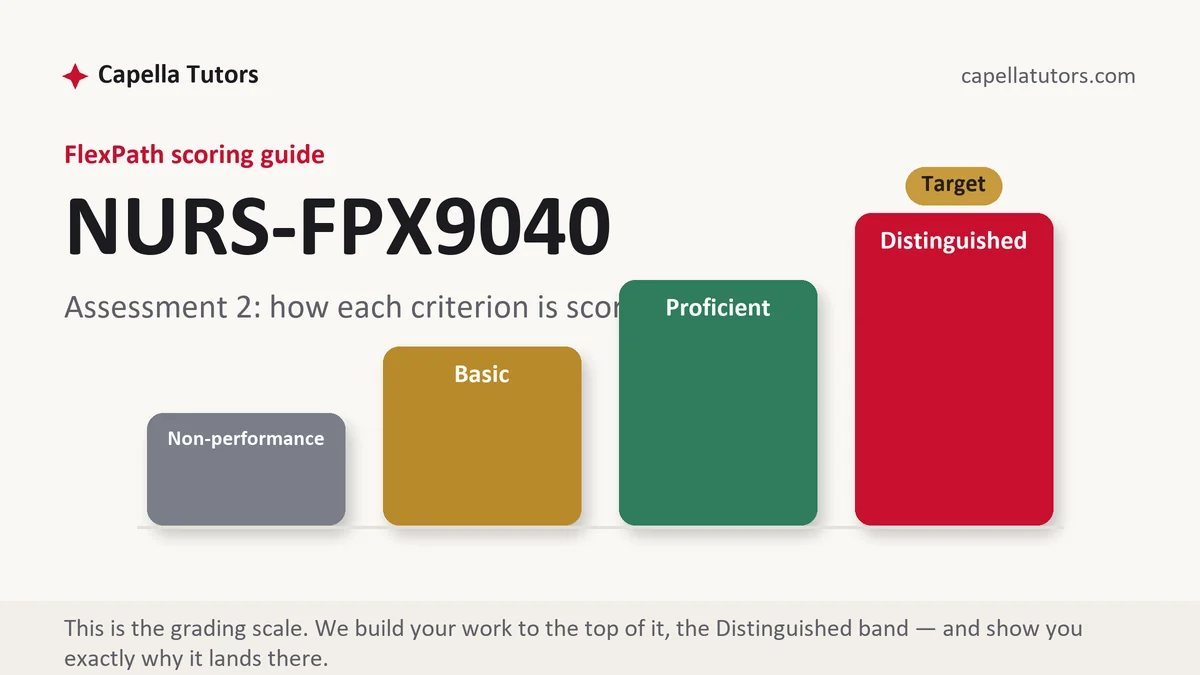
How NURS FPX 9040 Assessment 2 is scored
Each criterion carries four descriptors, and on a communication deliverable they turn on fit rather than on completeness:
| Level | What it means on a dissemination product |
|---|---|
| Distinguished | The audience is named and the product is visibly built for that room, the message that audience needs arrives first, the format's word or slide budget is respected, and there is a call to action somebody in the room has the authority to accept. The extra move is designing for the question you will be asked rather than the one you would prefer. |
| Proficient | A clear, accurate product covering the project. Well made, and it would work about equally well for any of three different audiences. |
| Basic | The written chapters compressed, aimed at nobody in particular, with method detail crowding out the finding. |
| Non-performance | A required element is absent, most often the identified audience or the call to action the criterion asked for. |
Three audiences can receive the same data, and they need three different openings. The unit that has to run the change next month needs to know what changes on their shift. The executive who decides whether it stays funded needs the ask inside the first three lines. The wider profession needs the method, because they cannot repeat what they cannot see. Choosing one and building for it is the whole assignment.
The NURS FPX 9040 Assessment 2 method, step by step
-
Name the audience and the decision you want from them
Write both at the top of your working file: who is in the room, and what you want them to do when you stop talking. Adopt, fund, replicate, or take over. Every later choice about content follows from that pair, and a product with no decision attached defaults to a summary.
-
Write the one sentence that survives if nothing else does
If your audience remembers a single line tomorrow, which line should it be. Put that sentence in the title, the opening and the close. Titles that name the topic waste the only moment the reader is guaranteed to be paying attention.
-
Respect the format's real budget
A poster is roughly 800 words with body type no smaller than 24 point so it reads from six feet. A twenty-minute talk is twelve to fifteen slides carrying one claim each. An executive brief states the ask in the first three lines. These are hard constraints, and first drafts break all three.
-
Give one figure the space it deserves
Usually the measure over time with the start of the intervention marked, sized so it is the first thing the eye lands on. Everything else supports it. A board covered in four equally sized charts tells the reader you could not decide which finding mattered.
-
Place the method where the questions come from
In a talk, spend the middle third on how you measured, because that is where the questions originate. Put limitations on a slide of their own rather than in the last bullet of the conclusion, since raising them yourself takes the sting out of the first question from the floor.
-
Rehearse against a hostile clock, then self-score
Read it aloud at spoken pace and time it honestly; speaker notes written at reading speed always overrun. Then check the product against each criterion, mark the level, and fix anything below the top before it is delivered rather than after.
A structure that maps to the criteria
Targets below are our planning defaults for a dissemination submission and its accompanying rationale, not Capella rules.
| Section | What it must do | Guide |
|---|---|---|
| Audience and purpose | Who receives this, what they control, and the decision the product is asking them to make. | ~250 words |
| Key message and title | The single sentence the audience should retain, and the title that states the finding rather than the subject. | ~200 words |
| Product content plan | Section by section or slide by slide, with the claim each one carries and the evidence behind it. | ~400 words |
| Visual and format choices | The figure given priority, the type sizes, the word or slide budget, and why each was chosen for this room. | ~250 words |
| Call to action | The specific ask, addressed to someone with the authority to say yes, with what it costs them. | ~200 words |
| Rationale and references | Why this format suits this audience, with current APA matched in both directions. | ~250 words |
Annotated sample excerpt
An original model paragraph from our team, showing how an executive-facing opening is built when the reader will not reach line ten.
Recommendation: fund 0.4 of a full-time equivalent to keep the intensive care palliative screening trigger running from October, at an annual cost of about 46,000 dollars.1 Over fourteen weeks the trigger raised the proportion of eligible patients receiving a palliative care consultation within 72 hours of meeting criteria from 34 percent to 71 percent across 211 admissions, and median time to consultation fell from 5.1 days to 2.3.2 The unit cannot sustain the screening step on existing staffing: it currently runs because a doctoral student reviews the census each morning, and when that review lapsed for nine days in August the proportion fell back to 39 percent, which is the most useful evidence in this brief about what happens without the post.3
- 1The ask arrives in the first line with a price attached. An executive audience reads for the decision, and burying it below the background is the commonest failure in this format.
- 2Two results with denominators, in one sentence, no method. The method belongs in an appendix for this reader and in the middle third of a talk for a professional one.
- 3Turns an interruption in delivery into the argument for the resource. Using your own lapse as evidence is the kind of move that separates a brief from a summary.
The full premium sample for your exact assessment, written fresh to your scoring guide and issue, is free to request. Study it, revise it into your own voice, and submit work you understand.
The five mistakes that cost Distinguished
- A compressed chapter aimed at nobody. Without a named audience the criterion about communicating to stakeholders has nothing to assess.
- A title that states the topic. The title is the only line everyone reads, and spending it on the subject wastes it.
- Method crowding out the finding. On a poster the method is a paragraph; on a slide deck it is the middle third, not the opening.
- Type nobody can read. Body text below 24 point on a board fails at six feet, and the audience simply walks past.
- No ask. A product that ends in thank you leaves the decision-maker with nothing to approve.
Pre-submission checklist
- The audience is named and the decision you want from them is stated
- One sentence carries the finding, and it appears in the title
- The format's word, slide or type budget is respected rather than approximated
- A single figure is given priority, with the intervention start marked
- Limitations carry their own slide or panel rather than a trailing bullet
- A call to action addressed to somebody with the authority to accept it
Deck, poster or brief due?
Tell us the audience and send the results. The deck comes back with speaker notes timed at spoken pace and the method slides placed where the questions land, posters inside the word budget with one figure given room, briefs with the ask in the first three lines. Rehearsal question set included.