This manual is for NURS FPX 9040 Assessment 1, start to submission. Assessment 1 of Doctor of Nursing Practice 5 usually asks for the whole project as one continuous document: problem, aim, evidence, method, delivery and results assembled so they read as a single argument, with the results measured against the aim you set at the beginning and the limitations volunteered in your own words. What is graded is the account rather than the result, and a project whose measure barely moved can finish at the top of the column. Below is our doctoral assembly method, a structure derived from the criteria, and an annotated sample excerpt. Would you rather it was written for you? A premium original sample for this exact assessment returns in 24 to 48 hours, revised without charge until the criteria are satisfied. Capella's catalog lists the course as NURS-FPX9040, and some courserooms print NURS9040; both point to this same Assessment 1.
One honesty note before the manual: Capella revises courses and scoring guides over time, so always write to the exact scoring guide attached to your assessment in the courseroom. The course identity above is verified on capella.edu; the method and structure below are our tutors' approach to it, not Capella's official rubric text.
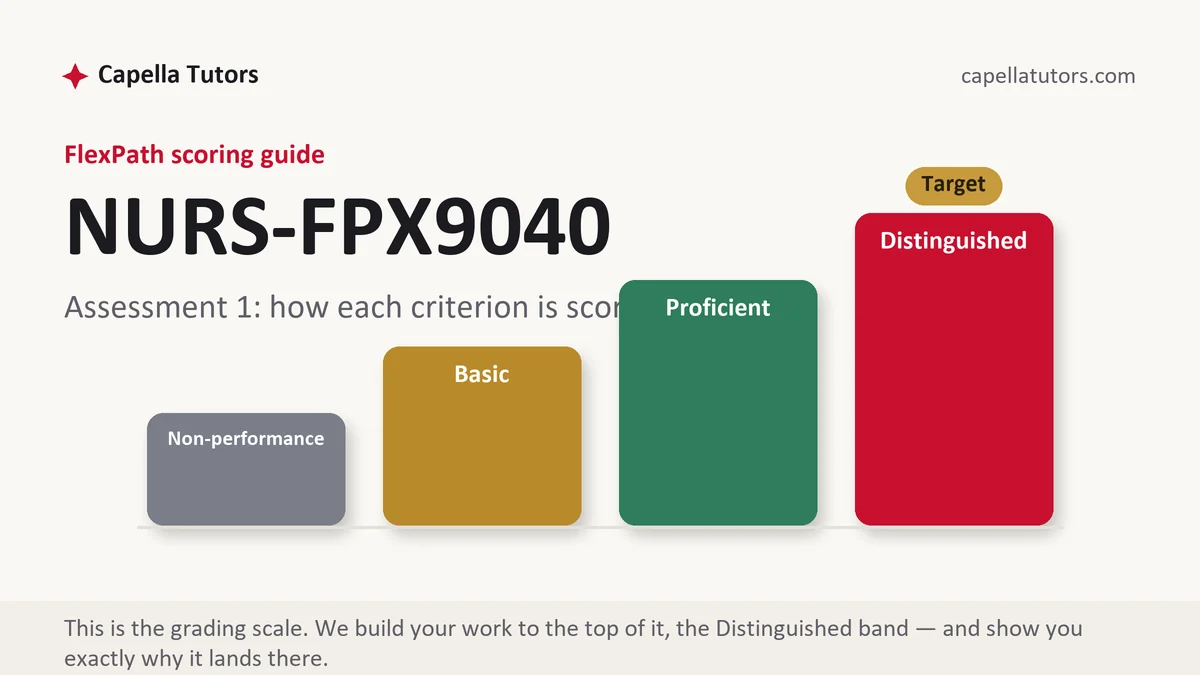
How NURS FPX 9040 Assessment 1 is scored
Criteria are levelled individually, and the descriptors at the end of a doctorate ask for control of your own evidence:
| Level | What it means on an assembled project account |
|---|---|
| Distinguished | The document reads as one argument, the aim and the measure are worded exactly as they were in the proposal, results carry their denominators and their uncertainty, and the limitations are volunteered with the design that would have resolved each one. The extra move is conceding the boundary before a reader reaches it. |
| Proficient | A complete and accurate account with results reported properly. Everything is present, and the conclusion is slightly larger than the design can carry. |
| Basic | Earlier chapters stapled together, effectiveness declared from the direction of the change, limitations listed as a short paragraph of generalities. |
| Non-performance | A required element is missing, most often the evaluation of results against the original aim. |
Drift is the failure evaluators find fastest at this stage, and it is entirely avoidable. If the aim named one population and the results report another, or the measure acquired a new definition somewhere in the middle courses, the whole evaluation reads as retrofitted. Put the proposal beside the draft and reconcile the wording line by line before you write anything new.
The NURS FPX 9040 Assessment 1 method, step by step
-
Reconcile the aim, the population and the measure against the proposal
Three phrases, checked word for word against what you wrote in the first capstone course. Where they differ, either restore the original wording or explain the change and the date it was made. An unexplained difference costs more than the change ever would have.
-
Assemble against the criteria, not against your chapter order
Lay the criteria in as headings, paste the top descriptors underneath, then move content into place. The document that results is one argument rather than five submissions in a row, and the seams that survive a copy-and-paste assembly are the first thing an experienced reader notices.
-
Write the results paragraph the way a journal would take it
Baseline with its denominator, post-implementation with its denominator, the absolute difference, the relative difference, the test if one is appropriate, and what it returned. In that order, without adjectives, and with the arithmetic recoverable from the numbers on the page.
-
Say what the design could never have detected
If the sample could not have shown a four-point difference, the honest sentence is that the finding is consistent with a real benefit and equally consistent with none. Reporting a p value without that context invites a reader to draw a conclusion your data cannot support.
-
Argue the other significance with arithmetic
Convert your effect into annual events at your real volume, then into the workload or cost it implies. A difference that fails a significance test can still be worth funding, and the case for it is made in numbers rather than in enthusiasm.
-
Volunteer the limitations, each with its remedy
Design, sample, window, concurrent events, anything measured by proxy, and for each one the study that would have settled it. A limitation you name is judgment; the same limitation extracted from you at defense is a gap. Then self-score every criterion and rewrite anything below the top.
A structure that maps to the criteria
Planning targets our tutors use for a final account, not Capella rules; appendices and tables sit outside the prose count.
| Section | What it must do | Guide |
|---|---|---|
| Problem, aim and evidence in brief | The origin of the project compressed without losing the measured baseline or the evidence behind the intervention. | ~300 words |
| Method and delivery | What was designed, what was approved, what went out, and at what fidelity, in continuous prose. | ~300 words |
| Results against the aim | Baseline and post figures with denominators, differences absolute and relative, the analysis and what it returned. | ~350 words |
| Interpretation | What the numbers mean clinically and operationally, with statistical and practical significance separated. | ~300 words |
| Limitations | Design, sample, window, concurrent events and proxies, each with the study that would have resolved it. | ~250 words |
| Conclusion and references | A conclusion sized to the evidence, with current APA matched in both directions. | ~200 words |
Annotated sample excerpt
A model paragraph from our doctoral team, written the way a results section reads when the author knows the size of their own evidence.
The aim set in the proposal was to raise the proportion of newly hired nurses assigned a trained preceptor within their first week from 58 percent to 85 percent on a 96-bed service by the end of the implementation period, measured identically at both ends as a documented preceptor assignment in the onboarding record.1 Baseline was 29 of 50 hires across the preceding nine months, 58.0 percent; during the fourteen implementation weeks 27 of 34 hires had an assignment inside the window, 79.4 percent, an absolute difference of 21.4 points and a relative increase of about 37 percent, with a chi-square on those counts returning a p value of 0.03.2 The aim itself was not met, and the design cannot rule out a concurrent effect: the service also opened a centralized onboarding coordinator role in the second implementation month, and no version of this evaluation can separate the two.3
- 1Restates the aim in the proposal's own words, including the target and the operational definition. Anything reworded here reads as retrofitting even when it is not.
- 2Counts before rates, absolute before relative, test last. A reader can recompute every figure without asking for the spreadsheet.
- 3Concedes that the target was missed and names the concurrent change in the same breath. Volunteering the confounder is what the top descriptor is written to reward.
The full premium sample for your exact assessment, written fresh to your scoring guide and issue, is free to request. Study it, revise it into your own voice, and submit work you understand.
The five mistakes that cost Distinguished
- An aim that drifted. If the outcome you report is not the outcome you named at the start, the whole evaluation reads as built backward from the data.
- Effectiveness declared from direction. A line that went down is not evidence of cause, and a threshold crossed is not a size.
- A p value with no power behind it. Reporting significance from a sample that could never have detected the effect misleads the reader and invites the obvious question.
- Limitations the reader finds first. Anything a panel spots before you concede it costs more than the concession ever would have.
- Chapters stapled rather than assembled. Five submissions in sequence is not one account, and the transitions are where it shows.
Pre-submission checklist
- Aim, population and measure worded exactly as they were in the proposal
- Results reported as counts first, then rates, then differences, then the test
- What the design could not have detected stated alongside what it found
- Practical significance argued in annual events, workload or cost at your volume
- Every limitation volunteered with the study design that would have resolved it
- The document reads as one argument, with no visible seams between chapters
Final account due?
Send the guide, your proposal and your results. We reconcile the aim against the original wording, rebuild the results paragraph at journal standard, separate the two kinds of significance, and write the limitations with their remedies attached. Two independent quality passes, revisions free until every criterion clears.