This manual is for NURS FPX 9030 Assessment 3, start to submission. Assessment 3 usually closes the implementation course by handling everything a clean chart leaves out: the deviations bounded by date, the ethics of how the data was collected and stored, and the comparison between what you delivered and the studies that justified delivering it. It is the submission that decides whether the final course inherits a dataset or an argument it has to reopen. What follows is the closing method our doctoral tutors run, a structure fitted to the criteria, and an annotated sample excerpt. If you would sooner hand it across, a premium original sample for this exact assessment lands in 24 to 48 hours and is revised free until the guide is met. Capella's catalog lists the course as NURS-FPX9030, and some courserooms print NURS9030; both point to this same Assessment 3.
One honesty note before the manual: Capella revises courses and scoring guides over time, so always write to the exact scoring guide attached to your assessment in the courseroom. The course identity above is verified on capella.edu; the method and structure below are our tutors' approach to it, not Capella's official rubric text.
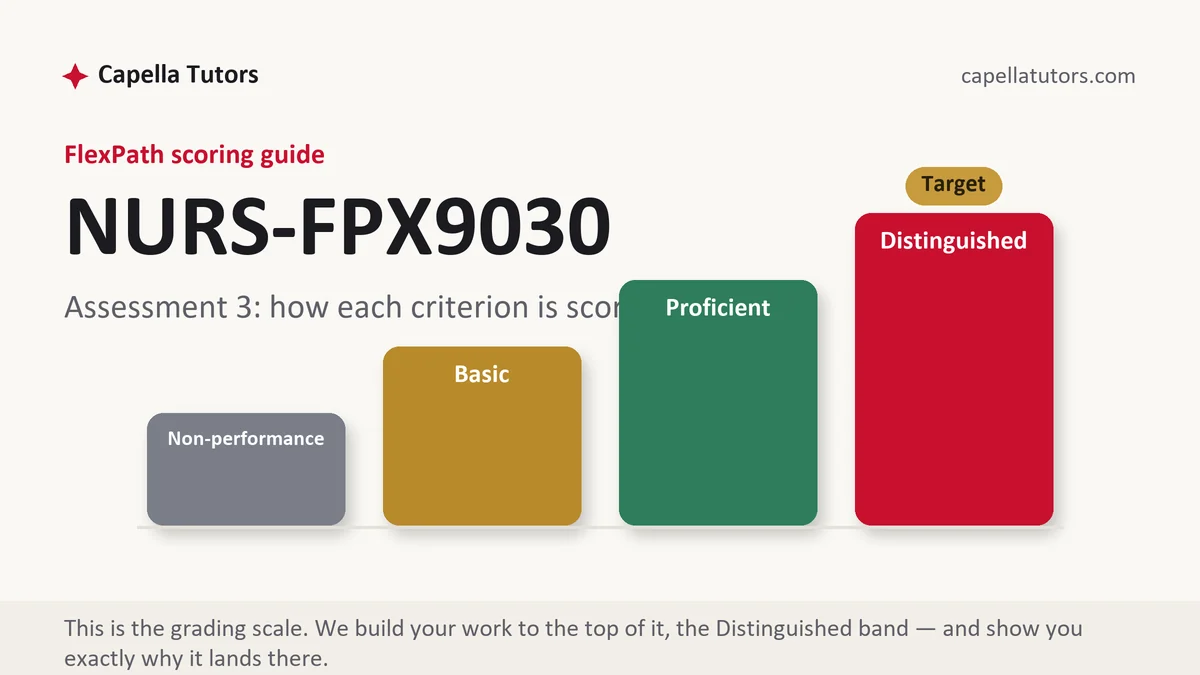
How NURS FPX 9030 Assessment 3 is scored
Every criterion gets its own level, and the top one describes an author in control of their own limitations:
| Level | What it means on deviations, stewardship and comparison |
|---|---|
| Distinguished | Deviations are dated, bounded and reported as separate periods rather than averaged in, privacy choices are described as decisions with small-cell reporting handled, and your delivery is compared to the source studies on population, baseline rate, dose, duration and setting. The extra move is saying what your project can and cannot claim before anyone asks. |
| Proficient | Deviations acknowledged, data handled properly, and the literature revisited. Sound, with the comparison kept general enough to avoid uncomfortable differences. |
| Basic | Barriers described in a paragraph without dates, and the evidence section rewritten from the design course with nothing new asked of it. |
| Non-performance | A required element is absent, most often the deviation record or any account of how the data was protected. |
Deviations are ordinary in real settings and none of them damage a doctoral project on their own. What damages it is discovering them during the write-up, because by then you cannot say which weeks were affected, and an evaluation whose disturbed periods cannot be bounded is one a reviewer has no way to accept.
The NURS FPX 9030 Assessment 3 method, step by step
-
Turn the deviation log into dated periods
For each departure, record what was supposed to occur, what occurred instead, the date it started, the date it ended, who decided, and which measures it touched. Then decide whether the affected weeks are still comparable, and if they are not, report them as a separate phase rather than blending them into the average.
-
Separate the deviations you chose from the ones that happened to you
A change you made in response to fidelity data is a cycle; a change imposed by a staffing gap or a system upgrade is a disturbance. They belong in different sentences, because one is evidence of judgment and the other is evidence about the environment.
-
Write data stewardship as choices with reasons
Which identifiers you deliberately never collected, where the working file lived, who had access, how the sheets were destroyed, and what you did where a cell held two patients. On a small unit the aggregate can identify people, and the criterion is looking for evidence you thought about it.
-
Compare your delivery to the source studies on five dimensions
Population, baseline rate, dose, duration and setting. A trial run across three academic centers for twelve months on units with twice your baseline, delivered by a dedicated coordinator, is not a benchmark your twelve-week single-unit project should be measured against, and naming the mismatch is the qualification.
-
Reread the studies for design before conclusions
The size of your own numbers has probably changed which of your sources are still relevant. Go back through the retained set with design and sample in view, and be prepared to demote a paper you leaned on in the design course because your project turned out to be a different kind of thing.
-
Write the sentence most drafts avoid, then self-score
Given the fidelity achieved and the window available, this is what the project can claim and this is what it cannot. Put it in the paper in your own words. Then level every criterion yourself and rewrite anything under the top before submitting.
A structure that maps to the criteria
Planning targets our tutors use for a closing implementation submission, not Capella rules; logs and tables sit outside the prose count.
| Section | What it must do | Guide |
|---|---|---|
| Deviation record | Each departure with its dates, its cause, its decision-maker and the measures it affected. | ~300 words |
| Bounded periods | Which weeks are reported separately, and how the rest of the series remains comparable. | ~200 words |
| Barriers and facilitators | What helped and what obstructed delivery, evidenced from the record rather than from impression. | ~250 words |
| Data stewardship | Identifiers avoided, storage, access, retention, destruction, and small-cell handling. | ~250 words |
| Comparison to the evidence base | Your delivery against the source studies on population, baseline, dose, duration and setting. | ~350 words |
| Claim boundaries and references | What the project can and cannot support, with current APA matched in both directions. | ~250 words |
Annotated sample excerpt
A model paragraph from our doctoral team showing how a comparison to the literature reads when it is honest about scale.
The nurse-led referral component in this project was modeled on two trials of tobacco cessation counselling in cardiac rehabilitation, and the differences between those settings and this one are large enough to change what a comparison means: both trials enrolled patients within seven days of an index cardiac event, delivered four counselling contacts by a dedicated cessation specialist over eight weeks, and reported abstinence at six months, while this project delivered a single structured referral by the rehabilitation nurse at intake and could observe only whether the referral was accepted.1 Baseline differed as well, at 38 percent current smokers in the pooled trial populations against 21 percent in this rehabilitation cohort, which means the eligible group here was both smaller and, plausibly, harder to move.2 The project therefore compares itself to those trials on the process step alone, and treats their abstinence figures as context for a later evaluation rather than as a benchmark this twelve-week window could have met.3
- 1Lays the two deliveries side by side on concrete dimensions instead of noting that findings were consistent with the literature. Specific mismatches are what a doctoral reader is checking for.
- 2Includes the baseline difference and states its likely direction, which is the harder half of the comparison and the half most drafts leave out.
- 3Draws the boundary of the comparison explicitly. Refusing an unearned benchmark protects every other claim in the submission.
The full premium sample for your exact assessment, written fresh to your scoring guide and issue, is free to request. Study it, revise it into your own voice, and submit work you understand.
The five mistakes that cost Distinguished
- Barriers described without dates. An undated disturbance cannot be bounded, and an unbounded period contaminates the whole series.
- Chosen changes and imposed changes in one list. Merging them hides the judgment you exercised and inflates the disruption you suffered.
- Privacy covered by not mentioning it. Silence is not a safeguard, and small-cell reporting on a twenty-bed unit is a real problem with a real answer.
- The literature section recycled. Pasting the design course's synthesis forward asks nothing of the evidence at the point where your own data can interrogate it.
- A benchmark accepted without checking scale. Measuring a twelve-week single-unit project against a multi-site trial concedes a comparison you never had to make.
Pre-submission checklist
- Every deviation carries start date, end date, cause, decision-maker and affected measures
- Disturbed weeks reported as separate periods rather than averaged in
- Deliberate cycles distinguished in writing from imposed disruptions
- Data handling written as decisions, including how small cells are reported
- Delivery compared to source studies on population, baseline, dose, duration and setting
- The boundary of what the project can claim stated in your own words
Closing out the implementation course?
Send the deviation notes, the guide and the studies your design rested on. We date and bound the disturbances, write the stewardship section as decisions, and build the comparison on the five dimensions that actually differ, so the final course inherits a dataset rather than an argument. Revisions free until it clears.