This manual is for NURS FPX 9030 Assessment 1, start to submission. Assessment 1 of Doctor of Nursing Practice 4 usually asks for the record of what actually happened on the unit: a week-by-week account of what was delivered, to whom, by whom, and what was collected alongside it, written so a reader could rebuild your project without asking a single question. Everything before this course could be produced at a desk, and the criteria at this stage are designed to tell the difference. Below is the reconstruction method our doctoral tutors use, a structure indexed to the criteria, and an annotated sample excerpt. Rather we assembled it? A premium original sample for this exact assessment returns inside 24 to 48 hours, with unlimited free revisions until the guide is satisfied. Capella's catalog lists the course as NURS-FPX9030, and some courserooms print NURS9030; both point to this same Assessment 1.
One honesty note before the manual: Capella revises courses and scoring guides over time, so always write to the exact scoring guide attached to your assessment in the courseroom. The course identity above is verified on capella.edu; the method and structure below are our tutors' approach to it, not Capella's official rubric text.
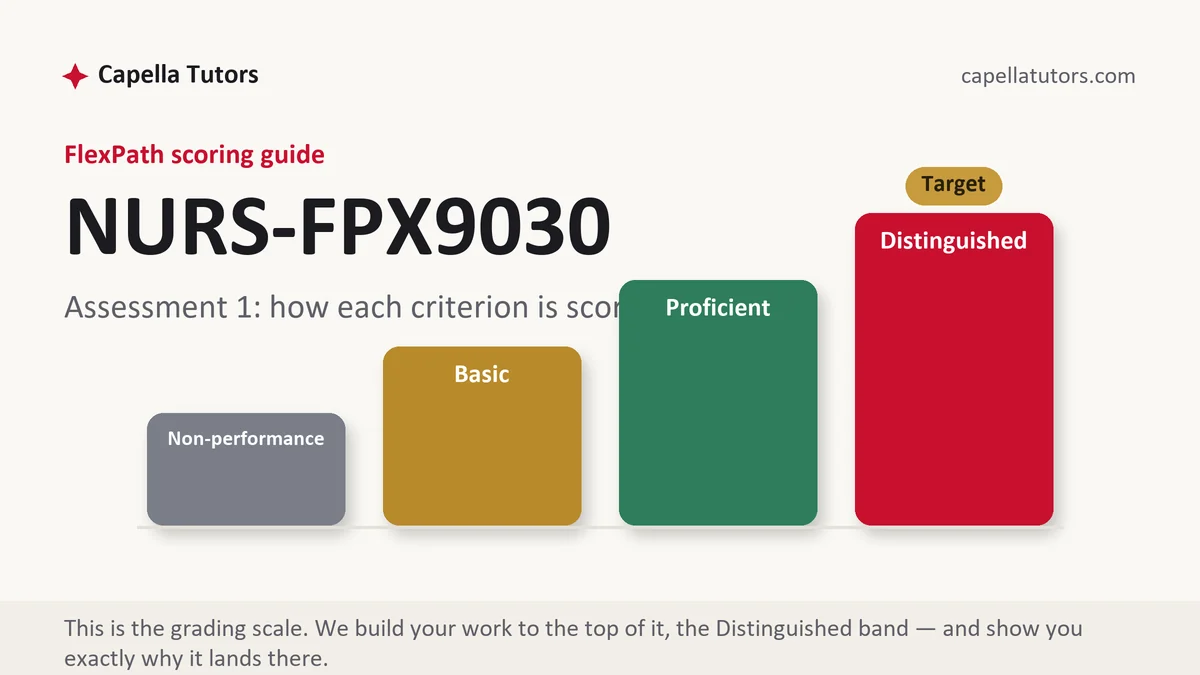
How NURS FPX 9030 Assessment 1 is scored
Criteria are levelled one at a time, and the top descriptor is a description of the artifact you should be building:
| Level | What it means on an implementation record |
|---|---|
| Distinguished | The account is written in dates, reach and frequency are expressed as proportions of what was intended, the collection schedule is shown to have held week by week, and the shortfalls are carried forward into the interpretation rather than parked. The extra move is a record complete enough to be audited by a stranger. |
| Proficient | Delivery is described accurately and the measures were collected. A reader can follow it and could not reconstruct week seven. |
| Basic | The plan restated in the past tense, with the intervention described as it was designed rather than as it went out. |
| Non-performance | A required element is absent, most often any figure for reach or frequency, which leaves the whole evaluation uninterpretable. |
Delivery is a number rather than a claim, and at this stage it is the number everything else depends on. If 46 of 58 eligible nurses completed the module inside its window, that is 79 percent, and roughly one nurse in five was never exposed to the thing you are about to evaluate. Report that before you report anything else and the rest of the submission becomes readable.
The NURS FPX 9030 Assessment 1 method, step by step
-
Build the timeline table before you write a sentence
One row per week: what was delivered, to whom, by whom, what was collected, and what interrupted it. Everything else in the submission draws from that table. Candidates who write the narrative first find gaps they can no longer fill, because nobody remembers whether the prompt ran in week seven.
-
Reconstruct from records, not from memory
Completion reports, sign-in sheets, huddle logs, message threads, the audit binder, calendar entries. Where a week has no document behind it, say so in the table rather than filling it with a plausible account. An acknowledged gap is a limitation; an invented week is a finding waiting to be contradicted.
-
Express reach and frequency as proportions of intent
Eligible population in the denominator, delivered in the numerator, for each component and for each period. Frequency gets the same treatment: if the daily step was supposed to run on 60 weekdays and ran on 51, that is 85 percent, and the missing nine days are a fact your outcome section will need.
-
Keep the denominator stable and flag it when it moves
An audit that quietly drops from twenty charts a week to eight has changed what its percentages mean. If sampling changed, mark the week it changed and report the affected period separately. Silent denominator drift is the single fastest way to lose a data criterion.
-
Log the interruptions while they are still datable
A unit closing to admissions, a champion transferring, a prompt switched off during an upgrade, a holiday week with agency staffing. None of these damage a doctoral project. Discovering them during the write-up does, because by then you cannot say which weeks were affected.
-
Read the record as an auditor, then self-score
Hand the timeline to someone who was not involved and ask them to describe week five back to you. Fix whatever they cannot see. Then mark each criterion D, P, B or N, rewrite anything below the top, and submit with the practicum log current.
A structure that maps to the criteria
Planning targets our tutors use for an implementation record, not Capella rules; the timeline table and logs sit outside the prose count.
| Section | What it must do | Guide |
|---|---|---|
| Setting and readiness at go-live | The unit as it was on day one, including staffing, volume and anything already in motion nearby. | ~250 words |
| Implementation timeline | Every delivered component with its date, audience, owner and what was collected that week. | ~350 words |
| Reach and dose | Eligible population, number reached, frequency achieved, each as a proportion of what was intended. | ~350 words |
| Collection schedule as run | What was audited each week, by whom, on what sampling rule, and whether the rule held. | ~250 words |
| Interruptions and context | Dated events that changed delivery or the environment, with the weeks they affected bounded. | ~250 words |
| Practicum and references | Hours logged against milestones with preceptor sign-off, and current APA matched both ways. | ~200 words |
Annotated sample excerpt
A model paragraph from our doctoral team, showing what an implementation record sounds like when it was kept rather than remembered.
The transitional-care call was intended for every patient discharged home after a chronic obstructive pulmonary disease exacerbation, and across the twelve implementation weeks 142 discharges met that definition, of whom 108 were reached on a first or second attempt inside 72 hours, 76.1 percent, with attempt times taken from the call log rather than from the nurses' recollection.1 Frequency held less well than reach: the protocol specified a second call at day seven, which was completed for 71 of the 108 patients contacted, 65.7 percent, and the shortfall is concentrated in weeks six through nine when the unit ran without its second care coordinator.2 The audit of discharge summaries stayed at twenty records a week for all twelve weeks except week ten, when the reviewer was on leave and eight records were pulled, so week ten is reported separately in every table rather than pooled.3
- 1Defines the eligible population, then gives reach as a proportion with the data source named. Call logs are auditable; recollection is not, and saying which one produced the figure is part of the criterion.
- 2Separates reach from frequency and locates the shortfall in specific weeks with a staffing cause. Two different fidelity dimensions, two different numbers.
- 3Flags the one week the sampling rule changed and quarantines it. A denominator that moves without warning invalidates every percentage around it.
The full premium sample for your exact assessment, written fresh to your scoring guide and issue, is free to request. Study it, revise it into your own voice, and submit work you understand.
The five mistakes that cost Distinguished
- The plan retold in the past tense. What was designed and what went out are different documents, and criteria at this stage exist to catch the substitution.
- No reach figure anywhere. Without a proportion of eligible cases actually exposed, neither a positive nor a null result can be interpreted.
- Weeks reconstructed from memory. A narrative with no document behind it cannot be defended when a reviewer asks what happened on the fourteenth.
- A sampling rule that drifted silently. Twenty charts one week and eight the next is not a series, and pooling them hides it.
- Practicum hours logged against shifts. Hours tied to project milestones are evidence of doctoral work; hours tied to your roster are a timesheet.
Pre-submission checklist
- A week-by-week table exists and every other section draws from it
- Each week's entry traces to a document rather than to recollection
- Reach and frequency reported separately, each as a proportion of intent
- Sampling rule stated, with any week it changed reported on its own
- Interruptions dated and their affected weeks bounded
- Practicum hours logged against milestones, preceptor sign-off current
Implementation record due?
Send the audit sheets, call logs, completion reports and the guide, in any format they exist in. We build the week-by-week timeline, compute reach and dose against their real denominators, bound the interruptions by date, and write the record so an auditor could follow it. Free revisions until it clears.