This manual is for NURS FPX 9020 Assessment 3, start to submission. Assessment 3 usually asks what the first weeks of delivery actually produced: the fidelity figures with their denominators, the interim movement in your measures read against those figures, the deviations logged as they happened, and one improvement cycle closed with a prediction written before the next batch of data arrives. It is the deliverable that separates a project from a status report, and the criteria are built to notice which one you handed in. What follows is our doctoral reading method, a structure that answers the criteria, and an annotated sample excerpt. If you would rather hand the reading over, a premium original sample for this exact assessment arrives within 24 to 48 hours and is revised free until the guide is met. Capella's catalog lists the course as NURS-FPX9020, and some courserooms print NURS9020; both point to this same Assessment 3.
One honesty note before the manual: Capella revises courses and scoring guides over time, so always write to the exact scoring guide attached to your assessment in the courseroom. The course identity above is verified on capella.edu; the method and structure below are our tutors' approach to it, not Capella's official rubric text.
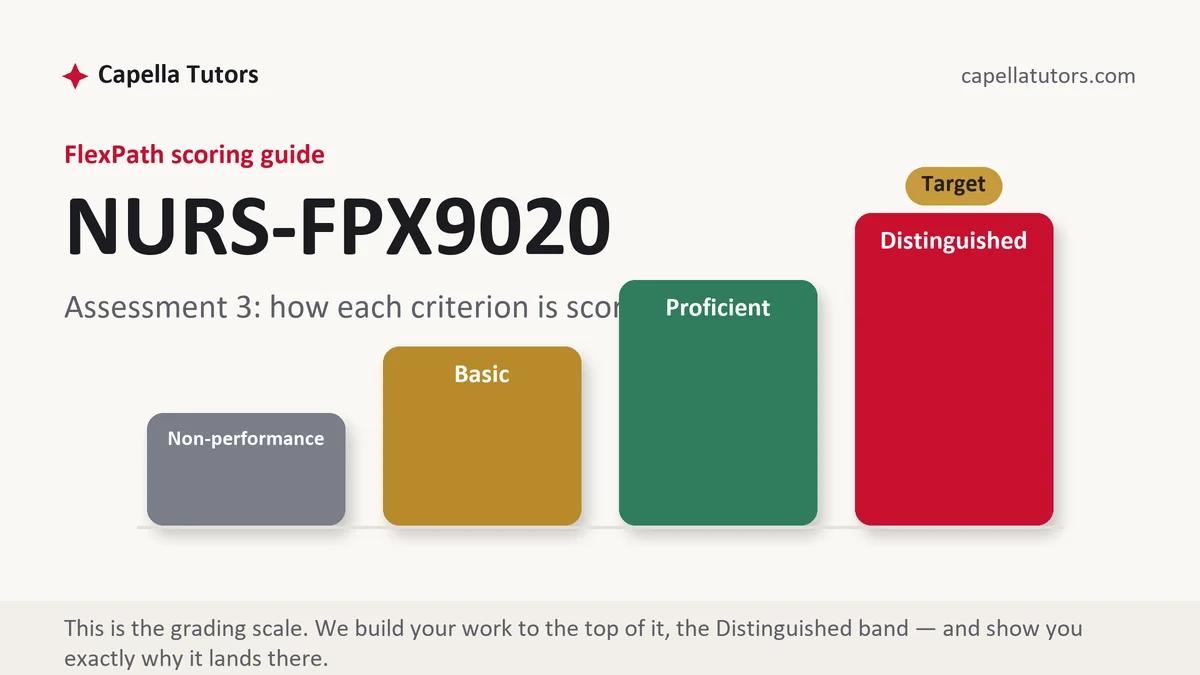
How NURS FPX 9020 Assessment 3 is scored
Each criterion is placed at one of four levels on its own merits. On a mid-project reading the levels sort like this:
| Level | What it means on an interim reading and improvement cycle |
|---|---|
| Distinguished | Fidelity is reported before outcome, every rate carries its denominator and window, attribution is explicitly withheld where the delivery figure does not earn it, misses are explained by workflow rather than by attitude, and one cycle closes with a dated change and the measure that will test it. The extra move is predicting the next result in writing. |
| Proficient | Interim data reported accurately with an adjustment described. Correct, and the interpretation runs slightly ahead of what the delivery figures support. |
| Basic | An improvement announced from a single month's movement, with fidelity absent and the denominator implied. |
| Non-performance | A required element is missing, most often the fidelity data or any account of what changed in response to it. |
Order of presentation carries marks here. Report the delivery figures first and the outcome second, because a reader who meets the outcome first will interpret it before learning that two thirds of eligible cases received the change. The same numbers in the reverse order read as evidence rather than as a claim.
The NURS FPX 9020 Assessment 3 method, step by step
-
Close the fidelity data before you look at the outcome
Total the tick sheets, fix the denominator, and compute adherence per component. Doing this first protects you from the most common reading error at this stage, which is explaining a number that has not been produced by the intervention yet because the intervention barely happened.
-
Report three figures in a fixed order
Reach, delivery and outcome, each with its denominator and its window. That sequence makes the interpretation almost automatic for the reader, and it is the structural difference between a mid-project account that scores and one that reads as advocacy.
-
Explain the misses by workflow
Find where the skipped components cluster: an hour, a day of the week, a covering role, a room. Adherence at sixty percent is almost never indifference, it is a step that does not fit the work at the moment it fires, and naming the moment is what makes the next cycle designable.
-
Withhold attribution you have not earned
If delivery reached two thirds of eligible cases, any movement is evidence about a partially delivered intervention, and saying so costs nothing while claiming otherwise costs a criterion. Write the sentence that declines the credit before an evaluator writes it for you.
-
Respect the size of your denominator
On ninety-odd cases a single event moves the rate about a point, so a rate that ticked upward is not a shift. Run-chart convention looks for a sustained run of points on one side of the median rather than one encouraging month, and texts differ on the run length, which is itself worth stating.
-
Close one cycle properly and predict the next
What the fidelity data showed, the change you made, the date you made it, the measure that will test it, and what you expect that measure to do. One documented cycle with a written prediction outscores three gestured at, and it gives the final courses something to build on.
A structure that maps to the criteria
Planning targets our tutors use for a mid-project submission, not Capella requirements; charts and logs sit outside the prose count.
| Section | What it must do | Guide |
|---|---|---|
| Delivery to date | What was delivered, over which weeks, to whom, and by whom, stated as dates rather than as phases. | ~250 words |
| Fidelity results | Adherence per component and dose delivered, each with its eligible denominator and observation window. | ~350 words |
| Interim measure movement | Process and outcome measures against baseline, same operational definitions, windows stated. | ~300 words |
| Interpretation | Movement read through the fidelity figure, with attribution withheld where delivery does not support it. | ~250 words |
| Deviations log | What departed from the protocol, when, why, who decided, and which weeks are affected. | ~200 words |
| Cycle closed and next prediction | The change made, its date, the testing measure, the expected result, and current APA both ways. | ~250 words |
Annotated sample excerpt
A model paragraph from our doctoral team, showing how interim numbers read when they are sequenced deliberately.
Across the first four weeks, the revised hypoglycemia response protocol was available on all 28 weekday shifts and on 19 of 28 night shifts, and a repeat glucose within fifteen minutes of treatment was documented for 63 of 88 eligible episodes on the 32-bed medical unit, 71.6 percent, against an eligible population defined as any capillary glucose below 70 recorded in the treatment record.1 The time-to-recheck measure has moved from a baseline median of 34 minutes across 12 weeks to 21 minutes across these four, which is real movement in a partially delivered intervention rather than an effect of the protocol, since more than one episode in four was managed without it.2 The 25 misses cluster: 17 occurred between 23:00 and 07:00, and the reason field most often records that the glucometer had to be retrieved from an adjacent unit, which is a supply problem the protocol did not anticipate rather than a compliance problem.3
- 1Delivery figures arrive first, with the eligible population defined in the same sentence as the rate. The reader knows what the denominator contains before any result appears.
- 2States the movement and then declines to attribute it, in the same sentence. Withheld credit is what the top descriptor is looking for at this stage.
- 3Locates the misses in time and traces them to a workflow cause, which turns a fidelity shortfall into the next cycle instead of into an excuse.
The full premium sample for your exact assessment, written fresh to your scoring guide and issue, is free to request. Study it, revise it into your own voice, and submit work you understand.
The five mistakes that cost Distinguished
- Outcome reported before delivery. The order tells the reader what you think the evidence is, and putting the result first claims more than the data allows.
- Deviations assembled at the end. Logged the week they happen they are data; recalled two months later they are anecdote nobody can date.
- Misses attributed to attitude. Staff buy-in as an explanation stops the analysis exactly where the useful work begins.
- One month read as a trend. On small denominators a single case moves the rate, and a rate that moved is not a signal.
- A cycle with no prediction. Changing something and waiting to see is not a test; naming the expected result in advance is.
Pre-submission checklist
- Fidelity figures computed and reported before any outcome appears
- Every rate carries its numerator, denominator and window in the same sentence
- Attribution explicitly withheld wherever delivery does not support it
- Missed components located by hour, day or role, with a workflow cause named
- Deviations dated, with the affected weeks bounded rather than averaged in
- One cycle closed with a dated change, a testing measure and a written prediction
Mid-project reading due?
Send the tick sheets in whatever state they are in, the guide, and your baseline definitions. We compute the fidelity, sequence the figures so the interpretation is unavoidable, bound the deviations by date, and close a cycle with a prediction attached. Revisions free until the criteria clear.