This manual is for NURS FPX 9020 Assessment 2, start to submission. Assessment 2 usually asks you to convert an approved design into something a stranger on a night shift could execute, and to build the instrument that will prove it was executed. That means the change written as a protocol at component grain, a fidelity tool covering adherence, dose and quality of delivery, and a training and communication plan for the people who have to run it. Criteria here are graded on operational specificity, and the difference between a plan and a protocol is where the points sit. Below is the way our doctoral tutors write one, a structure taken from the criteria, and an annotated sample excerpt. Prefer that we build it? A premium original sample for this exact assessment comes back in 24 to 48 hours, revised at no charge until the criteria clear. Capella's catalog lists the course as NURS-FPX9020, and some courserooms print NURS9020; both point to this same Assessment 2.
One honesty note before the manual: Capella revises courses and scoring guides over time, so always write to the exact scoring guide attached to your assessment in the courseroom. The course identity above is verified on capella.edu; the method and structure below are our tutors' approach to it, not Capella's official rubric text.
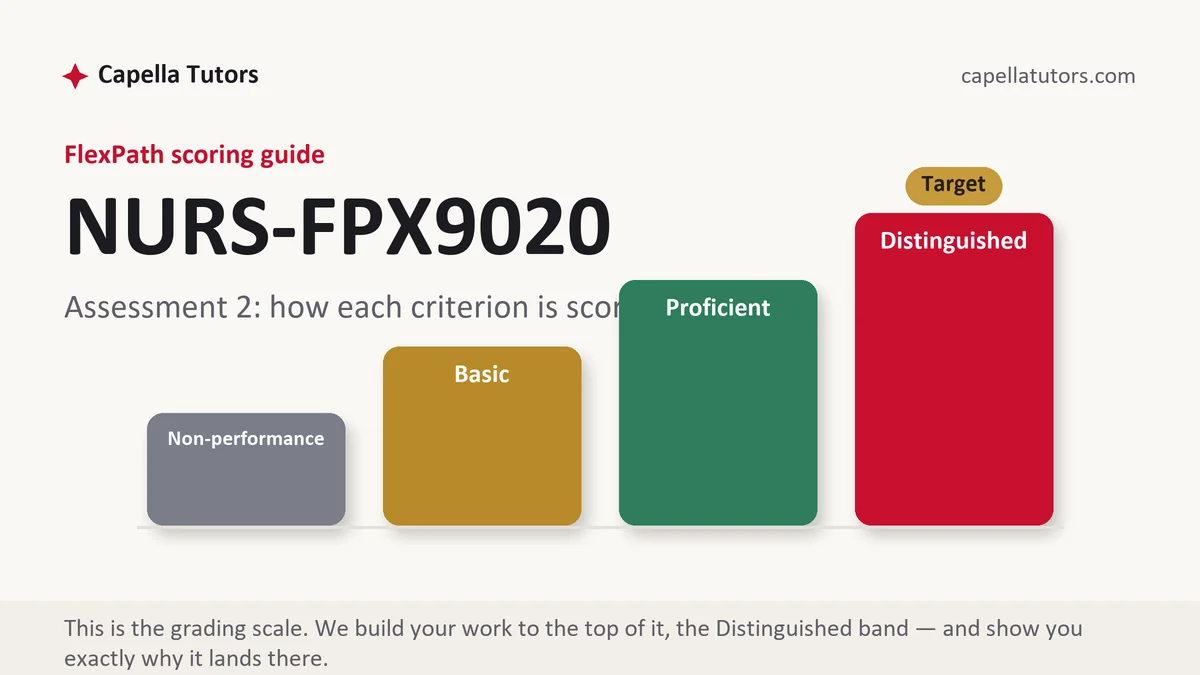
How NURS FPX 9020 Assessment 2 is scored
Four descriptors per criterion, each judged on its own evidence. Here is what the levels look like on an implementation-ready protocol:
| Level | What it means on a protocol and fidelity instrument |
|---|---|
| Distinguished | Every component carries a trigger, an actor, a time, a documentation location and an exception path, the fidelity tool measures adherence and dose separately and can be run by someone untrained, and the protocol says how each component is supposed to work rather than only what it is. The extra move is writing the theory of action beside the steps. |
| Proficient | A clear, complete protocol with a workable fidelity plan. Two people could still deliver it differently without either of them noticing. |
| Basic | A description of what will happen, in paragraphs, with the fidelity plan reduced to an intention to monitor compliance. |
| Non-performance | A required element is absent, most often the fidelity instrument itself or the exception handling for components that cannot be delivered. |
Fidelity and outcome are different measurements with different instruments, and the reason the criteria separate them is that a flat result cannot be interpreted without the first. Judging an intervention that was never really delivered is the structural error that spoils more doctoral projects than any analysis mistake, and the only defence against it is an instrument built before go-live, not reconstructed after.
The NURS FPX 9020 Assessment 2 method, step by step
-
Break the intervention into components you can count separately
Most changes are three or four things bundled together: a screening step, a documentation step, a referral step, a feedback step. Number them, because fidelity is measured per component and a bundle counted as one thing tells you nothing about which part failed.
-
Write each component in five fields
Trigger, actor, timing, documentation location, exception. The exception field is the one drafts skip and the one that saves the project: what happens when the actor is not there, when the trigger fires at three in the morning, when the field is greyed out. Undocumented workarounds become invisible variation.
-
State the theory of action beside each component
Say what each step is supposed to do to the problem: remove a memory burden, close a handoff gap, shift a default, add accountability. When a component has no stated mechanism it usually turns out to be there for reassurance, and the top descriptor rewards knowing which is which.
-
Build a fidelity instrument a charge nurse could run cold
One row per eligible case or per shift, one tick per component, a free-text reason whenever a component is skipped, and a defined eligible population so the denominator is never in doubt. If it takes longer than ninety seconds to complete, it will be completed from memory at the end of the week, which is not data.
-
Plan the training and the communication as delivery, not as announcement
Who is trained, by whom, in what format, over what window, and how the people who missed it are caught. Then say how staff will hear results while the project runs, because feedback close in time to the behavior from a respected colleague outperforms a monthly emailed report by a wide margin.
-
Pilot on paper, then self-score
Walk three imaginary patients through the protocol at three different hours and see what breaks. Fix the breaks in the document rather than at the bedside. Then mark each criterion yourself, rewrite anything under the top level, and submit with the appendix attached.
A structure that maps to the criteria
Planning targets our tutors use for a protocol submission, not Capella rules; instruments and appendices sit outside the prose count.
| Section | What it must do | Guide |
|---|---|---|
| Protocol overview | The components numbered, the eligible population defined, and the sequence a case moves through. | ~250 words |
| Component specifications | Each component in trigger, actor, timing, documentation and exception, with its mechanism stated. | ~450 words |
| Roles and escalation | Who owns each component, who covers it when absent, and what happens when it is not delivered. | ~200 words |
| Fidelity instrument | The tool itself, the observation unit, the eligible denominator, and how adherence and dose are counted separately. | ~300 words |
| Training and feedback plan | Delivery format, coverage window, catch-up route, and how results reach staff during the project. | ~250 words |
| Risks and references | What could stop delivery, the mitigation for each, and current APA matched both ways. | ~200 words |
Annotated sample excerpt
An original model paragraph from our doctoral team, pitched at the grain an implementation criterion is actually scored on.
Component two fires when a patient checks in for any prenatal visit at or after 24 weeks: the rooming medical assistant hands over the validated depression screening form with the vitals, the completed score is entered in the discrete screening field before the provider enters the room, and if the patient declines, the assistant records declined in the same field rather than leaving it blank.1 The mechanism is a default shift rather than a knowledge gain. Staff already know screening is indicated; what fails is that the form competes with rooming tasks, so the component moves it into the vitals bundle where the sequence is already habitual.2 When the assistant role is unfilled and the nurse rooms the patient, the same trigger applies and the exception is logged on the fidelity sheet as covered by nurse, because a component delivered by a different actor is a variation worth counting rather than a miss.3
- 1Trigger, actor, timing and documentation location in one sentence, including what to record when the patient declines. Blank fields are the enemy of a clean denominator.
- 2States what the component is supposed to do to the problem. A step with a named mechanism can be evaluated; a step included for completeness cannot.
- 3Handles the exception explicitly and turns it into a recorded variation. Unwritten workarounds are how two nurses deliver different interventions under one protocol name.
The full premium sample for your exact assessment, written fresh to your scoring guide and issue, is free to request. Study it, revise it into your own voice, and submit work you understand.
The five mistakes that cost Distinguished
- A protocol only its author could run. Components without an actor and a time get delivered differently by everyone, and the variation never shows up in the data.
- Fidelity promised as monitoring. Compliance will be monitored is not an instrument, and nothing can be built from it in the next course.
- The bundle counted as one thing. When four steps share a single tick box, a partial failure is indistinguishable from a full one.
- No exception path. Every real unit has hours when the named actor does not exist, and a protocol silent about them produces silent deviation.
- Training treated as an announcement. An email to the unit is not coverage, and coverage is what your dose figure will be divided by.
Pre-submission checklist
- Components numbered, with the eligible population defined once and used everywhere
- Every component carries trigger, actor, timing, documentation and exception
- The mechanism of each component stated in a sentence
- A fidelity instrument attached that an untrained colleague could complete
- Adherence and dose counted separately, with a reason field for every skip
- Training coverage, catch-up route and in-project feedback all specified
Protocol or fidelity tool due?
Send the guide, your approved design and how the unit actually runs. We write the protocol component by component with exceptions handled, build a fidelity sheet a charge nurse can run untrained, and specify the training so your dose figure has a real denominator. Free revisions until the guide signs it off.