This manual is for NURS FPX 9020 Assessment 1, start to submission. Assessment 1 of Doctor of Nursing Practice 3 usually asks for the permissions layer of the project written as a record rather than as a formality: which reviewing bodies were approached, on what dates, what classification each returned, which features of your design drove that classification, and what the practice site authorized in writing. It is the deliverable most students underwrite, because it feels administrative and is graded as reasoning. Below you will find the method our doctoral tutors apply, a structure aligned to the criteria, and an annotated sample excerpt. Would you sooner delegate it? A premium original sample for this exact assessment returns within 24 to 48 hours, with revisions carried free until the guide is satisfied. Capella's catalog lists the course as NURS-FPX9020, and some courserooms print NURS9020; both point to this same Assessment 1.
One honesty note before the manual: Capella revises courses and scoring guides over time, so always write to the exact scoring guide attached to your assessment in the courseroom. The course identity above is verified on capella.edu; the method and structure below are our tutors' approach to it, not Capella's official rubric text.
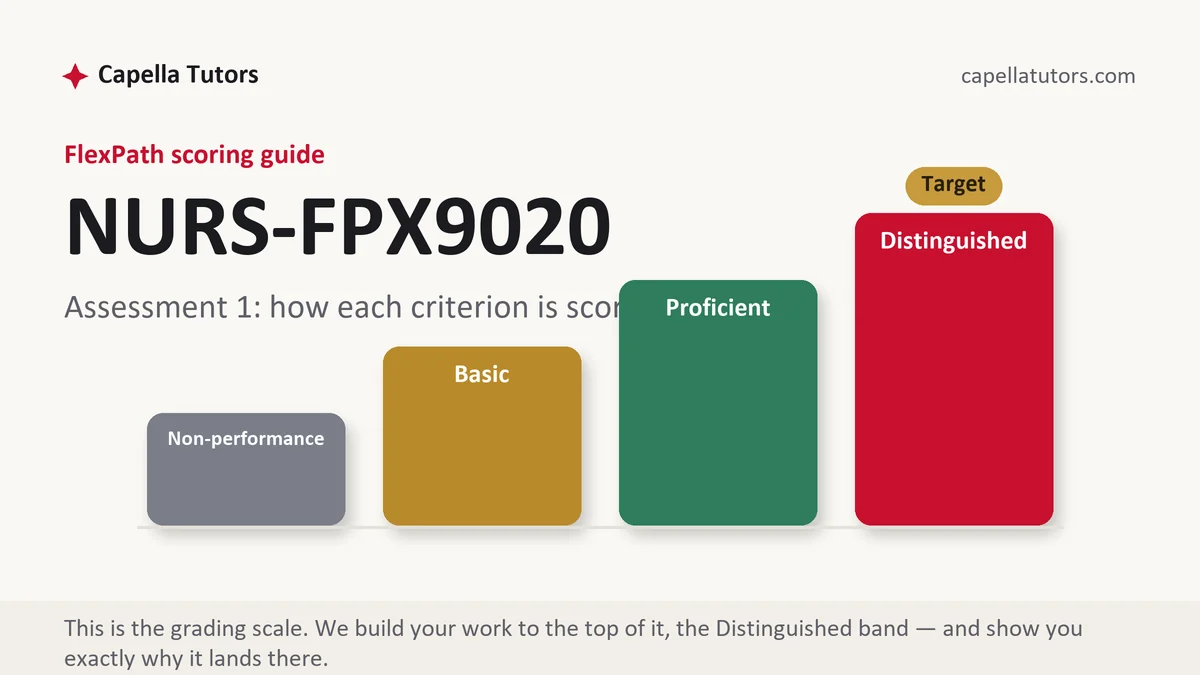
How NURS FPX 9020 Assessment 1 is scored
Criteria are scored separately against four descriptors, and no strong section rescues a weak one. What each level looks like here:
| Level | What it means on a determination and authorization narrative |
|---|---|
| Distinguished | Each determination is reported with its issuing body, its date and its category, the design features that produced that category are named, both institutional pathways are addressed rather than assumed equivalent, and the ethical handling of data is described as decisions you made. The move past sufficiency is showing the reasoning, not the receipt. |
| Proficient | Approvals are reported accurately and the site agreement is documented. Everything is there and nothing is explained. |
| Basic | Review described as a box ticked, with the classification asserted by the student rather than attributed to the body that issued it. |
| Non-performance | A required element is absent, commonly the site's written authorization or any account of the review pathway at all. |
One distinction carries most of the marks. A determination is a decision made by an authority on a date; an approval is one possible outcome of that decision. Federal policy defines research as a systematic investigation designed to produce generalizable knowledge, and improving care at a single site usually falls outside it, but the party entitled to say so is never the student. Write who decided, when, and on what basis, and attach the document.
The NURS FPX 9020 Assessment 1 method, step by step
-
Ask both institutions early and in writing
Your university has a review process and your practice site may have its own board or research council, they are separate queues with separate forms, and a letter from one is not currency at the other. Send both before you need them, because a classification can force a design change and design changes are cheap now.
-
Describe the project so it can be classified, not so it will be waved through
Say what you are changing, who is affected, what data you will collect, whether anything is randomized or withheld, and whether the findings are intended to travel beyond the site. Understating any of those to get a faster answer produces a determination that does not cover what you actually do.
-
Name the design features that drive the category
Randomizing who receives the change, withholding usual care from a comparison group, collecting identifiers the patient's care does not require, or enrolling people who must consent all push a project toward research. Stated intent counts too. List which of these your project contains and which it does not.
-
Write the data handling as decisions
Which identifiers you deliberately never collected, where the sheets live, who else can open them, how long they are kept and who destroys them. On a small unit add the small-cell problem: a table with two patients in a row can identify them, and saying how you will aggregate is part of the answer.
-
Get the site agreement in a form with a signature on it
Who signed, in what role, on what date, and what precisely was permitted: access to which report, contact with which staff, a change to which workflow. Support expressed in a corridor is not authorization, and the difference becomes visible the moment anyone asks for the document.
-
Build the appendix, then self-score
Determination letter, site authorization, any data use agreement, each labeled and referenced from the narrative by name. Then mark every criterion D, P, B or N and rewrite anything below the top. Submit early in the week, since two business days of evaluation is the norm at doctoral level.
A structure that maps to the criteria
These lengths are our planning defaults for a governance-weighted submission, not Capella rules; your guide decides where the weight belongs.
| Section | What it must do | Guide |
|---|---|---|
| Project summary for reviewers | The change, the population affected, the data collected, and the intent, in the words a reviewing body needs. | ~200 words |
| Classification reasoning | Which design features are present, which are absent, and why the resulting category follows from them. | ~350 words |
| Determinations received | Each body, date, category and any conditions attached, quoted and referenced to the appendix. | ~250 words |
| Site authorization | Signer, role, date and the specific permissions granted, including data access and workflow change. | ~250 words |
| Data handling and privacy | Identifiers avoided, storage, access, retention, destruction, and how small cells will be reported. | ~300 words |
| Appendices and references | Labeled documents, regulation and guidance cited to source, current APA matched both ways. | ~200 words |
Annotated sample excerpt
A model paragraph from our team showing how classification reasoning reads when it is argued rather than announced.
The project adds a standing prompt to the primary care visit workflow so that patients on long-term opioid therapy above a defined daily morphine milligram equivalent are offered a naloxone prescription, and it collects only the counts the practice's own reporting already produces, with no identifiers leaving the electronic record and no patient asked to do anything beyond ordinary care.1 Nothing is randomized, no comparison group is denied usual care, no data element is gathered that the visit does not require, and the stated intent is to change practice at these two clinics rather than to produce findings offered as generalizable, which together are the features the reviewing office weighed in returning a not-human-subjects-research determination on 3 February 2026, filed here as Appendix B.2 The health system's own nursing research council reviewed the same description separately and issued a letter of support on 11 February, and because the two processes are independent the project proceeded only after both were in hand.3
- 1Describes the activity accurately and completely before any classification is mentioned. A reviewer can only classify what you have actually told them.
- 2Names the specific design features that produced the category, then attributes the decision to the office that made it, with a date and an appendix. The student is not the one classifying.
- 3Treats the two pathways as separate rather than assuming reciprocity, which is the most common structural error in this section.
The full premium sample for your exact assessment, written fresh to your scoring guide and issue, is free to request. Study it, revise it into your own voice, and submit work you understand.
The five mistakes that cost Distinguished
- The student issuing the determination. Writing that the project is quality improvement and therefore exempt is a classification you are not entitled to make.
- One pathway treated as both. A university letter does not bind a health system, and a health system letter does not satisfy a university.
- Review reported as a date with no reasoning. The criterion is asking why the category followed from your design, and a filing reference does not answer that.
- Site permission described in the passive voice. Permission was obtained conceals the two facts that matter, who granted it and what exactly it covers.
- Privacy handled by omission. Not mentioning identifiers is not the same as deciding which ones you would never collect.
Pre-submission checklist
- The project is described completely enough for a reviewer to classify it
- Each determination carries its issuing body, its date and its category
- The design features behind the classification are listed, present and absent
- Both institutional pathways addressed as separate processes
- Site authorization named by signer, role, date and the permissions granted
- Data handling written as decisions, with small-cell reporting addressed
Determination narrative due?
Send the criteria, your design summary and whatever the review offices have sent back. We write the classification reasoning, separate the two pathways, document the site authorization properly and build the labeled appendix. Eight people on the pipeline, revisions free until the criterion clears.