This manual is for NURS FPX 9010 Assessment 3, start to submission. Assessment 3 usually turns the evidence work into something executable: the intervention specified as an activity with a countable dose, a change framework attributed and then actually used, measures defined so tightly that someone other than you could collect them, and an analysis chosen before any data exists. The criteria at this stage reward operational precision, and vague verbs are where drafts lose the top column. What comes next is the method our doctoral tutors work to, a structure laid over the criteria, and an annotated sample excerpt. Want it taken off your desk? A premium original sample for this exact assessment is back inside 24 to 48 hours, revised free of charge until the criteria are met. Capella's catalog lists the course as NURS-FPX9010, and some courserooms print NURS9010; both point to this same Assessment 3.
One honesty note before the manual: Capella revises courses and scoring guides over time, so always write to the exact scoring guide attached to your assessment in the courseroom. The course identity above is verified on capella.edu; the method and structure below are our tutors' approach to it, not Capella's official rubric text.
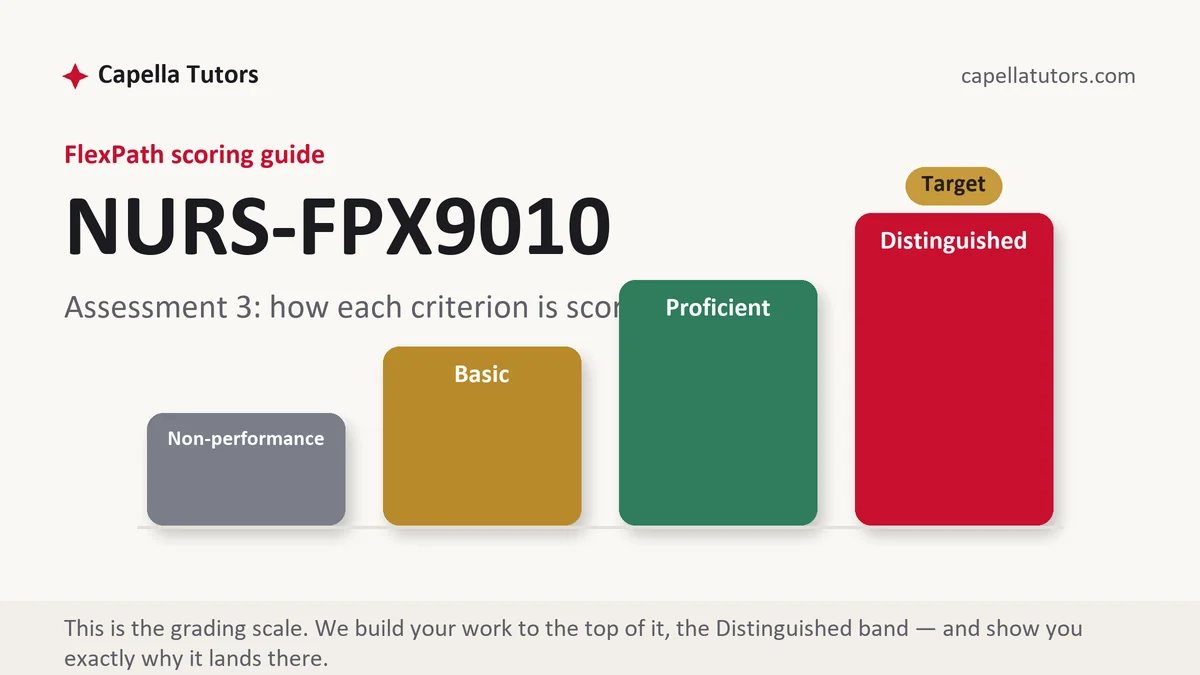
How NURS FPX 9010 Assessment 3 is scored
Every criterion carries four descriptors and is judged alone. Treat the top descriptor as a checklist written in prose:
| Level | What it means on a project design and measurement plan |
|---|---|
| Distinguished | The intervention is dosed in countable units with an owner and a trigger, the framework has a project activity mapped to each of its stages, every measure carries numerator, denominator, window, source system and collector, and the design states what it cannot rule out. The move past sufficiency is naming your own design's limits before the data does. |
| Proficient | A workable design with measures defined and a framework named. Complete, and a stranger would still need to ask you two questions before running it. |
| Basic | An intention described as a plan: staff will be educated, compliance will be monitored, outcomes will be tracked. Nothing in it can be counted. |
| Non-performance | A component the criterion required is absent, most often the analysis plan or the operational definitions behind the measures. |
One arithmetic check decides more about your design than any framework will. Multiply your baseline rate by your annual volume, apply the relative reduction the evidence supports, and look at how many events that is inside the window your program allows. If the answer is three, no statistical test will find it, and the design has to carry its weight on process measures with denominators large enough to move. Stating that in the plan is treated as rigor, not as weakness.
The NURS FPX 9010 Assessment 3 method, step by step
-
Build the artifacts first and write the prose around them
A logic model, a measurement table, a timeline with owners, a dose specification. Decide which artifact satisfies which criterion, build them, then write only the paragraphs that explain them. Prose written first tends to describe work that never gets built.
-
Do the detectability arithmetic before you commit
Baseline rate times volume times expected effect, inside your actual window. The number that comes out tells you whether your outcome can move visibly or whether your evaluation has to rest on process measures. Designs that skip this calculation discover it in the implementation course, where nothing can be changed.
-
Specify the intervention as a procedure with a dose
Not education for staff, but a twenty-minute module completed by every nurse on the unit inside three weeks, followed by a two-item prompt in the existing huddle, audited weekly. Trigger, actor, timing, documentation location and exception path, component by component. Anyone reading it should know what to deliver and when delivery has failed.
-
Make the framework do work
Cite the model to the people who built it and to the publication where they built it, then map each stage to something you will do on a date. A framework named in the introduction and abandoned afterward is visible from the table of contents, and doctoral criteria are written to catch it.
-
Define each measure until somebody else could collect it
Numerator, denominator, window, source system, collector, and whether it is outcome, process or balancing. Add the balancing measure deliberately, because a change that improves your number by lengthening someone else's day will be raised at defense if you do not raise it first.
-
Name the analysis and the threats in advance
Say what you will do with the numbers before you have any: run chart with the baseline median extended, proportions with intervals, or a simple comparison with its limits stated. Then list what a single-group before-and-after design cannot separate, including seasonality and any initiative running alongside yours.
A structure that maps to the criteria
Planning targets our tutors use for a design submission, not Capella requirements; tables and appendices sit outside the prose count.
| Section | What it must do | Guide |
|---|---|---|
| Aim statement | What will change, for whom, by how much, by when, worded so it can be judged true or false at the end. | ~150 words |
| Intervention specification | Each component as trigger, actor, timing, documentation and exception, with the dose in countable units. | ~400 words |
| Framework and logic model | The model attributed to its authors, with every stage mapped to a dated project activity. | ~300 words |
| Measurement plan | Outcome, process and balancing measures, each with numerator, denominator, window, source and collector. | ~350 words |
| Analysis and detectability | The analytic approach chosen in advance, with the arithmetic showing what the design can and cannot detect. | ~250 words |
| Threats, timeline and references | Confounders the design cannot rule out, the schedule with owners, and current APA both ways. | ~250 words |
Annotated sample excerpt
An original model paragraph from our doctoral team, written at the grain a design criterion is actually scored on.
The outcome measure is the proportion of oncology infusion patients with a scanned advance directive or documented goals-of-care conversation in the chart, numerator taken from the discrete document type in the electronic record and denominator from all patients completing a first infusion cycle in the calendar week, pulled each Monday by the clinic's data analyst rather than by the project lead.1 Because the clinic starts roughly 34 new cycles a week, a twelve-week implementation produces about 408 eligible patients, enough for a weekly proportion to move visibly, while the downstream outcome of hospice length of stay would yield too few events in the same window to be read as anything.2 One balancing measure is carried deliberately: mean chair time per first-cycle visit, taken from the existing scheduling report, since a conversation added to a treatment visit consumes minutes the clinic has not budgeted and a project that fixes documentation by lengthening the day will not survive its own success.3
- 1Numerator, denominator, window, source system and named collector in one sentence. Handing collection to someone other than the project lead is what makes the measure auditable.
- 2Shows the detectability arithmetic and then declines the measure that cannot carry the evaluation. Choosing the measure your volume supports is a design decision, and evaluators score it as one.
- 3A balancing measure with the reason it exists. Volunteering the way your project could do harm is the move the top descriptor is written to reward.
The full premium sample for your exact assessment, written fresh to your scoring guide and issue, is free to request. Study it, revise it into your own voice, and submit work you understand.
The five mistakes that cost Distinguished
- An intention where a procedure belongs. Staff will be educated cannot be delivered, counted or audited, and none of those omissions is recoverable later.
- Compliance rate used as if it were defined. The phrase means nothing until someone names the numerator, the denominator, the window and the report.
- A framework cited once and abandoned. If no stage of the model corresponds to a dated activity, the model is decoration.
- A design that cannot detect its own promise. Three avoidable events in twelve weeks will never reach significance, and the plan has to say so first.
- No balancing measure. Every change costs someone time, and a plan that has not looked for the cost has not finished thinking.
Pre-submission checklist
- The aim can be judged true or false with the data you plan to collect
- Every intervention component has a trigger, an actor, a time and a documentation location
- The framework is attributed and every stage maps to a dated activity
- Each measure names its numerator, denominator, window, source system and collector
- Detectability arithmetic shown, with the analysis chosen before any data exists
- Confounders the design cannot rule out listed in your own words, current APA both ways
Design and measurement plan due?
Send the guide, your synthesis and your baseline. We specify the intervention at protocol grain, map the framework to dated activities, build the measurement table with owners, and run the detectability arithmetic so the plan promises only what your volumes can show. Free revisions until it clears.