This manual is for NURS FPX 9010 Assessment 2, start to submission. Assessment 2 usually asks you to do something with the evidence you retrieved rather than describe it again: organize it by theme or mechanism, state where the studies agree, settle the places where they contradict each other, and then select an intervention that traces back to specific rows in your table. Synthesis is a verb the criteria mean literally, and a submission that summarizes study after study has answered a different question. The rest of this page carries our doctoral method, a structure organized around the criteria, and an annotated sample excerpt. If handing it over suits you better, a premium original sample for this exact assessment returns in 24 to 48 hours and keeps being revised until the guide is satisfied. Capella's catalog lists the course as NURS-FPX9010, and some courserooms print NURS9010; both point to this same Assessment 2.
One honesty note before the manual: Capella revises courses and scoring guides over time, so always write to the exact scoring guide attached to your assessment in the courseroom. The course identity above is verified on capella.edu; the method and structure below are our tutors' approach to it, not Capella's official rubric text.
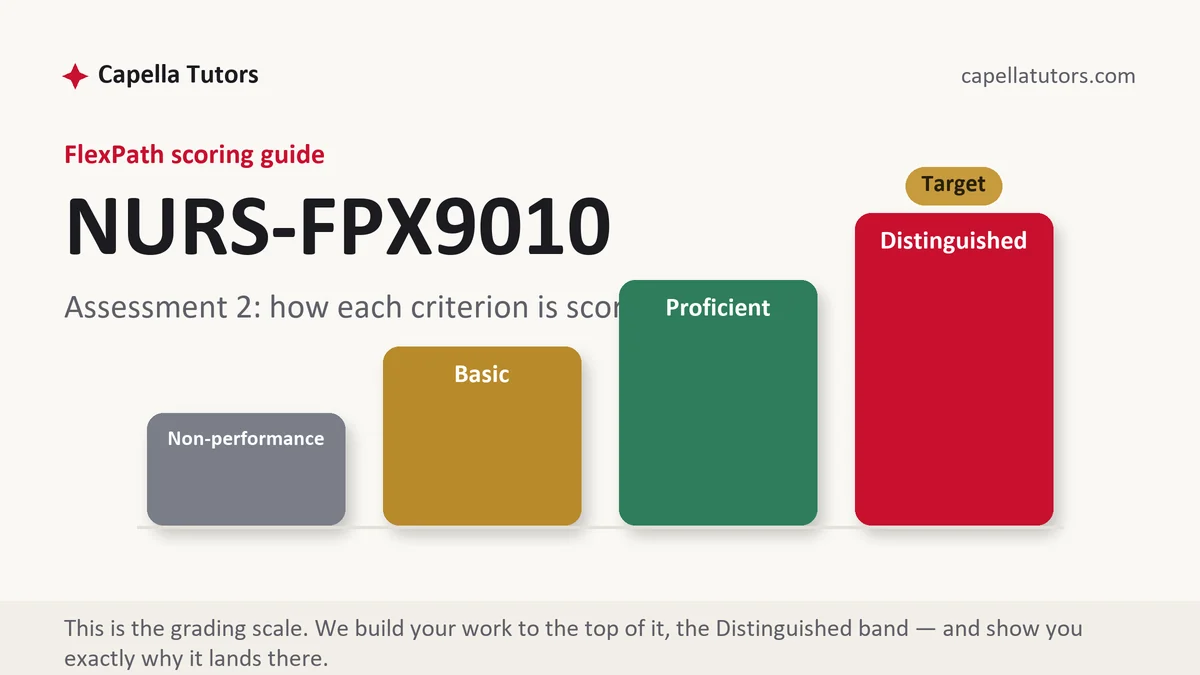
How NURS FPX 9010 Assessment 2 is scored
The scoring guide judges each criterion on its own and prints four descriptors for it. Read the top one as an instruction rather than as praise:
| Level | What it means on an evidence synthesis |
|---|---|
| Distinguished | Themes carry the argument, disagreements between studies are resolved by naming the difference that produced them, the intervention is traceable to identified rows in the evidence table, and the section closes on what the literature still cannot answer. The move past sufficiency is taking a position on the conflict. |
| Proficient | The evidence is organized and the intervention is justified. Everything is accounted for and nothing is adjudicated. |
| Basic | An annotated bibliography under a synthesis heading, one study per paragraph, with no sentence anywhere stating what the collected evidence supports. |
| Non-performance | A required element is missing, most often the rationale linking the chosen intervention to the evidence rather than to preference. |
There is a simple test for whether you have written a synthesis. Delete any single paragraph. If the argument still stands unchanged, that paragraph was a summary, and a page of summaries is a Basic section however carefully each one is written. Paragraphs in a synthesis depend on one another because each theme sentence commits you to something the next has to qualify.
The NURS FPX 9010 Assessment 2 method, step by step
-
Sort the evidence table by mechanism before you write a word
Group the retained studies by what the intervention was thought to act on rather than by author or by year. Those groups become your themes, and a theme that holds only one study is a signal to widen the group or to say plainly that the mechanism rests on thin evidence.
-
Write the theme sentence before you introduce any study
Each section opens with what the collected evidence supports, stated as a claim. The studies then arrive as support for that claim, in order of strength. Reversing the order produces the paragraph that recites four papers and concludes that more research is needed.
-
Find the contradictions and refuse to average them
Where two trials of the same change report opposite results, the answer usually lives in the difference between them: a shorter follow-up, a lower baseline rate, half the dose, a different professional delivering it. Name the difference and say which finding your setting resembles. Hedging both ways scores lower than choosing wrongly with a reason.
-
Weigh design and sample before conclusions
Read every source with its design and its sample size in front of you, then its findings. A conclusion is a claim and the design is what licenses it, and a synthesis that cites a 48-patient pre-post study beside a multi-site trial without marking the difference has told the evaluator it cannot see one.
-
Select the intervention against the cause you identified
Match the mechanism to your local barrier. If the deficit is a workflow gap, an education module will not move it whatever the pooled effect size says. Write the selection as a paragraph that names the rows in your table, the mechanism they support, and the reason the runner-up was rejected.
-
Close on the gap, then self-score the verbs
State what the evidence base cannot answer, since that gap is where your project's contribution sits. Then read each criterion's verb against what you actually wrote, mark the level yourself, and rewrite anything below the top before submitting.
A structure that maps to the criteria
Word targets below are planning defaults our tutors use for a synthesis-weighted submission, not rules; your guide governs the real weighting.
| Section | What it must do | Guide |
|---|---|---|
| Orientation to the evidence | What was retained, at what strengths, and how the body of evidence is organized in this paper. | ~200 words |
| Theme one and theme two | Each opens with a claim about what the evidence supports, then carries studies in order of design strength. | ~500 words |
| Contradictions resolved | The disagreements stated plainly, with the study-level difference that explains them and your position on which applies here. | ~300 words |
| Intervention selection | The chosen change, the mechanism it acts through, the evidence rows behind it, and why the alternative was rejected. | ~350 words |
| What the evidence cannot answer | The gap your project sits in, described without inflating it into a claim of originality. | ~200 words |
| References | Primary studies preferred over the reviews describing them, current APA matched in both directions. | as needed |
Annotated sample excerpt
A model paragraph from our doctoral team showing how a contradiction gets settled rather than smoothed over.
Routine screening for delirium on general medical wards is supported by the strongest evidence in this set as a detection intervention, not as a treatment one, and the two trials that report no benefit are the two that measured length of stay rather than recognition.1 The difference is not chance. Where nurses screened every shift with a brief validated instrument and an abnormal result triggered a same-day medical review, recognition rose from roughly a third of cases to near four in five; where the instrument was applied once on admission with no response pathway attached, detection improved and nothing downstream changed.2 The 28-bed geriatric medical unit in this project has no standing review pathway, which places it in the second group rather than the first, and any design that installs the instrument without installing the response should be expected to reproduce the null result rather than the positive one.3
- 1Opens on a claim about what the body of evidence supports, and immediately narrows what kind of claim it is. The studies arrive afterward as support rather than as a parade.
- 2Names the concrete difference between the positive and null trials instead of calling the literature mixed. This is the sentence that separates the top descriptor from the one below it.
- 3Applies the resolved conflict to this site and derives a design constraint from it. A synthesis that changes nothing about the project was written for its own sake.
The full premium sample for your exact assessment, written fresh to your scoring guide and issue, is free to request. Study it, revise it into your own voice, and submit work you understand.
The five mistakes that cost Distinguished
- One study per paragraph. Sequence is not synthesis, and the heading does not change what is underneath it.
- The literature called mixed. Mixed is a description of your reading, not of the evidence; the difference between the trials is usually recoverable in twenty minutes.
- An intervention chosen before the reading. When the selection paragraph cannot point at rows in the table, the evidence was decoration.
- Equal weight to unequal designs. Citing a small pre-post report and a systematic review in the same breath tells the evaluator you cannot rank them.
- A gap statement inflated into novelty. A practice doctorate translates evidence that exists; claiming nobody has studied this invites the reviewer to find who has.
Pre-submission checklist
- Every theme section opens with a claim about the evidence, not with an author
- No paragraph can be deleted without changing the argument
- At least one contradiction named and settled by a study-level difference
- Design and sample size stated before any effect is quoted
- The intervention traced to identified rows and the runner-up rejected in writing
- Primary sources cited rather than the reviews that describe them, current APA
Synthesis due and reading like a list?
Send the guide and your retained studies in any format. We regroup them by mechanism, write theme-led sections, settle the contradictions with the study differences named, and tie the intervention to the rows that support it. Two independent quality passes, revisions free until the criteria clear.