This manual is for NURS FPX 9010 Assessment 1, start to submission. Assessment 1 of Doctor of Nursing Practice 2 usually asks for the evidence retrieval that everything later in the capstone sequence rests on: a search another person could rerun and land on your set, inclusion and exclusion rules written before the screening rather than after it, and an appraisal that sorts what you kept by design strength instead of by publication date. It is the one deliverable in the degree graded almost entirely on method. Below is how our doctoral tutors build it, a structure that follows the criteria, and an annotated sample excerpt. Prefer to pass it across? A premium original sample built for this exact assessment comes back within 24 to 48 hours, revised without charge until the guide is met. Capella's catalog lists the course as NURS-FPX9010, and some courserooms print NURS9010; both point to this same Assessment 1.
One honesty note before the manual: Capella revises courses and scoring guides over time, so always write to the exact scoring guide attached to your assessment in the courseroom. The course identity above is verified on capella.edu; the method and structure below are our tutors' approach to it, not Capella's official rubric text.
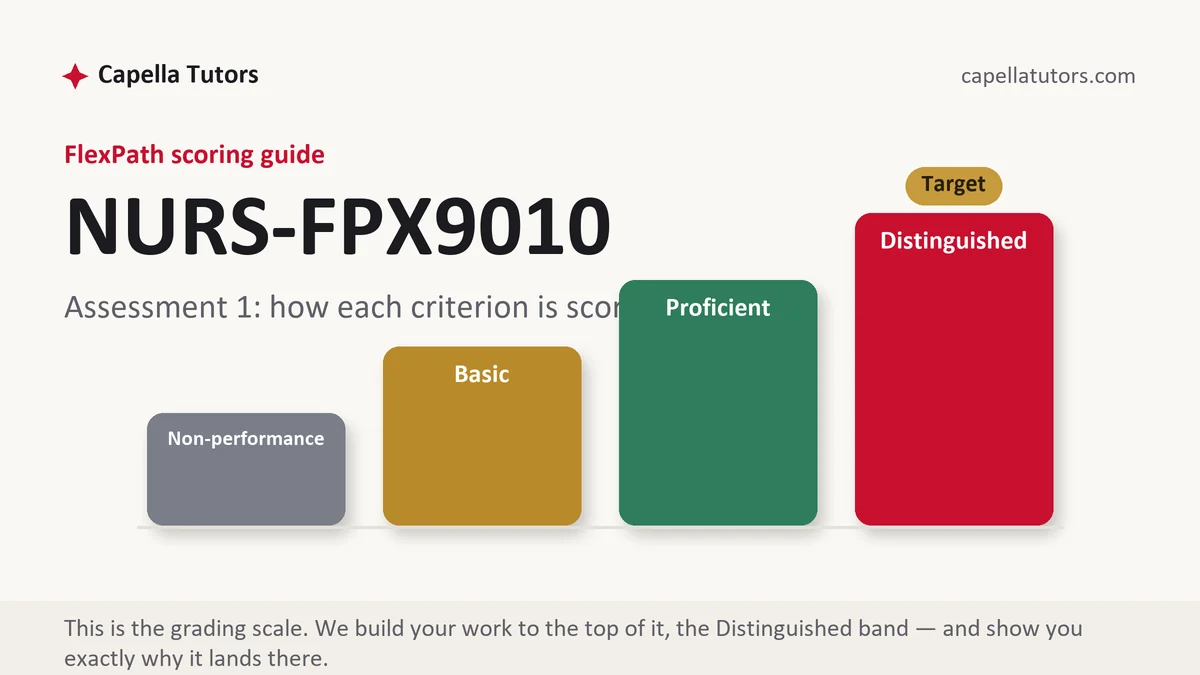
How NURS FPX 9010 Assessment 1 is scored
Each criterion is placed independently at one of four levels, and the wording of the level you are aiming at is the only specification that matters:
| Level | What it means on a search and appraisal deliverable |
|---|---|
| Distinguished | Databases, limits, controlled vocabulary and full strings are reported, counts are given at every screening stage with reasons for exclusion, and each retained study is rated with a named appraisal system including the weak ones, kept and labeled. The extra move is reproducibility, and reproducibility is checkable. |
| Proficient | A competent search with sources appraised and the reasoning visible. Solid, and a reader still could not rebuild your retained set from what you wrote. |
| Basic | Databases named in a sentence, sources described as relevant and current, and the appraisal reduced to whether the study agreed with you. |
| Non-performance | A required component is absent, most often the stage counts or the appraisal rating. An omitted method section cannot be scored as a weak one. |
Reproducibility is not a courtesy to the reader, it is the evidence that your later synthesis is honest. If a reviewer cannot rerun the search, they have no way of knowing whether the nine studies you kept are the nine strongest or the first nine that agreed with the intervention you had already chosen. Write the method so it convicts you if you cheated.
The NURS FPX 9010 Assessment 1 method, step by step
-
Turn the problem sentence into an answerable question
Population, intervention, comparison, outcome, and a time horizon if one belongs. The question decides your vocabulary, and vague questions retrieve thousands of records nobody can screen. Write it out, then check that every term in it will appear in a database thesaurus in some form.
-
Book the librarian before you run anything
Capella's library staff build strings for a living, and thirty minutes with one usually replaces two evenings of guessing. Bring the question and the concepts, ask for controlled vocabulary in each database you intend to use, and keep the transcript of what was suggested.
-
Write the inclusion and exclusion rules first
Years, languages, publication types, settings, populations and designs, all fixed before screening starts. Rules written after the fact tend to describe the studies you liked, and an evaluator who sees five exclusions that all point the same way will say so.
-
Run each database separately and record the strings verbatim
Copy the string exactly as executed, with the truncation, the Boolean operators, the field tags and the filters, into an appendix. Log the date you ran it and the number returned. A string that has been tidied for the paper is a string nobody can rerun.
-
Count at every stage and give reasons for the rejections
Records retrieved, duplicates removed, screened on title and abstract, read in full, retained, with the excluded full texts grouped by reason. Those counts are what let a reader see how much evidence exists and how you narrowed it, and they take an hour if you keep them as you go.
-
Appraise with a published system and keep the weak studies
Rate every retained source with a named tool and cite that tool to its authors. Then keep the low-level evidence in the table with its rating visible, because a small single-site report can support feasibility even when it cannot support effect, and deleting it looks like tidying.
A structure that maps to the criteria
These targets are our planning defaults for a method-weighted doctoral submission, not Capella rules; tables and appendices sit outside the prose count.
| Section | What it must do | Guide |
|---|---|---|
| Question and concepts | The searchable question, its components, and the vocabulary each component maps to. | ~200 words |
| Eligibility rules | Inclusion and exclusion criteria fixed in advance, each with the reason it was set. | ~250 words |
| Search method | Databases, dates run, limits, controlled vocabulary and keyword strings, with the strings reproduced in an appendix. | ~350 words |
| Screening and yield | Counts at retrieval, deduplication, title and abstract screening, full-text review and retention, with grouped exclusion reasons. | ~250 words |
| Appraisal and evidence table | Every retained study with design, setting, sample, dose, outcome, effect and rated strength, using a named system. | ~350 words |
| Gaps and references | What the retrieved evidence does not cover, and current APA matched in both directions. | ~200 words |
Annotated sample excerpt
An original model paragraph from our team, showing how a method section reads when it has been written to be checked rather than admired.
CINAHL Complete, MEDLINE via PubMed and the Cochrane Library were searched on 14 March 2026 for evidence on structured early ambulation after elective abdominal surgery, limited to English-language reports published from 2016 onward and to adult inpatient surgical populations.1 The MEDLINE string combined the exposure and outcome concepts as ("early ambulation"[MeSH] OR mobiliz* OR ambulat*) AND ("postoperative period"[MeSH] OR post-operat*) AND (protocol* OR bundle OR pathway), with the equivalent CINAHL headings substituted and the same field structure retained, and each string is reproduced as executed in Appendix A.2 The three databases returned 487 records, 91 of which were duplicates; 396 were screened on title and abstract against the stated rules, 58 were read in full, and 12 were retained, with the 46 full-text exclusions grouped as wrong population, 19, no comparison condition, 14, outcome not reported quantitatively, nine, and protocol unavailable, four.3
- 1Databases, the date the search was run and the limits, all in the first sentence. The run date matters because a search rerun in six months returns a different number and a reader needs to know which day yours describes.
- 2The actual string, with truncation and controlled vocabulary visible, and the appendix pointer. Describing a search in prose is not a method; printing it is.
- 3Counts at every stage with the exclusions grouped by reason. A reader can now tell how much evidence exists on this question and exactly where yours went.
The full premium sample for your exact assessment, written fresh to your scoring guide and issue, is free to request. Study it, revise it into your own voice, and submit work you understand.
The five mistakes that cost Distinguished
- A search described instead of reported. Naming two databases in a sentence tells a reader nothing they could act on.
- Eligibility rules written after screening. Criteria reverse-engineered from the studies you kept are visible in the pattern of the exclusions.
- No counts anywhere. Without a yield at each stage, the retained set could be a careful selection or the first page of results, and the paper cannot tell them apart.
- Appraisal as adjectives. Robust and high quality are not ratings; a named tool with a level assigned to each study is.
- The weak studies quietly deleted. Low-level evidence kept and labeled shows judgment, and a table with nothing below the top tier reads as curated.
Pre-submission checklist
- The question is written in searchable components before any string appears
- Inclusion and exclusion rules stated with the reason each was set
- Every string reproduced as executed, with its database and its run date
- Stage counts given from retrieval through retention, exclusions grouped by reason
- Each retained study rated with a named appraisal system, cited to its authors
- Reference list checked against citations in both directions, current APA
Search and appraisal due?
Send the scoring guide and your problem statement. We build the strings, run the screening, produce the evidence table with design, sample, dose, effect and rated strength in every row, and write the method so a librarian could rerun it. First premium sample free.