This manual is for NURS FPX 8024 Assessment 3, start to submission. The final deliverable in Advanced Global Population Health generally asks for the pathway from analysis to policy: an instrument rather than an aspiration, a body that owns it, a sequence with a horizon, and an evaluation built from indicators somebody already collects. Criteria at this level are looking for implementation, and the single fastest way to lose them is to end on a call for greater awareness. This manual gives the order our doctoral desk works in, the sections that satisfy the criteria, and an annotated excerpt of a policy paragraph. Rather it arrived finished? An original premium sample written against the criteria you upload lands in 24 to 48 hours, and rewrites cost nothing. Capella's catalog lists the course as NURS-FPX8024, and some courserooms print NURS8024; both point to this same Assessment 3. In current courserooms this assessment typically appears as "Leading Global Health Strategic Planning and Policy Development".
One honesty note before the manual: Capella revises courses and scoring guides over time, so always write to the exact scoring guide attached to your assessment in the courseroom. The course identity above is verified on capella.edu; the method and structure below are our tutors' approach to it, not Capella's official rubric text.
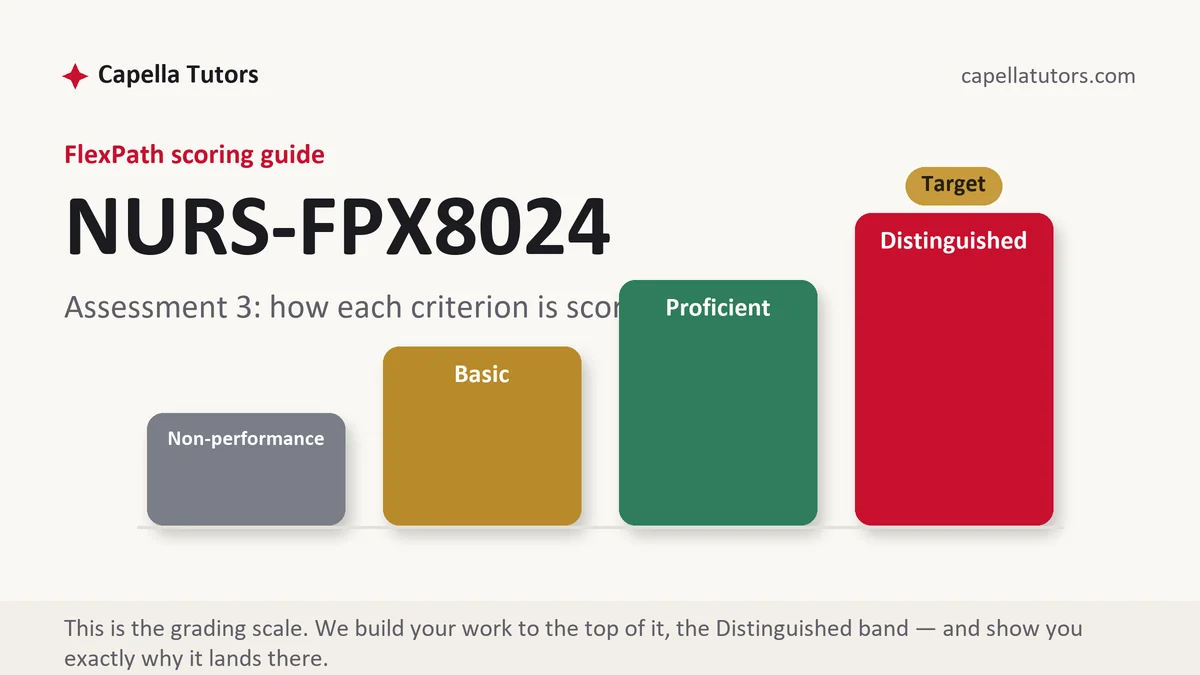
How NURS FPX 8024 Assessment 3 is scored
FlexPath grades each criterion separately against four levels and never produces a letter grade. The level wording is your brief:
| Level | What it means on a policy and governance synthesis |
|---|---|
| Distinguished | A named instrument with a named owner, a comparison that explains a difference through financing or governance, an honest account of who loses, and monitoring drawn from reporting that already runs. |
| Proficient | A sound policy recommendation with an implementation plan attached. Everything present, with the political economy left out. |
| Basic | A persuasive case for change that never becomes a regulation, a financing rule or a guideline anyone could be held to. |
| Non-performance | A required element is missing, most often the equity analysis or any evaluation plan beyond a general intention to monitor. |
Comparison is where this deliverable is won or lost. A second system included for decoration adds nothing, while a second system used to explain why one population does better on the same measure, and to attribute that difference to how care is financed or governed rather than to culture, satisfies several criteria at once.
The NURS FPX 8024 Assessment 3 method, step by step
-
Convert the recommendation into an instrument
National strategy, clinical guideline, financing rule, procurement change, taxation or regulation. Pick one and write it as text that could be enacted. Anything that cannot be drafted as an instrument cannot be implemented, monitored, or graded above Basic.
-
Locate the body that owns it
Ministry, regulator, insurer, professional council, district authority. Name the owner, name the legal or budgetary route, and say what a decision from that body would look like. This is the detail that most distinguishes a doctoral policy paper from an undergraduate one.
-
Use the comparison to decide something
Match the two systems on the same measure and the same year, then attribute the difference to financing, governance or delivery structure. If your comparison would still read the same with either country removed, it is decoration and the criterion will treat it that way.
-
Say who loses, then design around it
Every instrument moves money or discretion away from somebody. Name them, size the loss, and let the implementation sequence show that you took it seriously. A phased schedule presented as a concession reads as competent; an unphased one presented as urgency reads as naive.
-
Stratify the evaluation
Population indicators disaggregated by the axis your analysis said mattered, whether income, geography, sex or migration status. An aggregate improvement that hides a widening gap is a failed policy that reports as a success, and the equity criterion exists to catch exactly that.
-
Name the failure mode, then self-score
Workforce shortage, stockouts, competing donor priorities, or a data system that cannot report your indicator. Say which one is most likely and what you would watch for. Then grade yourself criterion by criterion, D, P, B or N, and rework whatever falls short.
A structure that maps to the criteria
Lengths below are our doctoral desk's planning targets for a policy synthesis, not Capella requirements; shift the weight to match your own scoring guide.
| Section | What it must do | Guide word target |
|---|---|---|
| Recommendation and instrument | The change requested written as an enactable instrument, with its scope and its effective horizon. | ~200 words |
| Cross-system comparison | Two systems on one standardized measure, with the difference attributed to financing, governance or delivery. | ~300 words |
| Owning body and pathway | Who enacts it, under which existing authority, and what the approval sequence looks like. | ~250 words |
| Winners, losers and equity | Who gains, who pays, who can block it, and which subpopulation is affected differently either way. | ~250 words |
| Implementation sequence | Phases with dates, the resources each needs, and the owner accountable for each phase. | ~250 words |
| Monitoring and references | Indicators from routine reporting, disaggregated, with the likely failure mode and current APA both ways. | ~250 words |
Annotated sample excerpt
An original model passage from our doctoral desk, written to show what policy specificity sounds like. Take the structure and fill it with your own setting.
The instrument here is a regulation rather than a campaign: mandatory maximum sodium limits across eleven categories of packaged food, made by the health ministry under powers the existing food standards act already grants and enforced through the inspection regime the food safety agency already runs.1 The comparator system reached a 12 percent fall in mean population sodium intake over six years using that instrument, while voluntary targets in a second market of similar size and similar burden moved industry reformulation by under 3 percent, and it is that contrast, not the epidemiology, that decides the recommendation.2 Who pays is stated plainly, since three domestic manufacturers hold most of the affected shelf space and will carry reformulation costs first, so the schedule phases the categories over 48 months to make the loss survivable rather than to disguise it, and the monitoring indicator is mean urinary sodium in the national nutrition survey, already fielded every three years and already disaggregated by income quintile.3
- 1Names the instrument, the enacting body and the authority it acts under, and does it in one sentence. Nothing here would require new legislation, which is why it is credible.
- 2Uses the comparison to settle a choice between two instruments rather than to illustrate a difference. That is what a comparison criterion is buying.
- 3States the loser, sizes the loss, phases the change, and attaches monitoring to a survey that already exists and already disaggregates. Four criteria served by one sentence.
The full premium sample for your exact assessment, written fresh to your scoring guide and issue, is free to request. Study it, revise it into your own voice, and submit work you understand.
The five mistakes that cost Distinguished
- A recommendation with no instrument. Raising awareness is not a policy, and no ministry has ever been held to it.
- No owner named. If nobody enacts it and nobody enforces it, the implementation criterion has nothing to score.
- Comparison as decoration. A second country described but never used to decide anything wastes the criterion that rewards it.
- Difference explained by culture. Reaching for culture where financing, workforce or governance would explain it reads as analytic avoidance.
- A brand new monitoring system. Indicators that require a survey nobody funds will not be collected, and the evaluation dies with them.
Pre-submission checklist
- The recommendation is written as an instrument somebody could enact
- The enacting body and its existing authority are both named
- The comparison decides a choice rather than illustrating a contrast
- Losers are named and the loss is sized, with a sequence that reflects it
- Indicators come from routine reporting and are disaggregated
- One likely failure mode volunteered, and every criterion self-scored D
Policy deliverable that has to survive a doctoral reader?
Send the scoring guide, the population, and whichever instrument you are leaning toward. We build the pathway and the comparison first, then two independent quality passes test every criterion and every figure. One original sample in 24 to 48 hours, then free revision for as long as the evaluator asks.