This manual is for NURS FPX 8024 Assessment 2, start to submission. The Global Health Issue Analysis asks you to analyze one global health issue in a defined population or country: its burden measured with the indicators the field uses, the social, economic and environmental determinants behind it, the current policies and programs that address it and where they fall short, and evidence-based recommendations for improvement. The grade turns on analysis rather than description. A paper that explains why the burden falls where it does, and why current responses have not closed the gap, scores higher than one that lists statistics. Below is the method our tutors use, a structure that maps to the criteria, and an annotated sample excerpt. Prefer to hand it off? A premium original sample for this exact assessment comes back in 24 to 48 hours, revised free until it meets the guide. Capella's catalog lists the course as NURS-FPX8024, and some courserooms print NURS8024; both point to this same Assessment 2. In current courserooms this assessment typically appears as "Global Health Issue Analysis".
One honesty note before the manual: Capella revises courses and scoring guides over time, so always write to the exact scoring guide attached to your assessment in the courseroom. The course identity above is verified on capella.edu; the method and structure below are our tutors' approach to it, not Capella's official rubric text.
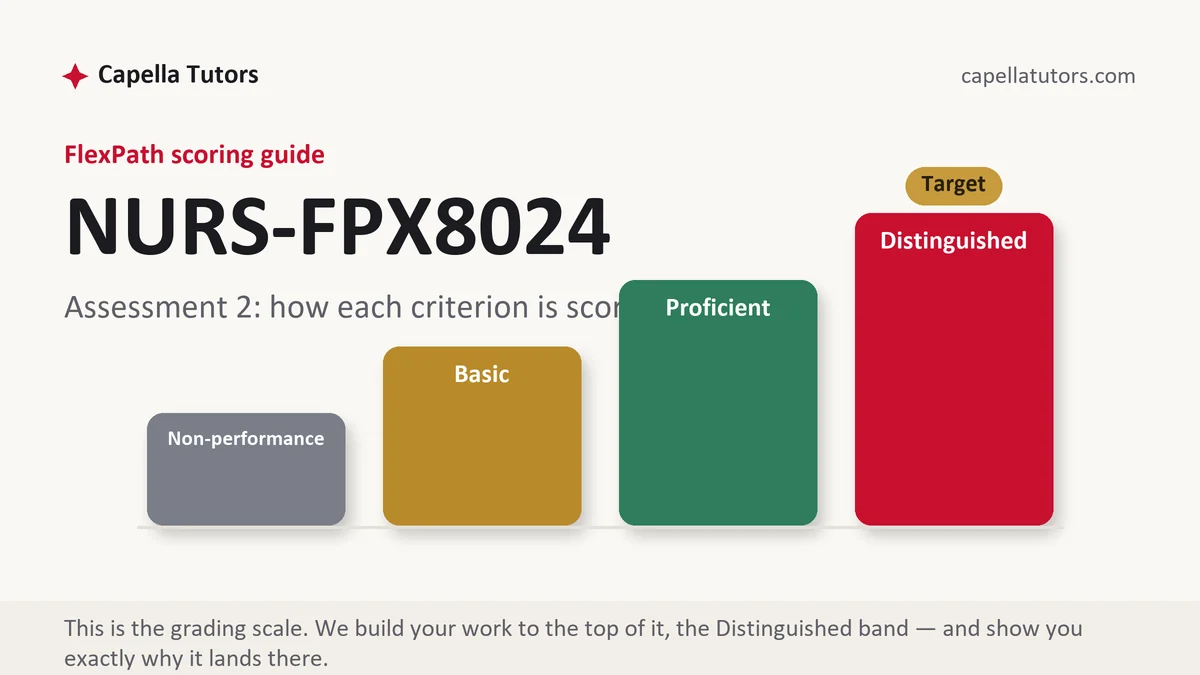
How NURS FPX 8024 Assessment 2 is scored
FlexPath does not use letter grades. Each criterion in the scoring guide lands on one of four levels, and the level descriptions are the real writing brief:
| Level | What it means on a global health issue analysis |
|---|---|
| Distinguished | The burden is described with current, sourced indicators, determinants are analyzed as causes, current responses are evaluated with evidence, gaps are explained, and recommendations are evidence-based and feasible for the setting. |
| Proficient | The analysis is accurate and complete, but determinants are listed rather than linked and recommendations are general. |
| Basic | The paper describes the issue with statistics and little analysis. |
| Non-performance | The determinants, the evaluation of current responses or the recommendations are missing. |
Define the population tightly, a country, region or group, so that data and recommendations fit together.
The NURS FPX 8024 Assessment 2 method, step by step
-
Choose the issue and population
For example tuberculosis in a specific country or maternal mortality in a region.
-
Measure the burden
Prevalence, incidence, mortality and DALYs where available, compared with regional or global figures.
-
Analyze the determinants
Poverty, education, gender, conflict, climate or health system capacity, linked to the burden with evidence.
-
Evaluate current responses
Government programs, global initiatives and NGO work, with evidence of what is and is not working.
-
Explain the gaps
Why current responses have not closed the gap, such as funding, access or coordination.
-
Recommend
Evidence-based actions suited to the setting, with the role of nurse leaders.
A structure that maps to the criteria
Word counts are planning targets our tutors use for this paper, not Capella rules; follow the length your scoring guide states.
| Section | What it must do | Guide |
|---|---|---|
| Introduction | The issue, the population and the purpose of the analysis. | ~150 words |
| Burden | Indicators with sources and comparisons. | ~250 words |
| Determinants | Causes linked to the burden. | ~275 words |
| Current responses and gaps | What is being done and why it falls short. | ~300 words |
| Recommendations and references | Evidence-based actions, then current APA. | ~200 words |
Annotated sample excerpt
An original model excerpt from our team, written to show the register that reaches the top of the guide. Learn the moves, then write your own version.
Tuberculosis incidence in the region is several times the global average, and the gap is widest in informal urban settlements where households of six or more share a single room.1 Crowding explains transmission, but delayed diagnosis explains why cases stay infectious for so long: the nearest clinic offering sputum testing is often more than an hour away, and a day's travel means a day's lost wages for families paid by the day.2 Those two determinants, housing and the cost of reaching care, point to different responses, which is why the recommendations pair community-based screening with transport support rather than relying on clinic expansion alone.3
- 1Locates the burden precisely and links it to a social condition.
- 2Explains a second determinant through its mechanism, not just its presence.
- 3Shows how the determinants shape the recommendations, the analytic step the top column rewards.
The full premium sample for your exact assessment, written fresh to your scoring guide and topic, is free to request. Study it, revise it into your own voice, and submit work you understand.
The five mistakes that cost Distinguished
- Statistics without analysis. Explain why the burden falls where it does.
- A population defined too broadly. Pick a country, region or group.
- Current responses ignored. Evaluate what is already being done.
- Recommendations that do not follow. Tie each recommendation to a determinant or gap.
- Old data. Use the latest indicators available.
Pre-submission checklist
- Issue and population defined
- Burden measured with current, sourced indicators
- Determinants analyzed as causes
- Current responses evaluated with evidence
- Gaps explained
- Evidence-based recommendations and current APA references
Want the global health analysis written?
Send the scoring guide and the issue you chose. Our team returns a premium original analysis in 24 to 48 hours, revised free until it meets the guide.